
Own Your Five: Why the 5-Yard Dash Is the Number I Care About Most in Speed Training
Everybody wants to measure everything. After nearly twenty years, this is still the one number I check first whenever someone asks about speed training, a speed program, or getting quicker.
Written by Thomas Newman, Founder, Newman HP · September 2026 · About 9 minutes
Own your five.
The rest will come.
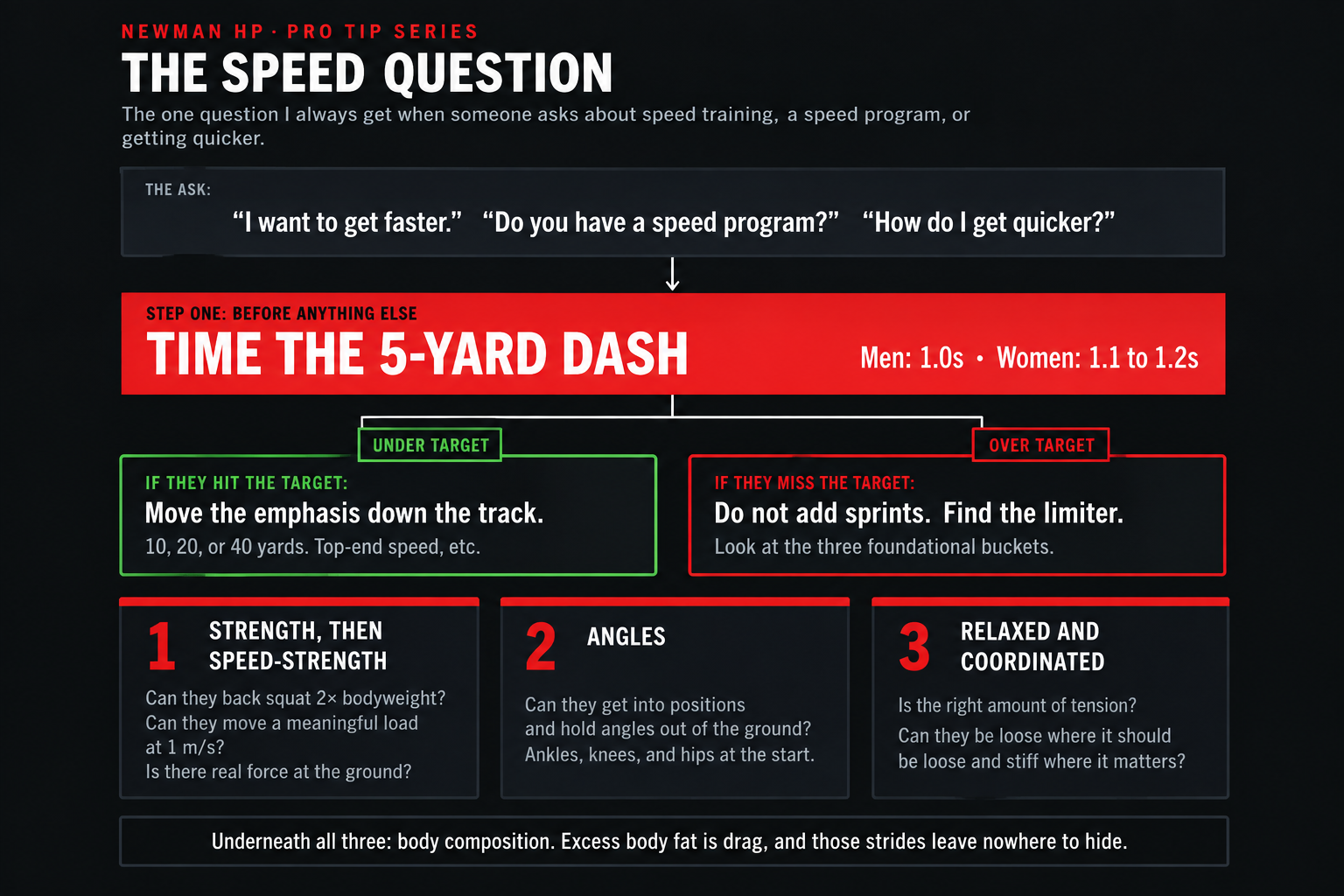
Everybody wants to measure everything now. GPS vests, force plates, bar velocity, laser-timed splits at every yard. I helped build some of that technology, so I am not against it. But after nearly twenty years of coaching, there is one number I go to first whenever an athlete, a parent, or a coach asks me about speed training, a speed program, or how to get quicker. It is a number most programs never bother to write down: the 5-yard dash.
To be specific, this is not a general intake test we run on everyone who walks in. It is the first thing I check the moment the conversation turns to speed and quickness. That distinction matters, because it tells you where the answer lives.
I did not invent this. Sean Manuel gave it to me. At the time he was the strength coach at Bishop Gorman High School in Las Vegas, a football program that went on to win three consecutive national titles. He showed me how he used the 5-yard split more than ten years ago. I took it to Yale, I used it with pro and tactical athletes after that, and it is still the first thing we check at Newman HP whenever speed is the question. It has never stopped working.
If you take one thing from this post, take this: own your first five yards and the rest of your speed will come.
Why the first five yards matter more than the last thirty
The standard approach to speed work is to chase the sport. Position drills, cone patterns, route running, flying 30s for top-end mechanics. None of that is bad. It just skips the part that decides everything else.
Nearly every ground-based sport begins the same way, with two or three steps from a dead stop or a hop. Coaches see this without ever naming it. "He has a great first step." "She is quick off the ball." "That kid is light on his feet." What they are actually describing is an athlete's ability to overcome inertia and get their own mass moving in as few steps as possible.
A linebacker does not get 40 untouched yards. A point guard does not get 30 strides of runway. They accelerate for a few steps, then stop, cut, jump, or play a ball. The first second of movement sets a ceiling on everything that happens in the next ten.
The split does not divide evenly
Here is the rule in our building: whenever we time a sprint, whether it is a 10, 20, 40, or 60, we always capture the 5-yard split. No exceptions.
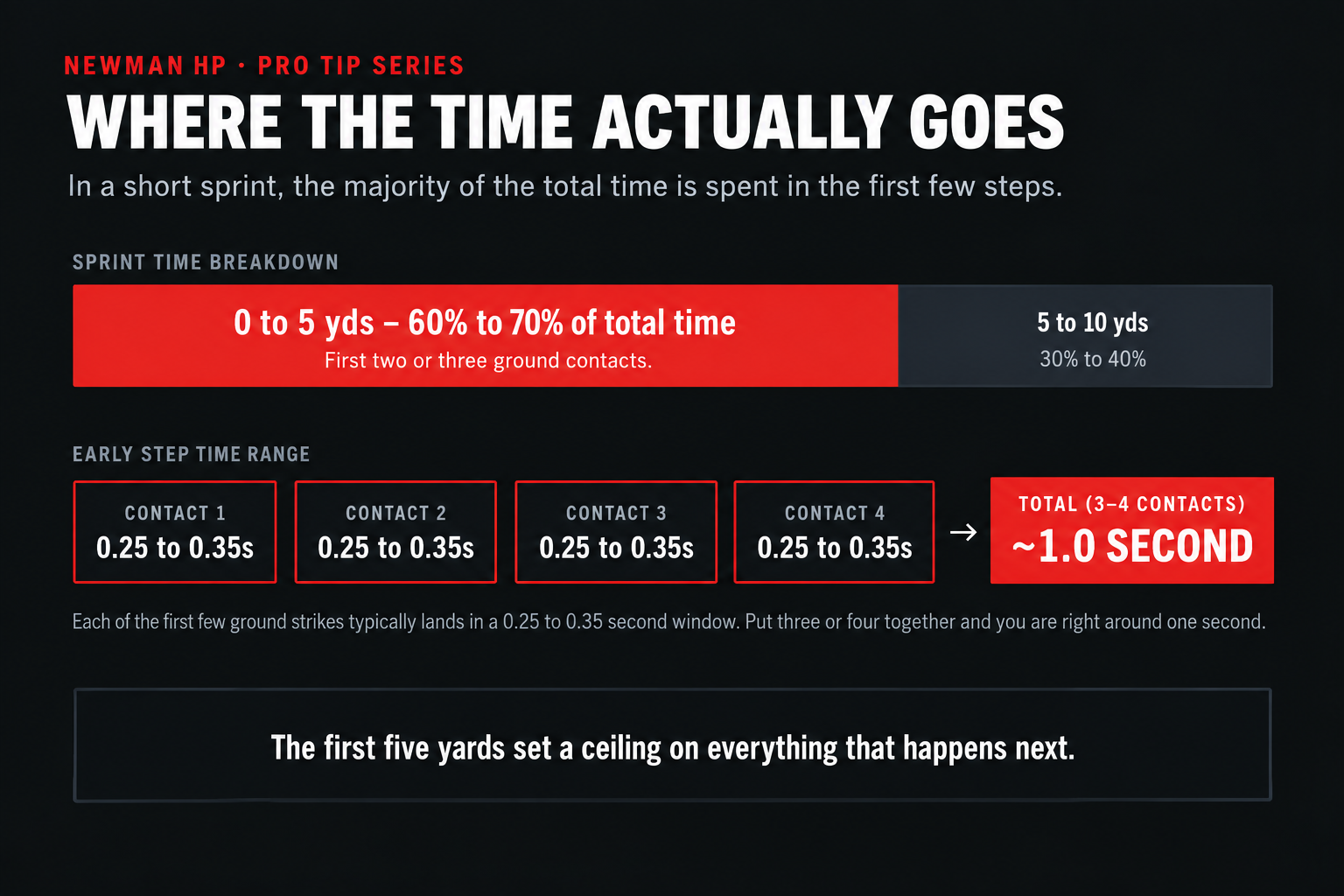
Common sense says that on a 10-yard dash, the first five yards and the second five should each take about half the total. That is not what the timer shows. In most athletes, 60 to 70 percent of the total time is spent in those first two or three ground contacts.
Those early contacts are surprisingly consistent. Across men and women, and across every sport we have tested, each of the first few ground strikes lands somewhere in a 0.25 to 0.35 second window. Put three or four of them together and you are right around one second. That second is where acceleration is won or lost.
So we set hard targets:
Men: 1.0 second or faster at 5 yards
Women: roughly 1.1 to 1.2 seconds
When an athlete misses the target, we do not tell them to run more sprints. We ask why. Was the force going straight down instead of back and out? Was there enough force at all? Or was the athlete strong but unable to get that strength out of the ground inside a quarter-second contact?
The algorithm we use at Newman HP
Athletes are governed by their physical qualities. You can drill starts every day, but if the strength, tendon stiffness, mobility, and body awareness are not there, the technique has nothing underneath it. That is why we run every slow 5-yard time through the same three buckets, in order.
Bucket 1: Strength, then speed-strength
Take a common case. An athlete runs a 10-yard dash in 1.8 seconds, which is respectable for high school or college, but their 5-yard split is 1.1 or 1.2. That athlete is quick over ten. They are leaking time at the start.
First question: how strong are they?
Can they back squat double bodyweight?
If yes, can they move a meaningful load at 1 meter per second?
Maximal strength is the raw material. It only becomes useful for sprinting when it can be expressed fast. That velocity window is what we call Schaefer's Law, and I wrote about it in detail in Schaefer's Law: Ten Years Later. The short version: once an athlete can move a meaningful load at 1 meter per second, we have force we can shape into plyometrics and then into running mechanics. The order is strength first, speed-strength second, and only then the sport's specific demand.
None of this is new thinking. Nebraska's Husker Power staff built their Performance Index around the same idea decades ago. Boyd Epley, Mike Arthur, and Dr. Chris Eskridge sorted their athletes into tiers, worked backward from the ones who had earned all-conference and national honors, and found that the tests separating them were power, change of direction, and speed over short distances: the vertical jump, the 10-yard dash, and the pro agility. I broke down the math behind that scoring system in The Math Behind Nebraska's Performance Index. The 5-yard split is the same logic, pushed one step closer to the start line.
Bucket 2: Angles
Physics does not care about your program. You move in the equal and opposite direction of the force you put into the ground.
I regularly see strong athletes who cannot get into a position to use that strength. Tight hips. Stiff ankles. They cannot flex the ankle, knee, and hip together, so the shins stay vertical, the torso stays upright, or the shin and torso angles fight each other. The joints are not stacked, and the force goes the wrong way.
This catches some of our strongest athletes. The same adaptations that built their stiffness can leave them too stiff for their sport. For those athletes, mobility work is not an accessory. It is the priority. I will say this plainly because I have watched it happen too many times: if an athlete has badly limited ankle range, no amount of strength or power work will move their 5-yard time until that ankle is unlocked.
Bucket 3: Balance and coordination
A start is a series of single-leg events. The athlete drives a large amount of force through one leg, then strikes the ground with the other. That contact has to be stiff enough and strong enough to keep the body accelerating while the opposite leg handles its own braking moment.
Does the trunk hold? Or do the pelvis and core start sliding around under load? If the frame leaks, the force leaks with it, and the timer shows it.
Body composition shows up on the stopwatch
There is one more variable the 5-yard dash exposes that a 40 can hide: body composition.
This is not an argument for smaller athletes. It is an argument for useful mass. Take two offensive linemen, both 305 pounds. One is at 40 percent body fat. The other is at 28 or 29 percent. The second lineman has far more of his weight contributing to locomotion instead of sitting in storage. Excess body fat is drag.
The same holds in softball, basketball, and volleyball. With only three or four ground strikes to work with, everything counts. You cannot hide behind technique. That is why the 5-yard dash is one of the best nutrition conversations I have with athletes. It turns body composition from a lecture into a number they can watch move.
How we program it
In a training block we test the 5-yard dash twice a week, usually Monday and Wednesday or Tuesday and Friday, and we make it a competition. The athlete's opponent is their own last time.
What I am watching for is transfer. If the block is built around the squat and the 1RM climbs, the 5-yard time should follow. Eventually that relationship flattens. That is the signal to shift emphasis, and the sequence looks like this:
Build maximal strength and watch the 5-yard split respond.
When it stalls, shift to speed-strength. Move load at 1 m/s.
When bodyweight-relative load moves at 1 m/s, emphasize unilateral strength and stability.
Clean up angles and coordination wherever they are capping force expression.
Pairing the weight room with the stopwatch is what gives us confidence in training transfer. We are not guessing whether the work carries over. We are watching it happen, or watching it fail to happen, twice a week.
Time of year and position dictate the details. For athletes who are not starting, this is the window to get aggressive, find the limiting factor, and attack it.
When to stop chasing the five
Once an athlete breaks one second, further gains at 5 yards get hard to find. That is when we move attention down the track, to the 5 to 10, the 10 to 20, or all the way out to 60, because the foundation is built.
But I cannot count the number of genuinely fast athletes I have watched chase a tenth or two off their 40, only to find the missing time sitting in their first five yards. It was never hiding somewhere along the run. It was at the start the whole time.
And in nearly two decades I have never had an athlete who was fast over five yards fail to improve later in the run. The strength they build to own those first steps is the same strength they express at the much higher cycling rates of top-end speed. Transition drills get better. The drive phase gets better. Upright mechanics get better.
The bottom line
Speed and agility get talked about like they are mysterious. They are not. They are high force application, whether it is linear, lateral, or multiplanar, and it all starts with the first few steps.
If an athlete is grinding and frustrated because their 40 or 60 will not budge, stop staring at the finish line. Time the five. Figure out whether the limiter is strength, speed-strength, angles, or coordination, and fix that first.
Own your five. The rest will come.
Frequently asked questions
How do you time a 5-yard dash accurately?
Use timing gates if you have them, with the start gate set at the athlete's first movement and the finish gate at 5 yards. Hand timing is fine for tracking an athlete against themselves, but it adds roughly 0.2 seconds of human error, so do not compare hand times to gate times or to another program's numbers. Whatever method you use, keep it the same every session.
What is a good 5-yard dash time?
For male athletes we want 1.0 second or faster from a gate start. For female athletes, 1.1 to 1.2 seconds. These are the targets we use in our facility, not universal standards, and they assume a consistent timing setup.
Should I test from a three-point stance or a standing start?
Test the way the sport starts. Football linemen and backs test from a three-point stance. Field and court sport athletes test from an athletic standing start. The one rule is consistency: use the same start every time so the number means something.
Can I improve my 5-yard dash without a weight room?
You can improve technique and angles anywhere, and for some athletes that is the limiter. But if the issue is strength or speed-strength, you need load. In our experience, an athlete who cannot squat somewhere near double bodyweight usually has more to gain from the weight room than from another sprint session.
How often should I test it?
Twice a week during a training block, on the same days, at the start of the session before fatigue sets in. It doubles as a warm-up competition and a running record of whether the block is transferring.
Why not just test the 10-yard dash?
You should. We do, and so does Nebraska, whose Performance Index has used the 10-yard dash since the Epley era. But a 10-yard time alone cannot tell you where the time went. The 5-yard split is what separates a slow start from a slow transition, and those two problems have completely different fixes.
Is a fast 5-yard dash useful outside football?
Yes. Every ground-based sport starts with two or three steps. Basketball, lacrosse, soccer, volleyball, tennis, and tactical work all live in that first second. The 40 is a football number. The five is a human movement number.
About the author
Thomas Newman is the founder of Newman HP. He has spent nearly two decades in elite human performance, with experience spanning Yale Athletics, clinical research, and sports technology. At Yale he served as Director of Student Athlete Performance and Innovation, where he helped build the lacrosse and football programs into national champions. He went on to hold executive leadership at Hawkin Dynamics, guiding the research and engineering teams that developed the company's force plate hardware, custom analytics software, and AI-driven performance predictors now used across the strength and conditioning industry. Newman HP is where all of that experience now lives under one roof, with no templates and no generic programs. Every solution is built from scratch around the person in front of us.
The methods in this post reflect more than a decade of use in the programs Thomas has led and in Newman HP's own training. They are shared as coaching practice, not as medical advice. Athletes returning from injury should clear sprint work with their medical provider first.
Related reading
Schaefer's Law: Ten Years Later, Newman HP
The Math Behind Nebraska's Performance Index, Newman HP
The False Binary: Why the Bilateral vs. Unilateral Debate Misses the Point, Newman HP
Have a question about your own 5-yard time or where your speed training should start? See how much you should prioritze speed training, or get in touch.
