
SCHAEFER'S LAW: TEN YEARS LATER
Ten years ago, we put words to a strength first roadmap for developing athletes. We called it Schaefer’s Law.
The idea was straightforward. First, build bilateral strength until the athlete has the ability to produce high levels of force, represented by a roughly 2X bodyweight Back Squat. Then, shift towards towards power and train the athlete to squat their bodyweight at roughly an average velocity of 1 meter per second during the concentric phase of the squat. Finally, once those two checkpoints have been established, prioritize sport specific force expression.
The order matters because athletic development is not just about collecting important qualities. It is about developing those qualities in the right sequence.
Ask ten coaches what the most important ingredient in an athlete is and you will probably get ten different answers. One coach may say speed. Another may say strength. Another may say power, mobility, skill, coordination, toughness, or availability. None of those answers are wrong because all of those qualities matter. The problem is that the question is incomplete. The better question is not only what ingredients matter, but when those ingredients need to be emphasized.
Think about it the same way you would think about baking a cake. One person may say flour is the most important ingredient. Another may say eggs, sugar, or butter. Technically, each answer can be defended. But a cake is not made by identifying one important ingredient. It is made by putting the right ingredients together in the right order. You cannot ice the cake before you bake it, and you cannot mix the ingredients after it comes out of the oven. You can have every necessary ingredient in the kitchen and still ruin the outcome if the preparation is out of sequence.
Athletic development works the same way. Strength, speed, power, skill, elasticity, and sport specific expression all matter, but they do not all belong at the front of the line. Schaefer’s Law is not saying strength is the only ingredient. It is saying strength is one of the first ingredients that has to be developed if the goal of the weight room is force expression.
Ten years later, Dr. Dan Schaefer’s development model still holds up. With more research, better tools, and more experience applying it across different athletes, the model has become even clearer. The thresholds still matter, but the real power of the model is the sequence.
The Band Problem: When Science Gets Too Cute
In the early 2010s, velocity based training became one of the most popular topics in the strength and conditioning world. Coaches began organizing athletes into velocity zones and using bar speed to describe the quality being trained, whether that was strength speed, speed strength, absolute strength, or peak power.
That language was useful because it helped coaches think beyond percentages and one rep maxes. It gave us a way to discuss not only how much load was on the bar, but how quickly the athlete could move it and what their intent was. That was a meaningful step forward.
The problem is that the field eventually started treating those cutoffs as if they were more precise than the body itself. We acted like 0.55 m/s and 0.65 m/s represented entirely separate biological events, as if the body was choosing adaptations based on exact decimal points.
As an industry, we got too cute.
Physiology is not a set of train tracks. It is a range of overlapping signals. Velocity matters, but the purpose of tracking it is not to create a false sense of precision. The purpose is to help the coach understand where the athlete sits in the development process and what problem needs to be solved next.
That is where Schaefer’s Law becomes valuable. It strips away unnecessary complexity and brings the coach back to two major checkpoints, in order, followed by a third phase where the correct tool depends on the athlete.
Two Checkpoints That Actually Matter
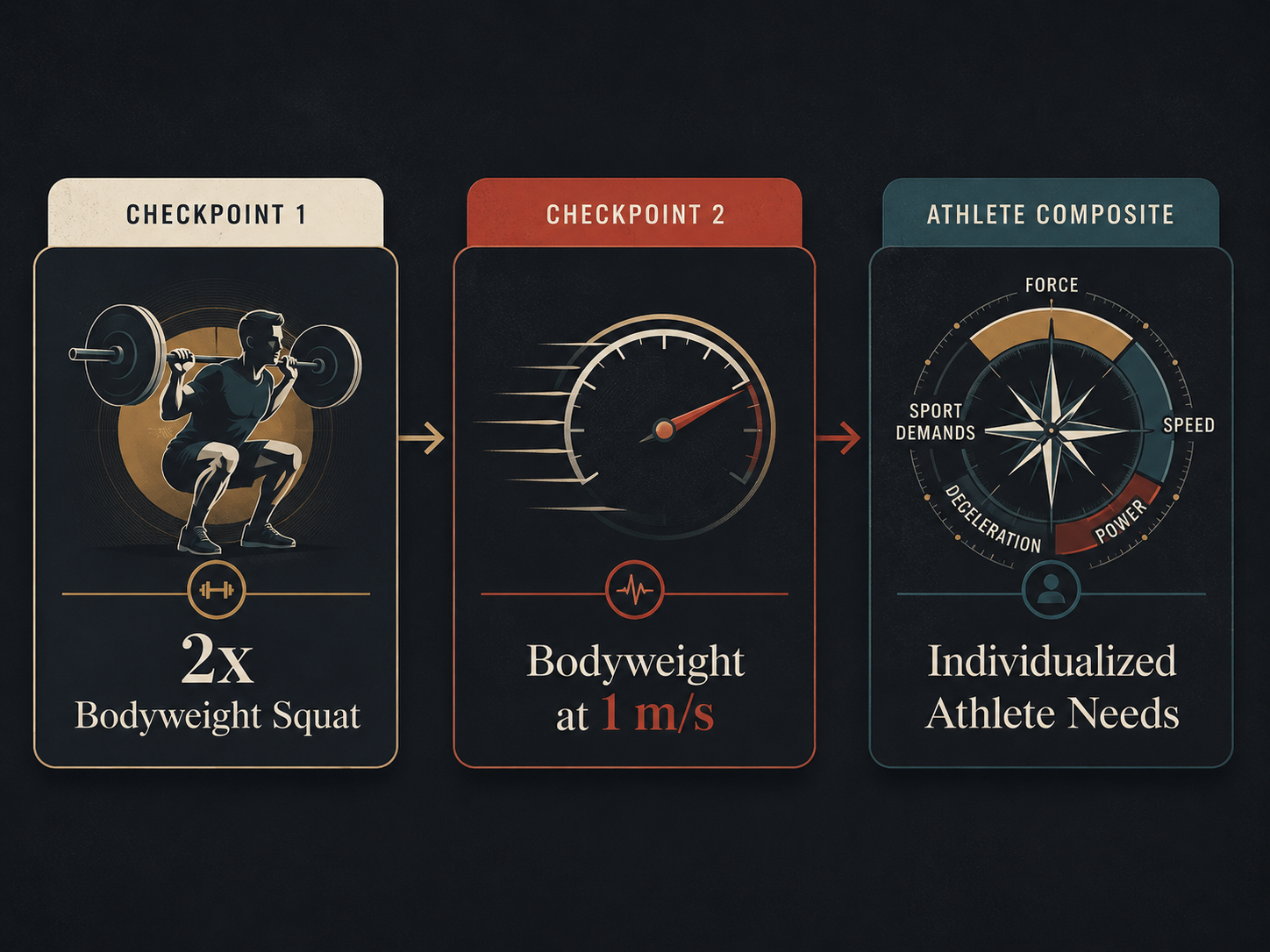
Strip away the jargon and Schaefer’s Law comes down to two major checkpoints.
Checkpoint one is the double bodyweight squat.
When an athlete can squat twice their bodyweight, that tells the coach something important about the engine. It does not mean two times bodyweight is a magical number, and it does not mean strength suddenly stops mattering once that number is reached. It means the athlete has likely built enough raw force production that the biggest return on investment may no longer come from simply chasing a bigger max.
Before that point, strength is often one of the clearest limiters. As the squat improves, the athlete becomes more capable of producing force, expressing force, and creating higher outputs. In that range, increases in strength tend to carry over well to improvements in power because the athlete is still building the foundation that supports everything else.
After that checkpoint, the equation begins to change. More strength can still help, but the return is no longer as clean or automatic. The athlete may need more time, more fatigue, and more training stress to add smaller amounts of strength, while getting less direct transfer to power and sport performance. That does not make strength unimportant. It simply means the coach has to ask whether maximal strength is still the main limiter.
That is why the double bodyweight squat is such an important marker. It tells the coach that raw force production may no longer be the biggest question mark. At that point, it is often more beneficial to shift attention toward how that force is expressed, absorbed, redirected, or supported by the other elements of the athlete composite.
Checkpoint two is bodyweight at 1 m/s.
Once the athlete has built enough raw strength, the next question is whether they can express that strength quickly. A strong athlete who cannot move meaningful load with speed is still missing the bridge between weight room strength and sport performance.
That is where the bodyweight squat at roughly 1 meter per second becomes the second major checkpoint. For most well trained athletes, 1 m/s is around 60% of their 1RM back squat. If the double bodyweight squat tells us the engine can produce serious force, the bodyweight squat at 1 m/s tells us the athlete can begin using that force with speed, which makes on field transfer more likely.
This second checkpoint matters because it shows that the strength built in phase one is starting to become usable. The athlete is no longer just stronger. They are beginning to turn strength into power.
Those two checkpoints are the backbone of Schaefer’s Law. First, prove the athlete can produce force. Then, prove that force can be produced faster. Once both checkpoints are cleared, the coach can begin moving the training closer to the actual demands of the sport.
What Changes After Checkpoint Two?

After checkpoint two, the barbell squat may no longer be the best tool for power development.
That does not mean the squat becomes useless. It means the squat has a built in limitation that becomes more important as the athlete advances. Even when the bar is light and the athlete is trying to move as fast as possible, a squat still requires braking. The athlete has to control the top of the movement. They cannot simply launch themselves off the ground with a loaded bar on their back.
That is why a speed squat can still spend a large share of the lift, at least some of the movement, decelerating the bar. The athlete may be trying to explode out of the bottom, but they still have to slow the bar down before it reaches the top of the range. That braking demand matters when the goal is to push the athlete toward faster and more direct force expression.
Movements like cleans, jumps, and med ball throws solve this problem. In a jump, the athlete leaves the ground. In a med ball throw, the ball leaves the hands. In a clean, the athlete has to keep accelerating the bar through a violent extension. These movements allow the athlete to apply force at an even faster rate without the same built in braking demand.
Coming back to Schaefer’s Law, squatting bodyweight at 1 m/s is an important checkpoint, but it is not the fastest environment the athlete needs to train in. It tells us the athlete can produce force relatively quickly, but sport often requires outputs that happen even faster than a squat allows.
That is why projectile based movements are essential at this stage. They create a training environment where the athlete can continue to accelerate, project, and express force without being limited by the same deceleration demands of a traditional barbell squat.
This is also where the athlete’s composite and sport begin to dictate the answer. A lineman benefits from being able to produce well above bodyweight at speed because the demands of that position reward raw force expressed quickly under load. A golfer does not need that same quality nearly as much. A pitcher has roughly 0.7 seconds to express force on the mound, so the question becomes less about general strength and more about whether the athlete can express the right qualities inside the time window of the sport.
The two checkpoints give the coach the foundation. Once they are cleared, the athlete composite helps decide what quality needs to be trained next. The athlete may need more speed, more power, better deceleration, better change of direction, better projection, or better expression inside the specific demands of the sport.
That is the real value of Schaefer’s Law. It does not trap the coach inside one method forever. It tells the coach when a tool has done its job and when it is time to move to the next one.
The sequence is simple:
Hit checkpoint one. Squat double bodyweight and prove the athlete can produce force.
Hit checkpoint two. Move bodyweight at 1 m/s and prove that force is becoming usable.
Once both checkpoints are cleared, the tool changes. The squat gives way to movements with less deceleration and more direct force expression, chosen based on what the athlete needs individually and what the sport actually demands.
Why the Order Matters
This is where a lot of programs get lost.
Some programs chase sport specific chaos before the athlete has enough horsepower. The training may look athletic, but the athlete still lacks the physical capacity to express force at the level the sport requires. Other programs make the opposite mistake. They stay trapped in maximal strength forever and never teach the athlete to use that strength quickly.
Both approaches miss the point.
The weight room is not supposed to be a bodybuilding contest, a substitute for sport practice, or a circus. The weight room is where we build and organize the body to produce force effectively and safely. First, the athlete needs the ability to produce force. Then they need the ability to produce it faster. Then they need to express it inside the demands of their sport.
That is why Schaefer’s Law is such a useful compass for the athlete development roadmap. It gives coaches a sequence and direction without pretending that every athlete needs the exact same final answer.
The cake ingredients matter. But if you go out of order, you are more likely to limit how well everything comes together.
Closing Thought
When we first put words to Schaefer’s Law, the focus was mainly on the thresholds: build serious strength, move bodyweight fast, and then make those qualities show up in sport. Those checkpoints still matter, but ten years later, the bigger lesson is the order behind them.
Strength is the engine, velocity is the bridge, and sport specific expression is the destination. Once an athlete has built enough force and can move it fast, the coach can look at the athlete composite and ask better questions. What does this athlete actually need now? Does the next phase need to emphasize speed, power, deceleration, change of direction, or a more specific expression of force inside the demands of the sport?
The answer changes once the foundation is in place, and that is the point. Schaefer’s Law gives the coach a way to know when the priority should change.
That is Schaefer’s Law. Ten years later, it still produces incredible results, and the research has only made it harder to argue against.
Frequently Asked Questions
What is Schaefer’s Law?
Schaefer’s Law is a three step training roadmap: build bilateral strength, shift to power development by moving meaningful load faster, and then prioritize sport specific force expression. It was named after Dr. Dan Schaefer and has become a useful coaching framework for organizing athletic development.
What does “1 meter per second at bodyweight” actually mean?
It is a velocity checkpoint measured with a bar speed tracker or velocity based training device. If an athlete can move a barbell loaded to their own bodyweight at around 1 m/s in the squat, they have crossed an important bridge from simply being strong to being able to express that strength faster. It functions as a simple marker that coaches and sport staff can both understand.
Do I need to track velocity down to the decimal point?
No. Chasing that level of precision is one of the mistakes the field made when velocity based training first became popular. Velocity training works best as a guide for decision making, not as a reason to build elaborate testing protocols that eat into training time.
My athlete is not getting faster even though their squat numbers keep going up. What is going on?
If load is climbing but bodyweight velocity is stuck, the issue may not be maximal strength anymore. The athlete may need better recovery, better readiness, better intent, or a shift toward training that teaches them to express force faster. This is where coaching matters. The number tells you there is a problem, but the coach still has to decide why.
Is Schaefer’s Law still relevant now that we have force plates, motion capture, and AI dashboards?
Yes. Those tools can enhance the law, but they do not replace it. They help coaches see how athletes land, move, produce force, and express power. But the bigger question is still the same: can the athlete produce enough force, express it quickly, and apply it in the time windows of sport?
Does this apply to every sport, or just power sports like football?
The order applies broadly because it reflects the development of power expression, not the demands of one specific sport. The application changes by sport, but the sequence still matters. Build the engine, express force faster, then push that expression closer to the sport.
Does the double bodyweight squat apply to every population?
No. The double bodyweight squat is most useful as a benchmark for male athletes in sports where high force production matters. For female athletes, a benchmark closer to 1.5 to 1.8 times bodyweight is often more appropriate. Youth athletes do not need to chase those numbers yet. Their priority is movement quality, coordination, progressive strength, and long term development. Endurance athletes can benefit from strength training, but they are not the primary population this framework is built around.
How is this different from just training for a bigger 1RM?
A bigger max tells you an athlete can produce more force. That matters. But most sports also require force to be expressed quickly. Velocity at a standardized load gives coaches another layer of information. It shows whether the strength the athlete built is starting to become usable.
Does Schaefer’s Law replace sport practice?
No. Athletes still have to play, practice, and develop sport skill. Schaefer’s Law is not a replacement for sport. It is a weight room roadmap for building the force qualities that support sport performance.
References
Suchomel, T. J., Nimphius, S., & Stone, M. H. (2016). The importance of muscular strength in athletic performance. Sports Medicine, 46, 1419–1449.
Suchomel, T. J., Nimphius, S., Bellon, C. R., & Stone, M. H. (2018). The importance of muscular strength: Training considerations. Sports Medicine, 48, 765–785.
Weakley, J., Mann, B., Banyard, H., McLaren, S., Scott, T., & García-Ramos, A. (2021). Velocity-based training: From theory to application. Strength and Conditioning Journal, 43(2), 31–49.
Włodarczyk, M., Adamus, P., Zieliński, J., & Kantanista, A. (2021). Effects of velocity-based training on strength and power in elite athletes: A systematic review. International Journal of Environmental Research and Public Health, 18(10), 5257.
Jukic, I., Castilla, A. P., García-Ramos, A., Van Hooren, B., McGuigan, M. R., & Helms, E. R. (2023). The acute and chronic effects of implementing velocity loss thresholds during resistance training: A systematic review, meta-analysis, and critical evaluation of the literature. Sports Medicine, 53, 177–214.
Liao, K. F., Wang, X. X., Han, M. Y., Li, L. L., Nassis, G. P., & Li, Y. M. (2021). Effects of velocity based training vs. traditional 1RM percentage-based training on improving strength, jump, linear sprint and change of direction speed performance: A systematic review with meta-analysis. PLOS ONE, 16(11), e0259790.
Cormie, P., McGuigan, M. R., & Newton, R. U. (2011). Developing maximal neuromuscular power: Part 2. Training considerations for improving maximal power production. Sports Medicine, 41(2), 125–146.
Thompson, S. W., Lake, J. P., Rogerson, D., Ruddock, A., & Barnes, A. (2023). Kinetics and kinematics of the free-weight back squat and loaded jump squat. Journal of Strength and Conditioning Research, 37(1), 1–8.
Makaruk, H., Starzak, M., Tarkowski, P., Sadowski, J., & Winchester, J. (2024). The effects of resistance training on sport-specific performance of elite athletes: A systematic review with meta-analysis. Journal of Human Kinetics, 91, 135–155.
Faigenbaum, A. D., Kraemer, W. J., Blimkie, C. J. R., Jeffreys, I., Micheli, L. J., Nitka, M., & Rowland, T. W. (2009). Youth resistance training: Updated position statement paper from the National Strength and Conditioning Association. Journal of Strength and Conditioning Research, 23(5), S60–S79.
