Study the Uninjured: Volleyball ACL Prevention
Walk into almost any gym that runs “ACL prevention” and you’ll see the same scene: athletes practicing landings, pushing their knees out, holding a stick overhead while a coach watches for valgus collapse. Nearly every ACL prevention program in existence was reverse-engineered from people who already got hurt. Researchers looked at the injured knee, found the valgus collapse, the muscle imbalance, the late and stiff landing, and built a program to correct those flaws. The instinct is reasonable, and the research behind it is real. Neuromuscular and plyometric training programs have been shown to cut knee injury rates in female athletes (Hewett et al., American Journal of Sports Medicine, 1999). We got a lot out of looking at of that research, but there is an even better question which we can learn even more from.
We keep asking what the injured athlete did wrong. The better question is what do athletes who play a full season, or a whole career, without tearing have in common.
We’ve spent years working alongside programs like Oregon, FSU, Yale, and the same answer keeps coming back: strength.
Strength Is More Than the Number on the Bar
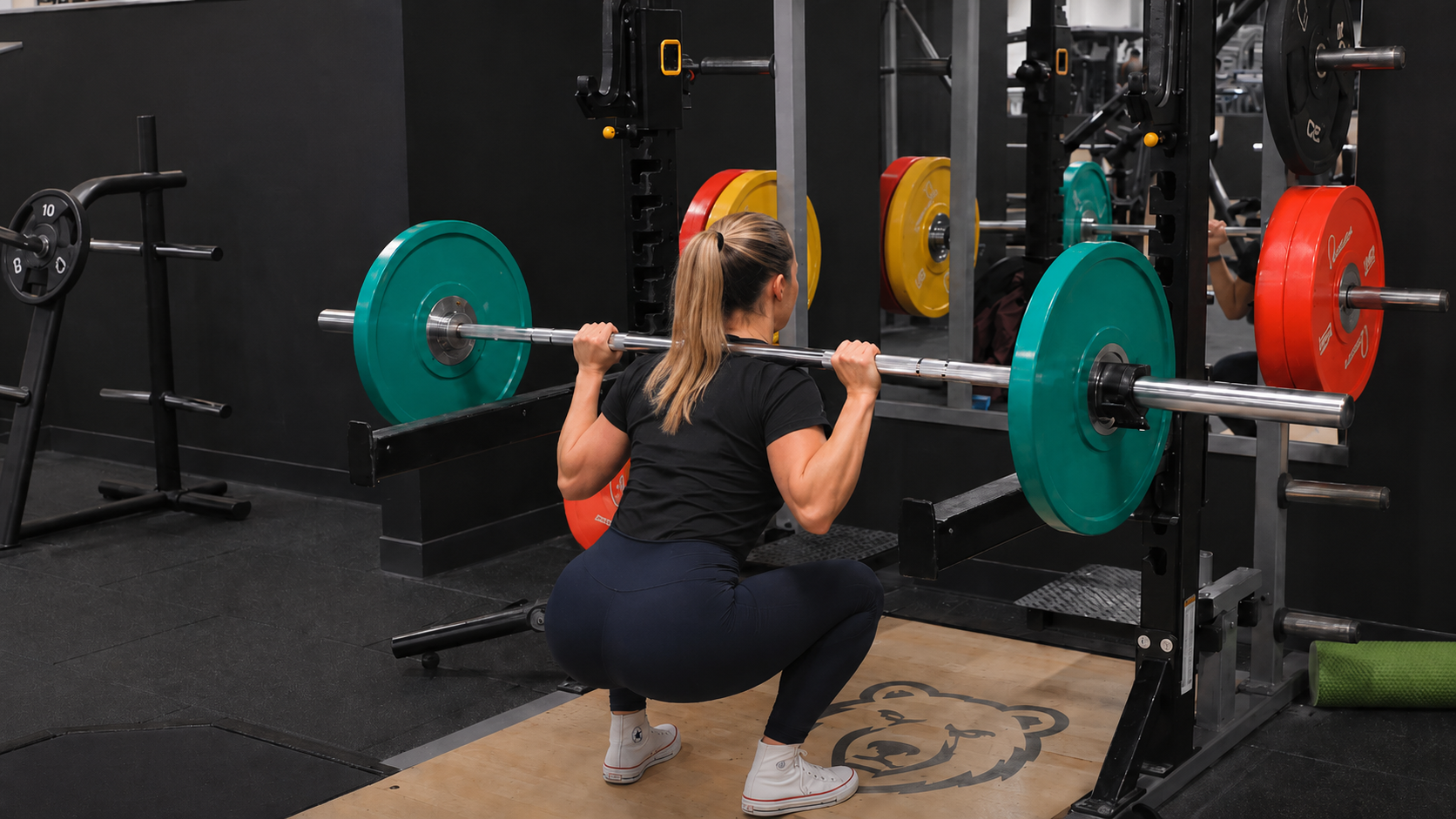
The number on the bar is only a proxy. What matters is what the training leaves behind under the surface: in the tendon, in the connective tissue, in the wiring between brain and muscle once you’ve built the capacity to absorb force again and again. The barbell is incidental. What earns the squat its place in the program is the adaptation it leaves in the tissues that have to survive a jump.
This is why “it’s just a jumping sport, so we’ll practice jumping and landing” falls apart. You can drill a beautiful knees-out, soft landing all day. Then the athlete gets tired, the technique you spent all that time grooving evaporates, and you remember that a safe landing strategy has to sit on a floor of force production. Practicing landings while you’re weak is just choreography dressed up as prevention.
Technique work without a strength base is a rehearsal that collapses under fatigue. Build the capacity first, and the technique you’ve drilled actually has something to stand on when the practice gets hard.
The Three Things Healthy, Uninjured Athletes Actually Share
When we look at the volleyball players who stay healthy and available, three factors show up again and again.
1. High relative strength.
Their bodyweight-to-force production ratio is high. They have the reserve to absorb what the sport asks of them.
2. A gradual exposure to jump frequency.
They do not go from a clean high school injury history into a college gym where the volume of jumps and landings suddenly triples before their tissues are ready for it.
3. They own the landing, not just the jump.
This one is counterintuitive. The vertical does not tell the whole story. Performance may hold steady or even climb by the end of a hard practice, but the real separator is what happens on the way down. Healthy athletes can keep absorbing force when fatigue sets in. They do not just jump well. They land with enough strength, timing, and tissue capacity to survive the repetitions.
You’ll always come back to the Earth. The only question is what pays the bill: muscles moving through a range of motion to absorb the shock across three joints, or a hard, immediate impulse driven straight into the cartilage and the patellar tendon. You can survive far more soft, three-joint landings than hard ones. Which means the whole point of training is to control the trip back down. If the injury risk lives in the landing and not the jump, then measuring the jump alone will miss the problem every time. Track what happens on the way down, especially late in practice when fatigue sets in.
The Newtonian Floor: Thresholds Before Drills
Before an athlete earns the right to chase fancy jump-and-land work, she needs a Newtonian floor: a baseline of force the body can produce and absorb. For a female volleyball player, here’s the conversation we actually start with.
• Back squat around 1.8 times bodyweight.
• Front squat around 85 percent of the back squat.
• Walking lunge around 40 percent of the back squat.
Hit those numbers and your jump training tends to get more effective on its own, and your landings get quieter. Nothing changed about how you drilled landings. You finally built the floor to stand them on.
A few caveats, because the details matter. It doesn’t have to be a barbell back squat. A belt squat or a leg press can build the same vertical, glute-driven base, if there’s a low-back concern. But all squats are not the same, a few degrees of range-of-motion difference changes the neural pathway, the tissue, and how force gets expressed. The traditional safety squat bar is a great tool, but mechanically it behaves more like a front squat, so don’t fool yourself into thinking you’re training the posterior, vertical pattern when you aren’t. Use a bar that forces your glutes load in the vertical path (See Here - Transformer Bar), then build into the front squat, then the walking lunge.
These three numbers for the back squat, front squat, and walking lunge provide objective targets that help coaches more confidently and safely progress athletes to higher-risk jump volume.
Protect What Strength Depends On
Strength is the foundation, but a few maintenance items decide whether you keep it.
Knee range of motion.
After ACL surgery, one of the first things a physical therapist chases is full knee flexion, roughly 140 degrees, heel to the butt on the table. So here is a fair question. If that range matters so much after a reconstruction, why are we not protecting it year round before anything goes wrong? As jump frequency climbs, the quads and hip flexors adapt. They tighten. They stop giving the athlete the same access to range. The body still has to find motion somewhere, and if it cannot get it from the knee or the hip, the next place it borrows from is the low back. That is why a freshman who suddenly develops low back pain in college is often not dealing with a back problem first. A knee and a hip stopped giving, so the back started taking the load instead. To monitor this maladaptation of jumping, we recommend a prone knee flexion test, athletes commonly refer to it as “the heel to butt test” and it belongs in the plan all season.
The Achilles and calf.
An isometric component, like a floating heel raise or an isometric calf raise that progresses into multidirectional work, loads the tendon and builds the spring the athlete has to land on. Pair that with anterior tibialis work at the front of the shin, and now you have covered both ends of the lower leg. And remember, jumping is never a clean vertical line. You jump, you drift, you land sideways, and your center of mass slides outside your base. The single leg strength you built has to hold up when a reach takes the athlete outside their sphere of control. That is exactly why the bilateral to unilateral sequence, plus the core strength to rein a wayward center of mass back in is important.
The Part That Decides the Season
You can land ten times with perfect technique. That proves nothing. A practice asks for fifty. If you don’t have the strength to make the forty-first and the fiftieth landing look like the first, then capacity was the limiting factor all along, and technique was a distraction.
Fatigue is the test, and strength is what you bring to it.
So yes, train the jump. Drill the landing. Just sequence it correctly. Build the Newtonian floor first, protect the knee’s range of motion and the calf’s spring, and stop reverse-engineering your whole program from the people who already got hurt. Go study the ones who didn’t.
Technique drills answer the question of what a landing should look like fresh. Strength answers the question of what it still looks like on rep fifty. Programs need both, in the right order.
Frequently Asked Questions
My daughter cannot squat 1.8 times her bodyweight yet. Should she stop jump training completely until she gets there, or can both happen at the same time?
Both can happen at the same time, but the sequencing matters. You can still work on jumping, teach the concepts, and build the mechanics while the strength is being developed. What you cannot expect is the same return you would get from a real jump program. Until the strength base is in place, jump training is largely a technical education, not a primary performance driver. Use that time well. Just do not confuse it with the thing that actually moves the needle.
What age should a female volleyball player start serious strength training to prevent ACL injury?
According to the NSCA position statement, athletes can begin as early as middle school, or basically any time they become competitive. The priorities at that stage are form, technique, and coordination, not load. And the younger the athlete, the slower the progression needs to be. Their bodies are not yet equipped to handle high volumes and high loads, especially on top of what the sport is already demanding. Starting early is good. Rushing the load is where it goes wrong.
What does a bad landing actually look like? What should a parent spot from the bleachers?
Look for awkward. A good rule of thumb is that great athletes stay on their feet. If someone is jumping and landing and rolling to a side, or it just does not look clean and controlled, that is the signal. You do not need to be a biomechanist to see it. When it looks wrong, it probably is. The word is awkward. Trust it.
Is ACL injury only a concern for girls, or should boys be doing this same kind of training?
The research consistently shows female athletes tear ACLs at higher rates than males, and that gap is most pronounced in jumping and cutting sports like volleyball, basketball, and soccer. The anatomical and hormonal differences are real. That said, the strength first, sequence correctly principle applies to every athlete regardless of sex. Building the Newtonian floor before chasing jump performance is never a bad idea. The research just makes it more urgent for female athletes.
Why test a back squat number specifically? Couldn’t we just look at vertical jump height instead?
Vertical jump height measures output, not capacity. An athlete can maintain or even improve her jump while her landing mechanics quietly deteriorate under fatigue, because the jump and the landing draw on different things. The back squat threshold is a more direct read on the force-absorption reserve she actually has in the tank, which is what protects her late in a long practice or a long season.
If an athlete already hit the 1.8x bodyweight squat threshold, is she safe from ACL injury?
No single number eliminates risk. The squat threshold is a floor, not a guarantee. It tells you the athlete has the baseline force capacity the sport requires. It does not mean every other variable is automatically handled. Fatigue management, jump volume, range of motion, and landing mechanics still matter. Treat the threshold as a necessary condition you build everything else on top of, not a finish line.
How often should these strength benchmarks be retested during a season?
A reasonable cadence is preseason, midseason, and postseason, with closer monitoring around any spike in jump volume, like the transition from high school to college play or a return from injury. Strength can erode quietly during a heavy competition stretch even while skill performance looks fine, so testing on a fixed schedule catches a falling floor before an injury does.
My athlete already tore her ACL once. Does this approach still apply during return to play?
Yes, and arguably it matters more. Post-surgical rehab already chases the knee range of motion and tendon resilience markers described above; the strength floor just becomes the objective gate for when she’s ready to add jump volume back in, rather than a calendar date. Returning to full jump training before the strength base is rebuilt is one of the more common ways athletes end up with a second injury.
Next Steps
Want to see where your athlete actually stands? Start with our free Peak Power Calculator.And if you’re navigating a return from injury, our Return to Performance program was built for exactly this conversation.
References
Hewett, T. E., Lindenfeld, T. N., Riccobene, J. V., & Noyes, F. R. (1999). The effect of neuromuscular training on the incidence of knee injury in female athletes. A prospective study. American Journal of Sports Medicine, 27(6), 699–706. https://pubmed.ncbi.nlm.nih.gov/10569353/
Faigenbaum, A. D., Kraemer, W. J., Blimkie, C. J. R., Jeffreys, I., Micheli, L. J., Nitka, M., & Rowland, T. W. (2009). Youth resistance training: Updated position statement paper from the National Strength and Conditioning Association. Journal of Strength and Conditioning Research, 23(5 Suppl), S60–S79. https://pubmed.ncbi.nlm.nih.gov/19620931/
Hewett, T. E., Myer, G. D., & Ford, K. R. (2006). Anterior cruciate ligament injuries in female athletes: Part 1, mechanisms and risk factors. American Journal of Sports Medicine, 34(2), 299–311. https://pubmed.ncbi.nlm.nih.gov/16423913/