How to Know Your Sets and Reps Are Dialed In
Most coaches know how to write a workout. Fewer coaches can look at that workout and clearly explain what adaptation it is chasing, what fatigue it is creating, and whether the dose actually matches the athlete in front of them. Choosing the right sets and reps is where the art and science of human performance meet.
Resistance training can be organized in almost endless ways. The number of possible combination of sets and reps in an hour session is 10^64. You can manipulate sets, reps, load, rest, tempo, exercise selection, weekly exposure, density, progression, and intent. Once those variables start interacting, the possibilities get massive. There are countless ways to train, but things are simplified when you get targeted and understand that there are only a handful of ways to train optimally for a specific athlete on a specific day. That is why programming is not just about knowing good rep schemes. It is about understanding what those rep schemes are doing.
That is the point of this guide. The goal is to help coaches become more confident in what they are prescribing. When you understand the goal, the workload, the fatigue cost, and the recovery demand, you have a much better chance of giving the athlete a fantastic stimulus.
Step 1: Define the Primary Adaptation
Before you choose sets and reps, you have to know what you are trying to improve.
That sounds obvious, but it is where a lot of programs start to drift. A coach writes a strength session, adds a little hypertrophy, adds some conditioning, throws in extra jumps, and suddenly the athlete is doing a lot of work without a clear primary signal.
The body can adapt to many things, but it cannot prioritize everything equally at once. When the goal is unclear, the stress becomes unclear too.
That does not mean you can never blend qualities. Good coaches blend qualities all the time. The discipline is knowing what the main adaptation is for that session, what secondary qualities are being touched, and what the total cost is going to be.
If today is a maximal strength day, the session should reflect that. If today is a power day, bar speed and quality should drive the prescription. If today is a hypertrophy day, the volume and effort need to match that goal. If today is a work capacity day, you should know that the recovery cost may be coming from a very different place than it would in a heavy strength session.
This is also where junk volume starts to matter.
Junk volume is not just “bad exercises” or “extra work.” Junk volume is any work that creates more cost than contribution relative to the goal of the session. It may look productive on paper, but if it compromises tomorrow’s training more than it supports today’s adaptation, it needs to be questioned.
A simple starting point looks like this:
Maximal Strength: The goal is force output, motor unit recruitment, and neuromuscular efficiency. Most of this work lives around 85 to 100% of 1RM for 1 to 5 reps, with 3 to 5 minutes of rest. The dominant fatigue is CNS and neural.
Power and Explosiveness: The goal is rate of force development and velocity at submaximal loads. Most of this work lives around 30 to 80% of 1RM for 1 to 3 reps, with 2 to 4 minutes of rest. The dominant fatigue is neural, with minimal metabolic cost.
Hypertrophy: The goal is increasing muscle cross sectional area. Most of this work lives around 65 to 85% of 1RM for 6 to 12 reps, with 30 to 90 seconds of rest. The dominant fatigue is a mix of metabolic stress and mechanical tension.
Endurance and Work Capacity: The goal is fatigue resistance and oxidative capacity. Most of this work lives around 40 to 65% of 1RM for 12 to 20 plus reps, with 15 to 45 seconds of rest. The dominant fatigue is metabolic and cardiovascular.
These ranges are starting points, not laws.
Muscle can grow across a wide range of loads when sets are taken close to failure. A hard set of 15 can build size in a similar way to a hard set of 8. The difference is not whether one works and the other does not. The difference is efficiency, recovery cost, and whether that prescription fits the athlete.
For years, we leaned heavily on classic 3 by 10 hypertrophy work. For most athletes, it worked exactly how you'd expect. They grew, they recovered fine, the progression made sense on paper. But we kept running into the same issue with a specific type: the twitchy, explosive athletes. Fast sprinters, jumpers, guys built for one big output rather than sustained output. They'd gas out mid-block, and it wasn't a recovery problem or an effort problem. It was that 70 to 75% for 8 to 12 reps was never going to ask enough of their fast-twitch fibers to get their attention.
Athletes with a higher proportion of fast-twitch fiber generally need a higher percentage of 1RM to fully recruit those fibers. Moderate loads taken to moderate reps just doesn't create enough tension to force the adaptation. So we moved them into 6 to 8 reps at a heavier percentage, closer to where their fibers actually get called into play, and the response changed almost immediately. Same hypertrophy goal, different route to it, because the athlete's fiber makeup demanded a different recruitment threshold.
That is the level of thinking coaches should be chasing. Not "does 3 by 10 work," because of course it can, for the right athlete. The real question is whether this athlete's physiology matches the stimulus you're giving them. And that question only has an answer if you're paying attention to more than just whether the sets got completed.
Which brings up the next problem. Feel alone won't tell you that. You need a way to measure what's actually happening in the session.
Step 2: Measure the Work
Most lifters judge a session by feel: was it hard, did it burn, were they wrecked the next day. Those things matter, but they don't tell the whole story. Soreness tells you something happened, not whether the right thing happened. If you want real confidence in your programming, you need a way to measure what you're actually prescribing, not just how it felt afterward. You don't need to track every number that exists. Pick a few simple ones that each tell you a different part of the story, because no single workload metric is complete on its own. Used together, they show you the session with a lot more clarity than feel ever will.
Tonnage
Tonnage is sets multiplied by reps multiplied by load. It tells you the total amount of weight moved, which makes it useful for tracking volume trends across a block. If tonnage jumps too quickly, the athlete may be getting more total work than they're prepared to recover from. If it barely changes, you may not be creating enough stimulus to move the adaptation forward. In a hypertrophy block specifically, tonnage should be climbing from one exposure to the next, since growth is largely a function of progressive volume over time. Around 8% is a good target increase session to session. Push much past that and you're outrunning what the athlete can actually recover from and turn into tissue. The limitation with tonnage on its own is that it doesn't tell you how heavy the work was relative to the athlete. Ten thousand pounds moved at 50% is not the same stress as ten thousand pounds moved at 85%, even though the number looks identical on paper.
Pounds Per Rep
Pounds per rep is tonnage divided by total reps. It gives you the average load each rep carried, which is a quick way to see the character of a session without digging through the full set by set breakdown. A higher number usually points to a strength bias, something in the middle often means hypertrophy or low intensity strength work, and a lower number usually means the session leaned toward volume, endurance, or density. Two athletes can put up nearly identical tonnage numbers and still have completely different sessions. If one athlete's pounds per rep is significantly higher than the other's, that athlete moved less total weight per rep but under heavier load, meaning the actual stress on their system was not the same even though the spreadsheet says otherwise.
INOL
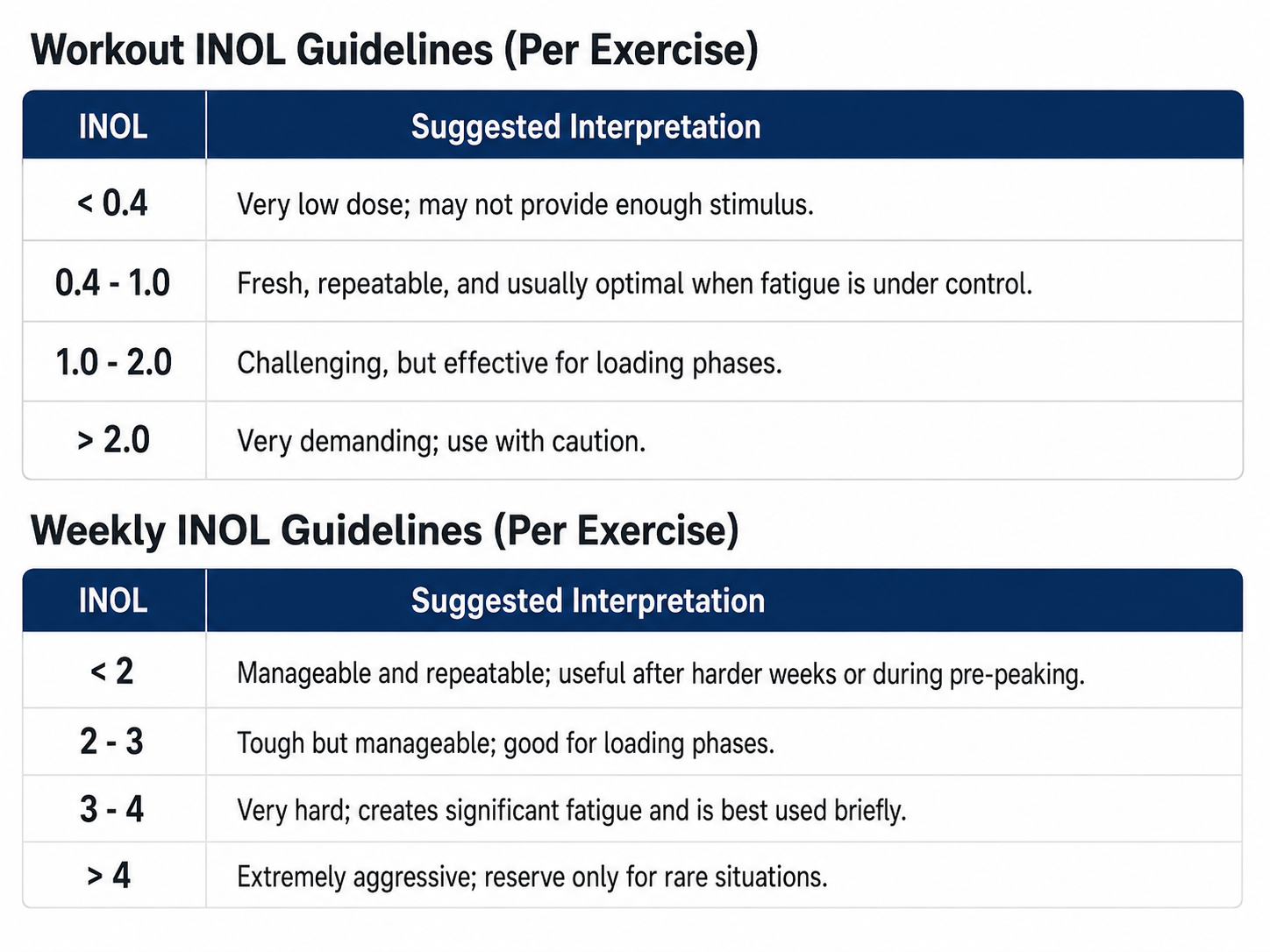
INOL stands for Intensity Number of Lifts. The formula is reps divided by 100 minus the percentage of 1RM, summed across the exercise. It helps you understand how stressful the work was relative to the intensity used, which gives you something tonnage can't, because it accounts for the relationship between volume and percentage rather than just total weight moved. One thing worth being careful with is treating a low INOL number as automatically meaning a light or easy day. A single heavy rep at 90% can produce a lower INOL than a moderate set at 70%, but that single rep is not a light day by any real measure, it's just a low dose in this specific formula. INOL tells you how much load you accumulated relative to intensity, not how hard the session actually was on the athlete. It's a tool for seeing loading stress from an angle volume alone can't show you, not a replacement for understanding what the number is actually measuring.
K Value
K value is a density measure. The formula is tonnage divided by duration multiplied by bodyweight. It tells you how much work was packed into how much time relative to the size of the athlete doing it. Two athletes can move identical tonnage, but if one gets it done in 40 minutes and the other needs 70, those are not the same session, even though the total weight moved looks the same on paper. Density is worth tracking because volume alone doesn't determine how hard a session actually was. A lifter can grind out the same tonnage over a rushed 40 minutes or a relaxed 70, and the body experiences those two versions very differently. Density is one more piece of that puzzle, sitting alongside intensity, rest, and everything else the athlete brings into the room that day.
Bar Speed
Bar speed is probably the most honest readout you get in real time. Velocity based training gives you feedback on effort and fatigue as it's happening, not after the fact. When velocity drops at a fixed load, that's neuromuscular fatigue showing up right in front of you. It doesn't automatically mean the set or the session needs to stop, but it's information tonnage alone will never give you. This matters most on days built around power, speed, or high quality strength work, where the whole point is bar speed. If the athlete is supposed to be moving the bar fast and it's no longer moving fast, the prescription has quietly stopped matching the goal, even if the sets and reps on paper still look right. None of these numbers, tonnage, pounds per rep, INOL, K value, or bar speed, are the answer on their own. They're tools. Put together, they give you a real picture of what you're actually handing your athlete that day.
Step 3: A Monday in the Weight Room

Let’s put the tools into a real coaching example. Picture a Monday team lift for a Division 1 baseball program. Four different athletes are training. Each one is using a different prescription, and each prescription is chasing a different adaptation.
To compare them clearly, we will use the same 200 pound lifter for each example.
Athlete A: Strength
5 by 5 at 80%
Load: 400 pounds
Duration: 45 minutes
Tonnage: 10,000 pounds
Pounds per rep: 400
INOL: 1.25
K value: 1.11
Bar speed: 0.55 m/s, steady
This is a strength biased session. The pounds per rep number is high, the intensity is meaningful, and the bar speed is steady. The athlete is accumulating productive work without showing a major velocity drop.
Athlete B: Power
10 by 3 at 70%
Load: 350 pounds
Duration: 60 minutes
Tonnage: 10,500 pounds
Pounds per rep: 350
INOL: 1.00
K value: 0.875
Bar speed: 0.75 to 0.65 m/s
This looks like a power session, but the bar speed tells you more than the written prescription. If velocity starts at 0.75 and drops to 0.65, fatigue is starting to interfere with the quality of the output.
That does not automatically make the session wrong. It just tells you that the coach needs to pay attention. If the goal is high quality power output, the later sets may no longer be giving you the same training signal as the early sets.
Athlete C: Hypertrophy
4 by 12 at 65%
Load: 325 pounds
Duration: 50 minutes
Tonnage: 15,600 pounds
Pounds per rep: 325
INOL: 1.37
K value: 1.56
Bar speed: 0.50 m/s, slows late
This session carries a lot of productive volume. The tonnage is higher than A and B, the density is higher, and the INOL is in a heavy but useful range. The late bar speed drop makes sense because hypertrophy work is going to create more local fatigue.
For the right athlete, this may be a very effective session. For the wrong athlete, or at the wrong time in the week, it could create more cost than you intended.
Athlete D: Endurance and Work Capacity
5 by 20 at 50%
Load: 250 pounds
Duration: 70 minutes
Tonnage: 25,000 pounds
Pounds per rep: 250
INOL: 2.00
K value: 1.79
Bar speed: 0.40 m/s, steep late drop
This session wins the tonnage battle by a mile. It also carries the highest INOL and the steepest velocity drop.
That does not mean it is a bad session. If the goal is work capacity or fatigue resistance, this may be exactly what you wanted. But if the coach wrote it thinking it was just a “lighter” day because the percentage was only 50%, the numbers tell a different story.
Lower intensity does not always mean lower cost.
That is one of the biggest lessons in programming. A session can be light from a percentage standpoint and still be expensive from a recovery standpoint.
What the Numbers Reveal
Look at Athlete D's numbers by themselves and you'd think it was just a long, tiring day. Tonnage was the highest of the four, INOL was the highest of the four, and bar speed showed the steepest drop of the four. But that's the whole point. If you only had one of those numbers, you'd be making a decision on partial information, and partial information is how you end up misreading a session. If a coach saw only the tonnage number for Athlete D, they might assume the work capacity block is going great. If they saw only the bar speed drop, they might assume the athlete is overreaching and needs to back off. Both readings are incomplete on their own. Put together, they tell you the athlete did exactly what a work capacity day is supposed to do, accumulate a large, metabolically demanding load, and the steep velocity drop late in the session is expected, not alarming.
This is where the real value shows up. A high INOL number isn't automatically a red flag, a high tonnage day isn't automatically a good day, and a velocity drop isn't automatically a sign something went wrong. Each one only means something once you know what the session was supposed to accomplish. That's the shift that actually changes how you coach. Instead of asking which number matters most, you start asking what each number is telling you about this specific athlete on this specific day, and whether what happened in the weight room actually lines up with what you wrote on paper. That gap, between what you planned and what the numbers show you actually happened, is where better programming comes from.
Ask for the Receipts
We live in a time where everyone has a system. Everyone has a favorite rep scheme, a favorite progression model, and a highlight reel of athletes who got better under them. That doesn't mean the system is wrong. It just means the next question should be simple: what actually happened, was it what you expected, how did you measure it, could the athlete recover from it, and did the next exposure improve. That's what separates a real program from a collection of workouts that happen to be written down.
If someone tells you a session should hit 30,000 pounds, ask why that number. If someone tells you INOL should never cross 1.5, ask where that line came from. If someone tells you their program works, ask compared to what, measured how, and over what timeline. Those aren't gotcha questions meant to poke holes in someone's system. They're the same questions a good coach should already be asking about their own program, because the answers are what turn a hunch into something you can actually stand behind.
The best coaches aren't guessing from scratch every week. They know what they planned, they know how the athlete responded, and they have a real expectation for what should happen next. Over time that builds history, history gives you context, and context is what makes your next decision better than your last one. That's also why writing things down matters. Without some form of tracking, you might still get good workouts, real effort, even results for a while. But you'll struggle to know why something worked, why it eventually stopped working, or what actually needs to change. You don't need to track every metric in this guide. You need enough of one to have a real conversation with the program instead of just a feeling about it.
For more on this check out our blog “Mark Rippetoe is a Data Scientist in a Cowboy Hat”
Reps Are Only a Piece of the Equation
Show a lifter their bar speed on a heavy single or their tonnage total for the week, and you'll usually see them lean in. Numbers get attention. But that reaction on its own isn't buy in, it's curiosity, and curiosity fades if nothing backs it up. What actually builds buy-in is explaining why the prescription fits them specifically, showing them what you're looking for before the set even starts, and then letting the work prove the number right over time. This matters even more with intermediate and advanced lifters, since their progress isn't always obvious day to day the way it is for a beginner. They may need several exposures before a pattern shows up clearly, and if they trust the process behind the numbers, not just the numbers themselves, they're far more likely to stick with the plan long enough for it to work.
But even with full buy in, reps are still only half the equation. The other half is recovery. It doesn't matter how smart the rep scheme is if the athlete can't adapt to it, because the training stimulus only means something if the body has the resources to turn it into progress. This is where nested systems come in. The athlete isn't just recovering from squats. Their nervous system, muscle tissue, connective tissue, glycogen stores, hydration status, sleep debt, immune function, stress load, and hormonal environment are all responding on their own separate timelines underneath the surface. The body is a complex system built out of smaller systems, and good programming is really just a way of applying stress with more control and more respect for that complexity.
That's why a workout can't be judged only by what happened in the weight room. The athlete has 168 hours in a week, and a coach might only be present for four or five of them. The other hours still count. If an athlete is in a hypertrophy block but sleeping poorly, eating inconsistently, and carrying a heavy load of life stress, the plan that looked perfect on paper may no longer be the right plan. The biology has to be respected. Stimulus and recovery move together, and if you lose one, you lose the adaptation with it.
How to Choose Sets and Reps for the Next Block
Here's a simple workflow you can actually use. Start by naming the primary adaptation, not the rep scheme. The goal comes first, always. From there, choose the general loading range that fits it. Strength usually lives heavier, power usually lives lower in reps with more emphasis on speed, hypertrophy usually needs enough volume and effort to create a real growth signal, and work capacity usually comes with a bigger metabolic and recovery cost attached to it.
Once the goal and loading range are set, pick at least one workload metric to actually track. If you're only starting with one, make it tonnage, it's simple and it tells you a lot on its own. If you want a clearer read on intensity, add pounds per rep. If you want a better sense of loading stress, add INOL. If density matters to you, add K value. And if you have access to velocity, bar speed will show you fatigue in real time in a way nothing else can. The goal isn't to drown yourself in numbers, it's to pick the ones that actually help you understand what you just gave the athlete.
Then, once the block starts, hold what actually happened up against what you expected. Did the athlete tolerate the work. Did the target quality improve. Did bar speed hold where it needed to. Did intensity climb without tonnage jumping too far behind it. Did the athlete look better in the next exposure, or did the last session cost more than it should have. That comparison, expected versus actual, is where programming stops being a spreadsheet and starts being coaching.
Final Thoughts: Track, Measure, Adapt
There's no single best way to measure a session. The only real mistake is measuring nothing. The best results rarely come from a magic rep scheme, they come from matching the dose to the goal, watching how the athlete actually responds, and adjusting before the body forces the issue for you.
Two numbers are especially worth watching when it comes to progression: intensity and tonnage. A solid strength plan should generally show something like a 3 to 5% increase in intensity from one exposure to the next, while keeping tonnage within roughly 8 to 10%. If intensity jumps too aggressively, the biology may not keep pace. If tonnage climbs too wildly, the recovery cost can get away from you before you notice. And if progress crawls along at 1 to 2% when the goal was to push harder, that's usually a sign the athlete is either under stimulated or not recovering well enough to express the adaptation you're chasing.
So if an athlete squats heavy on a Friday and intensity is the goal, you should already have a rough idea of what you want to see the following Friday. Maybe the load climbs 3 to 5%. Maybe tonnage holds inside a controlled range. Maybe bar speed tells you the athlete isn't ready for the jump you had planned. Or maybe the numbers tell you it's time to change the angle, change the scheme, or adjust the dose entirely. That's the real value of tracking. It gives you a better conversation with the program, a better conversation with the athlete, and most importantly, it gives the athlete a better chance at the adaptation they're actually training for.
At Newman HP, this is the level of detail we believe athletes deserve, not because numbers make coaching less human, but because the right numbers let us care for the athlete more completely. Better programming was never about proving how much you know. It's about giving the athlete the best possible chance to adapt, recover, and keep moving forward.
Frequently Asked Questions
How do I choose sets and reps for my goal?
Start with the primary adaptation. If the goal is strength, use heavier loads and lower reps. If the goal is hypertrophy, use enough volume and effort to create a growth signal. If the goal is power, keep the reps low and the intent fast. If the goal is endurance or work capacity, expect a larger metabolic cost. The goal should drive the prescription.
What rep range builds muscle versus strength?
Strength is usually trained most efficiently with 1 to 5 reps at 85% or higher. Hypertrophy is commonly trained with 6 to 12 reps at 65 to 85%, but muscle can grow across a wider range of reps when sets are taken close to failure. The right choice depends on the athlete, the goal, and the recovery cost.
What is INOL in strength training?
INOL stands for Intensity Number of Lifts. The formula is reps divided by 100 minus percentage of 1RM. It helps coaches understand loading stress by looking at how many reps were performed relative to how heavy the load was.
What is a good INOL number?
As a rough guide per exercise, under 0.4 is light, 0.4 to 1.0 is a productive dose, 1.0 to 2.0 is heavy but useful in certain loading phases, and above 2.0 is usually a lot unless you are intentionally peaking or pushing.
Does rep scheme matter more than recovery?
No. The rep scheme and recovery plan have to work together. The best prescription in the world will not create the desired adaptation if the athlete cannot recover from it. Sleep, nutrition, hydration, stress, training age, and previous loading history all matter.
How many reps should I do for power?
Power work is usually best trained with low reps, often 1 to 3, and enough rest to keep output high. Loads can vary widely depending on the exercise and the goal, but the intent should stay fast. If speed drops too much, the session may no longer be training the quality you intended.
What is velocity based training?
Velocity based training uses bar speed to help gauge effort and fatigue in real time. If velocity drops at a fixed load, fatigue is showing up. That information can help a coach decide whether to keep pushing, reduce load, or end the exercise before the session drifts away from the goal.
References
American College of Sports Medicine. Progression models in resistance training for healthy adults. Medicine & Science in Sports & Exercise. 2009;41(3):687-708. https://pubmed.ncbi.nlm.nih.gov/19204579/
Schoenfeld BJ, Grgic J, Van Every DW, Plotkin DL. Loading recommendations for muscle strength, hypertrophy, and local endurance: a re-examination of the repetition continuum. Sports. 2021;9(2):32. https://pmc.ncbi.nlm.nih.gov/articles/PMC7927075/
Schoenfeld BJ, Grgic J, Ogborn D, Krieger JW. Strength and hypertrophy adaptations between low- versus high-load resistance training: a systematic review and meta-analysis. Journal of Strength and Conditioning Research. 2017;31(12):3508-3523. https://pubmed.ncbi.nlm.nih.gov/28834797/
Holt NC, et al. The effect of fast and slow motor unit activation on whole-muscle mechanical performance. Journal of Experimental Biology. 2014;217(14):2366-2374. https://pmc.ncbi.nlm.nih.gov/articles/PMC3996609/
Schoenfeld BJ, et al. Resistance training volume enhances muscle hypertrophy but not strength in trained men. Medicine & Science in Sports & Exercise. 2019;51(1):94-103. https://pmc.ncbi.nlm.nih.gov/articles/PMC6303131/
Lift Vault. INOL Calculator Tool. https://liftvault.com/resources/inol-calculator-tool/
Balsalobre-Fernández C, Torres-Ronda L. The implementation of velocity-based training paradigm for team sports: framework, technologies, practical recommendations and challenges. Sports. 2021;9(4):47. https://pmc.ncbi.nlm.nih.gov/articles/PMC8066834/
Jukic I, et al. The acute and chronic effects of implementing velocity loss thresholds during resistance training: a systematic review, meta-analysis, and critical evaluation of the literature. Sports Medicine. 2022;53:177-214. https://pmc.ncbi.nlm.nih.gov/articles/PMC9807551/
Rippetoe M. Keeping a Training Log. Starting Strength. https://startingstrength.com/training/keeping-a-training-log
About The Author
Thomas Newman is the founder of Newman HP and a Certified Strength and Conditioning Specialist (CSCS) with nearly two decades in human performance. As Director of Student Performance and Innovation at Yale University, he oversaw more than 800 student-athletes across 29 varsity programs and contributed to a Division I National Championship in men's lacrosse and back-to-back Ivy League football titles. He has served as Lead Performance Specialist at Mass General Brigham's Center for Sports Performance and Research (CSPAR) and as Chief Innovation Officer at Hawkin Dynamics, where he helped develop force-plate analytics and AI-driven performance tools used across the industry. He is a co-author of the Human Kinetics textbook Developing the Athlete: An Applied Sport Science Roadmap for Optimizing Performance Success (Kraemer, Ratamess, Newman, 2024) and today provides concierge performance services to professional athletes across professional sports.