
Why Athletic Progress Slows Down: Nested Systems and Flexible Individualization
Somewhere this week, a coach is writing next week's program the same way they wrote last week's. Add five pounds. Add a rep. Move the line of progression up one notch. For a long stretch it worked, and it was a thing of beauty to watch. The athlete climbed that line week after week, and the climbing felt like proof that the system was sound. Then one day the line and the athlete quietly stopped agreeing with each other. The numbers on the page kept rising. The body following them did not.
This happens all the time, and it is rarely a failure of the athlete or their effort. More often, it is a failure of the framework around them. Early progress teaches everyone to trust the line. Add weight, add reps, push the plan forward, and the body adapts. But the mistake is assuming that the same line will keep working forever.
The reason the line eventually fails is not because the athlete stopped caring. It is because the athlete is not one simple system. They are a collection of nested systems, each responding to training, recovery, stress, nutrition, sleep, and life on its own timeline.
The Athlete Is a System of Systems
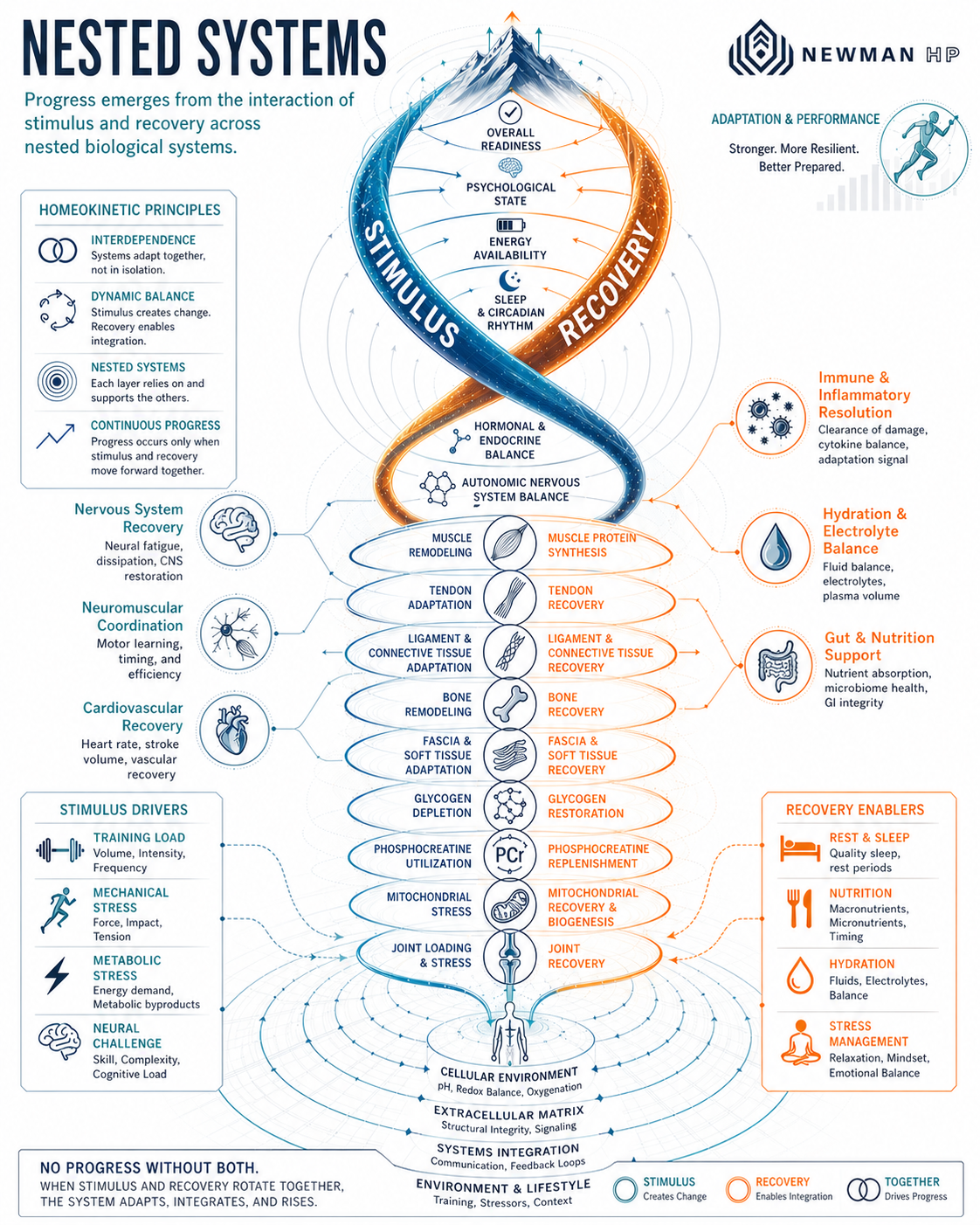
These are examples of nested systems. A nested system is a smaller system that sits inside a larger one while still influencing the whole. In the body, muscles, tendons, bones, glycogen stores, hydration, sleep, immune response, inflammation, hormones, connective tissue, gut function, and psychological state are all smaller systems within the larger athlete system.
They do not all move on the same timeline. Some recover quickly. Some adapt slowly. Some regulate the internal environment that allows adaptation to happen at all. Muscle depends on fuel. Tendon depends on loading history. Bone depends on repeated mechanical stress over time. The nervous system depends on sleep, stress, and recovery. Hydration affects blood volume, heart rate, heat tolerance, coordination, and perceived effort.
This is why readiness is not one thing. Readiness is what emerges from the interaction of all these systems on a given day. An athlete may feel fine, but their jump output may be down. They may have no soreness, but their tendon may still be irritated. They may be motivated, but under-fueled. They may feel physically recovered, but neurologically flat.
That is why simple programming eventually breaks down. The coach is not managing one variable. The coach is managing the interaction between many systems.
Progress Is a Helix
The better image is not a straight ladder. It is a helix. (Refer back to the image above).
Stimulus and recovery rotate together. Training creates the signal. Recovery integrates the signal. When both sides keep rotating together, the athlete rises. When stress outruns recovery, the helix stops climbing.
Early in training, the helix is forgiving. The athlete is far from their ceiling. Their outputs are lower. The cost of each session is lower. They can make progress even when the plan is not perfect because the body has more room to absorb mistakes.
That is why linear progression works so well for beginners. It is not because the body is simple. It is because the beginner has a greater margin.
As the athlete advances, that margin shrinks.
A stronger athlete does not just lift more weight, they also create more stress per rep. A faster athlete does not just sprint faster. They put more force through muscle, tendon, bone, fascia, and the nervous system every time they touch the ground. A more powerful athlete does not just produce more output. They create a larger recovery cost every time they train near their ceiling.
The higher the athlete climbs, the harder it becomes to keep the whole helix rotating upward.
Different Systems Recover on Different Timelines
The body does not finish recovering all at once.
Glycogen replenishment: about 24 hours with enough carbohydrate, longer if under-fueled
Bone remodeling and measurable bone adaptation: 12 to 24+ weeks
The point is simple: this list is only a snapshot, not the full system. Every workout hits multiple nested systems, and those systems are not ready again at the same time. They also will not recover on the same timeline for every athlete. That is why fixed programming becomes less reliable as athletes advance, and why individualization matters.
The Two Problems This Creates
Once you understand nested systems, two programming problems become obvious.
The first problem is program-level progression.
As athletes move beyond the novice stage, stress cannot keep climbing in the same clean linear way forever. Early on, there is more room in the system. Adaptations are easier to create because the athlete is farther from their ceiling. Strength can improve quickly through neural changes first: better coordination, better recruitment, better timing, and better skill with the movement. Structural changes come later as muscle, tendon, connective tissue, and bone adapt to repeated stress. Eventually, progress becomes more specific and much harder to earn.
That is why a beginner may add weight every week, while an advanced athlete may fight for months to move one notch higher. If a world-class athlete improves at all, that is a major adaptation. The closer the athlete gets to their ceiling, the less room there is for easy progress, and the more precise the stress has to become. Heavy stress, light stress, power work, technical work, hypertrophy, recovery, and lower-output sessions all have a place because progress now depends on matching the right stress to the right system at the right time.
The second problem is daily adjustment.
Even when the long-term plan is correct, the athlete does not show up as the same system every day. Sleep, hydration, glycogen, connective tissue, inflammation, nervous system state, mood, nutrition, and life stress all affect what that athlete can absorb in that session.
These problems are connected, but they are not identical. The long-term plan has to evolve because the athlete becomes more advanced and the cost of progress rises. The daily session has to adjust because the athlete’s nested systems are always moving on different timelines.
Less Wiggle Room at the Top
As the athlete gets better, they have less wiggle room for the nested systems to fall behind.
This is the key coaching point.
A beginner can sleep badly, eat poorly, miss some recovery, and still often progress. Again, that does not make those things good. It just means the athlete is operating far enough below their ceiling that the system can tolerate the mistake.
An advanced athlete is different.
When the athlete is already strong, fast, powerful, or highly trained, small problems matter more. The same sleep debt creates a bigger issue. The same missed meals matter more. The same tendon irritation matters more. The same emotional stress matters more. The same hydration issue matters more.
The athlete is operating closer to the limits of the system, so the systems have to line up more precisely.
That is why progress gets harder. Not because advanced athletes are fragile. Because advanced outputs are expensive.
The better the athlete becomes, the more important it is that stress and recovery rotate together.
Individualization Starts With the Nested Systems
This is where team programming gets exposed.
A coach can say, “We are running a hypertrophy block.”
That may be the right plan. But hypertrophy is not just sets of 8 to 12. Hypertrophy is a stress and recovery environment.
What is each athlete eating?
Who is getting enough protein?
Who is getting enough carbohydrate to support the volume?
Who had enough quality sleep?
Who has a tendon that is tolerating today’s session but not adapting fast enough for the next three weeks?
Who is carrying inflammation from practice, travel, school, family stress, or poor recovery?
Who is gaining from the block, and who is just surviving it?
A team can share the same training theme, but that does not mean every athlete should complete the same type of session on the same day. The block may be focused on hypertrophy, strength, or power, but the athlete in front of you may not be ready for that stress today.
Some adjustments may involve volume or loading, but the bigger idea is session selection. The target stays fixed, while the day’s training stress changes to match the athlete’s current state.
That is where flexible nonlinear periodization comes in.
Bringing It Back to the Athlete
This is why the plan cannot be treated like a fixed line on a calendar.
The athlete is not just completing workouts. They are absorbing stress through a complex system made up of many smaller systems, all recovering and adapting on different timelines. Early on, there is enough room for progress to look simple. Add weight, add reps, repeat the pattern, and the athlete improves.
But as the athlete gets better, the margin shrinks. Progress becomes harder to earn. The same workout creates a different cost. The same stress does not land the same way on every athlete, or even on the same athlete every week.
That is why flexibility becomes more important, but flexibility has to be understood correctly. People hear “flexible”, and think “random.” They think it means the athlete gets to pick what they feel like doing. They think it means the coach is being soft, reactive, or unstructured.
That is not what it means.
The goal is not flexible. The targeting is exact. What changes is the way the coach gets the athlete there. Flexible nonlinear periodization keeps the destination clear while allowing the route to match the athlete’s current state.
The better the athlete becomes, the more precise that match has to be.
FAQ
What are nested systems in athletic training?
Nested systems are smaller systems inside the larger athlete system. Muscle, tendon, bone, glycogen stores, hydration, sleep, immune response, inflammation, hormones, connective tissue, gut function, and psychological state all influence how an athlete responds to training. None of them works alone, and none of them recovers or adapts on the exact same timeline.
Why does athletic progress slow down over time?
Progress slows because the athlete has less room for easy adaptation. Beginners are far from their ceiling, so small increases in stress can create fast improvement. As athletes become stronger, faster, and more advanced, each new gain costs more. The stress has to become more precise because the margin for error gets smaller.
Why does the same workout affect athletes differently?
The same workout can create a different internal cost for every athlete. One athlete may be fueled, rested, and ready to absorb the stress. Another may be under-fueled, sleep-deprived, sore, inflamed, or carrying tendon stress. The session may look identical on paper, but it does not land the same way inside the body.
What is flexible nonlinear periodization?
Flexible nonlinear periodization is a structured way to adjust training based on the athlete’s current state. The goal does not change. The target stays exact. What changes is the session selected on a given day so the training stress better matches what the athlete is ready to absorb.
Does flexible programming mean random training?
No. Flexible does not mean random, soft, or unstructured. It does not mean the athlete gets to pick whatever they feel like doing. It means the coach has a clear target and adjusts the route based on readiness, recovery, and the systems that are prepared for stress that day.
Can a team still follow the same training goal?
Yes. A team can still be in a hypertrophy, strength, power, or return-to-play phase. But that does not mean every athlete needs the same type of session on the same day. The team goal can stay the same while the daily training stress changes based on the athlete in front of the coach.
Why does individualization matter more for advanced athletes?
Advanced athletes create more stress with the same category of work. A heavy lift, sprint, jump, or high-output session costs more when the athlete is closer to their ceiling. Because the margin is smaller, missed sleep, poor nutrition, tendon irritation, emotional stress, or unresolved fatigue matter more. The better the athlete becomes, the more precise the match has to be between the training stress and the systems ready to absorb it.
Talk With Newman HP
References
Alba-Jiménez, C., Moreno-Doutres, D., & Peña, J. (2022). Trends assessing neuromuscular fatigue in team sports: A narrative review. Sports, 10(3), 33.https://doi.org/10.3390/sports10030033
Almstedt, H. C., Canepa, J. A., Ramirez, D. A., & Shoepe, T. C. (2011). Changes in bone mineral density in response to 24 weeks of resistance training in college-age men and women. Journal of Strength and Conditioning Research, 25(4), 1098–1103.https://doi.org/10.1519/JSC.0b013e3181d9647f
Burke, L. M., van Loon, L. J. C., & Hawley, J. A. (2017). Postexercise muscle glycogen resynthesis in humans. Journal of Applied Physiology, 122(5), 1055–1067.https://doi.org/10.1152/japplphysiol.00860.2016
Charest, J., & Grandner, M. A. (2020). Sleep and athletic performance: Impacts on physical performance, mental performance, injury risk and recovery, and mental health. Sleep Medicine Clinics, 15(1), 41–57.https://doi.org/10.1016/j.jsmc.2019.11.005
Del Vecchio, A., Casolo, A., Negro, F., Scorcelletti, M., Bazzucchi, I., Enoka, R., Felici, F., & Farina, D. (2019). The increase in muscle force after 4 weeks of strength training is mediated by adaptations in motor unit recruitment and rate coding. The Journal of Physiology, 597(7), 1873–1887.https://doi.org/10.1113/JP277250
Eriksen, E. F. (2010). Cellular mechanisms of bone remodeling. Reviews in Endocrine and Metabolic Disorders, 11, 219–227.https://doi.org/10.1007/s11154-010-9153-1
Fleck, S. J. (2011). Non-linear periodization for general fitness and athletes. Journal of Human Kinetics, 29A, 41–45.https://doi.org/10.2478/v10078-011-0057-2
Folland, J. P., & Williams, A. G. (2007). The adaptations to strength training: Morphological and neurological contributions to increased strength. Sports Medicine, 37(2), 145–168.https://doi.org/10.2165/00007256-200737020-00004
Halson, S. L. (2014). Monitoring training load to understand fatigue in athletes. Sports Medicine, 44(Suppl 2), 139–147.https://doi.org/10.1007/s40279-014-0253-z
Hughes, D. C., Ellefsen, S., & Baar, K. (2018). Adaptations to endurance and strength training. Cold Spring Harbor Perspectives in Medicine, 8(6), a029769.https://doi.org/10.1101/cshperspect.a029769
Jäger, R., Kerksick, C. M., Campbell, B. I., Cribb, P. J., Wells, S. D., Skwiat, T. M., et al. (2017). International Society of Sports Nutrition position stand: Protein and exercise. Journal of the International Society of Sports Nutrition, 14, 20.https://doi.org/10.1186/s12970-017-0177-8
Kenkre, J. S., & Bassett, J. H. D. (2018). The bone remodelling cycle. Annals of Clinical Biochemistry, 55(3), 308–327.https://doi.org/10.1177/0004563218759371
Kraemer, W. J., & Ratamess, N. A. (2005). Hormonal responses and adaptations to resistance exercise and training. Sports Medicine, 35(4), 339–361.https://doi.org/10.2165/00007256-200535040-00004
Kraemer, W. J., Solomon-Hill, G., Volk, B. M., Kupchak, B. R., Looney, D. P., Dunn-Lewis, C., et al. (2017). Recovery responses of testosterone, growth hormone, and IGF-1 after resistance exercise. Journal of Applied Physiology, 122(3), 549–558.https://doi.org/10.1152/japplphysiol.00599.2016
Kubo, K., Kanehisa, H., & Fukunaga, T. (2001). Effects of different duration isometric contractions on tendon elasticity in human quadriceps muscles. Journal of Physiology, 536(2), 649–655.https://doi.org/10.1111/j.1469-7793.2001.0649c.xd
McDermott, B. P., Anderson, S. A., Armstrong, L. E., Casa, D. J., Cheuvront, S. N., Cooper, L., et al. (2017). National Athletic Trainers’ Association position statement: Fluid replacement for the physically active. Journal of Athletic Training, 52(9), 877–895.https://doi.org/10.4085/1062-6050-52.9.02
McMahon, S., & Jenkins, D. (2002). Factors affecting the rate of phosphocreatine resynthesis following intense exercise. Sports Medicine, 32(12), 761–784.https://doi.org/10.2165/00007256-200232120-00002
McNamara, J. M., & Stearne, D. J. (2010). Flexible nonlinear periodization in a beginner college weight training class. Journal of Strength and Conditioning Research, 24(1), 17–22.https://doi.org/10.1519/JSC.0b013e3181b2c69f
Miller, B. F., Olesen, J. L., Hansen, M., Døssing, S., Crameri, R. M., Welling, R. J., et al. (2005). Coordinated collagen and muscle protein synthesis in human patella tendon and quadriceps muscle after exercise. Journal of Physiology, 567(3), 1021–1033.https://doi.org/10.1113/jphysiol.2005.093690
Moore, D. R. (2019). Maximizing post-exercise anabolism: The case for relative protein intakes. Frontiers in Nutrition, 6, 147.https://doi.org/10.3389/fnut.2019.00147
Morton, R. W., Murphy, K. T., McKellar, S. R., Schoenfeld, B. J., Henselmans, M., Helms, E., et al. (2018). A systematic review, meta-analysis and meta-regression of the effect of protein supplementation on resistance training-induced gains in muscle mass and strength in healthy adults. British Journal of Sports Medicine, 52(6), 376–384.https://doi.org/10.1136/bjsports-2017-097608
Murray, B., & Rosenbloom, C. (2018). Fundamentals of glycogen metabolism for coaches and athletes. Nutrition Reviews, 76(4), 243–259.https://doi.org/10.1093/nutrit/nuy001
Peake, J. M., Neubauer, O., Della Gatta, P. A., & Nosaka, K. (2017). Muscle damage and inflammation during recovery from exercise. Journal of Applied Physiology, 122(3), 559–570.https://doi.org/10.1152/japplphysiol.00971.2016
Sale, D. G. (1988). Neural adaptation to resistance training. Medicine & Science in Sports & Exercise, 20(5 Suppl), S135–S145.https://doi.org/10.1249/00005768-198810001-00009
Sawka, M. N., Burke, L. M., Eichner, E. R., Maughan, R. J., Montain, S. J., & Stachenfeld, N. S. (2007). American College of Sports Medicine position stand: Exercise and fluid replacement. Medicine & Science in Sports & Exercise, 39(2), 377–390.https://doi.org/10.1249/mss.0b013e31802ca597
Soodak, H., & Iberall, A. (1978). Homeokinetics: A physical science for complex systems. Science, 201(4356), 579–582.https://doi.org/10.1126/science.201.4356.579
Stone, M. H., Hornsby, W. G., Haff, G. G., Fry, A. C., Suarez, D. G., Liu, J., et al. (2022). Training specificity for athletes: Emphasis on strength-power training. Sports Medicine - Open, 8, 78.https://doi.org/10.1186/s40798-022-00464-9
Stožer, A., Vodopivc, P., Križančić Bombek, L. (2020). Pathophysiology of exercise-induced muscle damage and its structural, functional, metabolic, and clinical consequences. Physiological Research, 69(4), 565–598.https://doi.org/10.33549/physiolres.934371
Thomas, K., Dent, J., Howatson, G., & Goodall, S. (2018). Neuromuscular fatigue and recovery after heavy resistance, jump, and sprint training. Medicine & Science in Sports & Exercise, 50(12), 2526–2535.https://doi.org/10.1249/MSS.0000000000001733
Tsai, M. S., et al. (2024). Effect of the temporal coordination and volume of cyclic mechanical loading on Achilles tendon adaptation. Communications Biology, 7, 351.https://doi.org/10.1038/s42003-024-05914-6
Wiecha, S., et al. (2024). Physical therapies for delayed onset muscle soreness. Sports Medicine - Open, 10, 48.https://doi.org/10.1186/s40798-024-00671-0
Yung, K. K., et al. (2022). Characteristics of complex systems in sports injury rehabilitation: Examples and implications for practice. Sports Medicine - Open, 8, 24.https://doi.org/10.1186/s40798-022-00415-4
