How to Find the Right Program: The 9 Square Program Check
If you have ever searched for the best workout for your sport, your position, or your goal, you already know how it goes. You find a program. Maybe it works for a while. Maybe it does not. Progress slows, you get hurt, or something newer comes along, and you are searching again.
The act of applying a stimulus to a person to change their biology, and then carrying that change onto a field or a court or a mound, has been the central fascination of this field since the early strongman era. We have had a long time to get it right. And yet, in a world that now runs on artificial intelligence, a program that reliably produces results is still about as easy to find as Bigfoot.
After nearly twenty years of writing programs for athletes at every level, and being paid based on whether those programs worked, here is what I can tell you. Finding the right program is not complicated. It comes down to two questions. Where are you, and what does your program run on? Answer both and you will know, before you lift a single weight, whether the plan you’re considering can actually work for you.
Why Searching Doesn't Work
First off, the seach never ends. Here’s why, before you choose a single exercise, the number of possible rep and set combinations is roughly ten to the sixty-seventh power. That is not a large number. It is a number without a useful comparison. There are about ten to the nineteenth grains of sand on Earth and about ten to the fiftieth atoms in the planet itself. Rep schemes alone outnumber the atoms in the Earth by a factor with seventeen zeros, and that is before you add exercise selection, order, tempo, bands, chains, and velocity targets.
There is no such thing as trying them all. There is only knowing which ones you need.
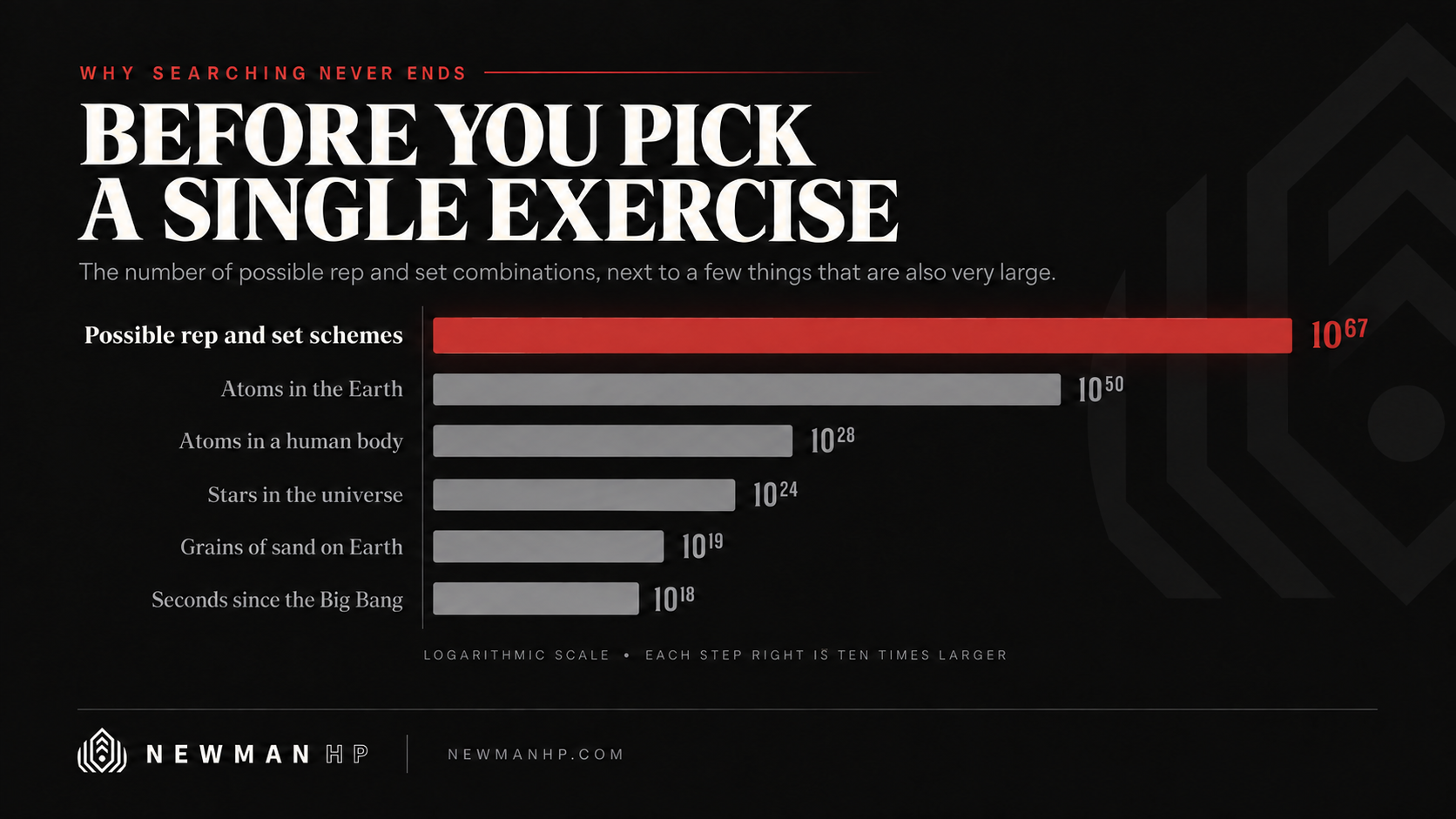
An entire industry lives inside that extremely large number. When the option space is infinite, novelty is free. There is always something that has never been tried, always a reason the last program was wrong and this one is right, and the supply never runs out because the math says it cannot.
You cannot search your way to the right program any more than you could read your way to the right grain of sand. You can only narrow the field by knowing which row and which column you belong in.
How the Revolving Door Works
Most athletes have lived this cycle without ever seeing the mechanism. It is worth seeing, because once you do, it stops working on you.
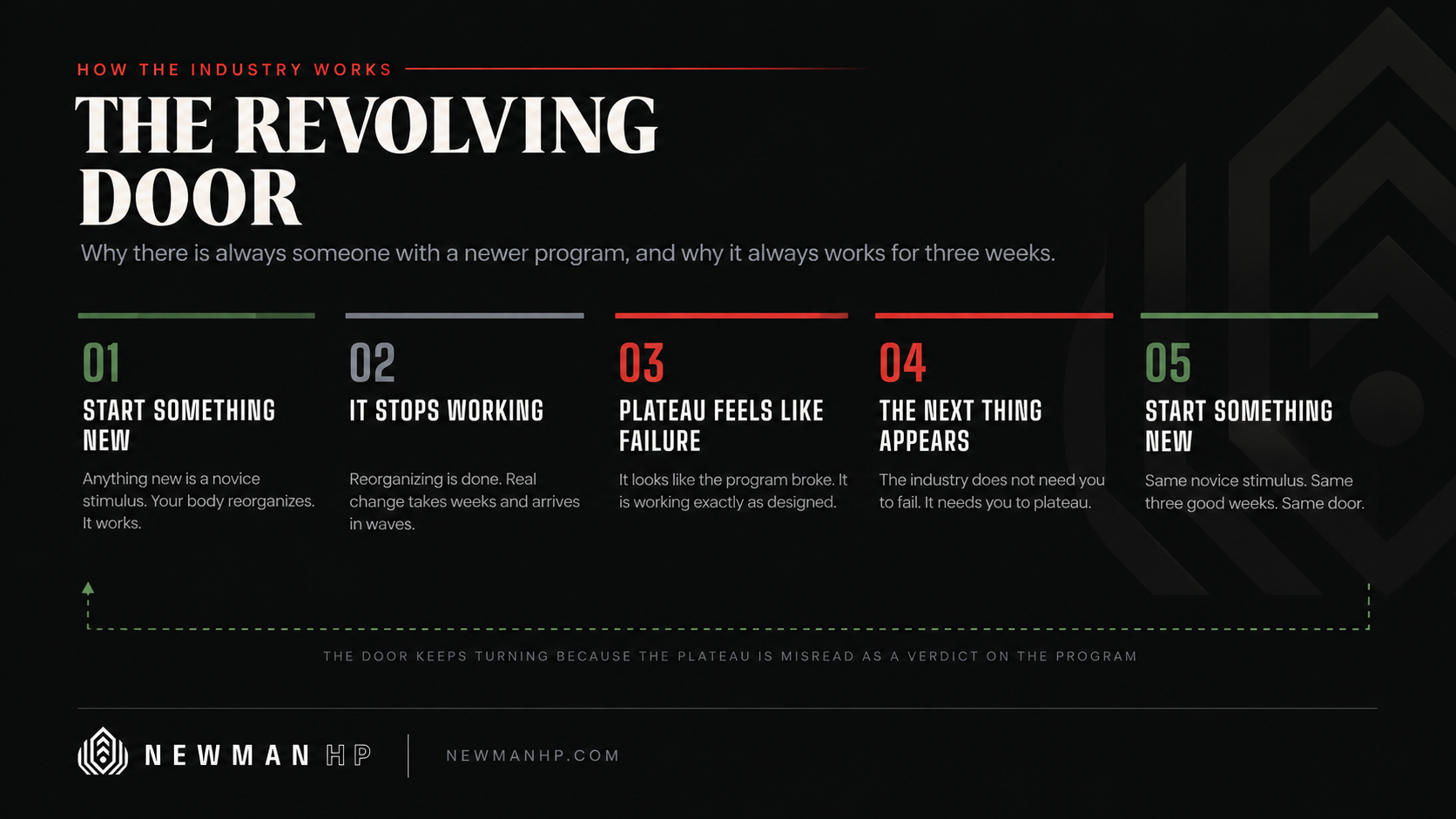
You start something new. If that program happens to give you a stimulus you actually need, the response can come quickly. An unfamiliar movement, loading pattern, or training demand gives your nervous system something new to organize around, and the numbers may jump before much has changed structurally. That early progress is real, but it is weak evidence. It tells you that you responded to something in the program. It does not tell you that the entire program is right for you.
Then the easy gains slow. The next adaptation may require changes in muscle, tendon, connective tissue, or work capacity. Those take longer, and they show up in waves. A slowdown does not automatically mean the program failed. It may simply mean the fast part of the adaptation is over and the slower part now has to be earned.
This is where the revolving door starts. A plateau feels like a verdict, and there is always another program to try. Sometimes the next program is the wrong stimulus and you get nothing. Sometimes it makes the problem worse. Sometimes you get lucky and it happens to line up with something you need, giving you another quick bump.
That occasional success is what makes the cycle convincing. If you change programs enough times, eventually one of those changes may work. It becomes easy to credit novelty itself when the real reason was that the new stimulus happened to match a current need.
The athletes who escape this cycle are not the ones who keep finding better programs. They are the ones who get better at interpreting what changed. A sustained plateau may mean a quality has moved into a different row. It may also be fatigue, poor recovery, a bad week, or a programming problem. The useful question is what changed, and what that quality needs now.
Question One: Where Are You?
Every quality you train sits in one of three rows. Your row has nothing to do with how good you are at your sport or how many years you have played it. It describes how that specific quality responds to training right now. And, as you will see, you are almost never in just one row.
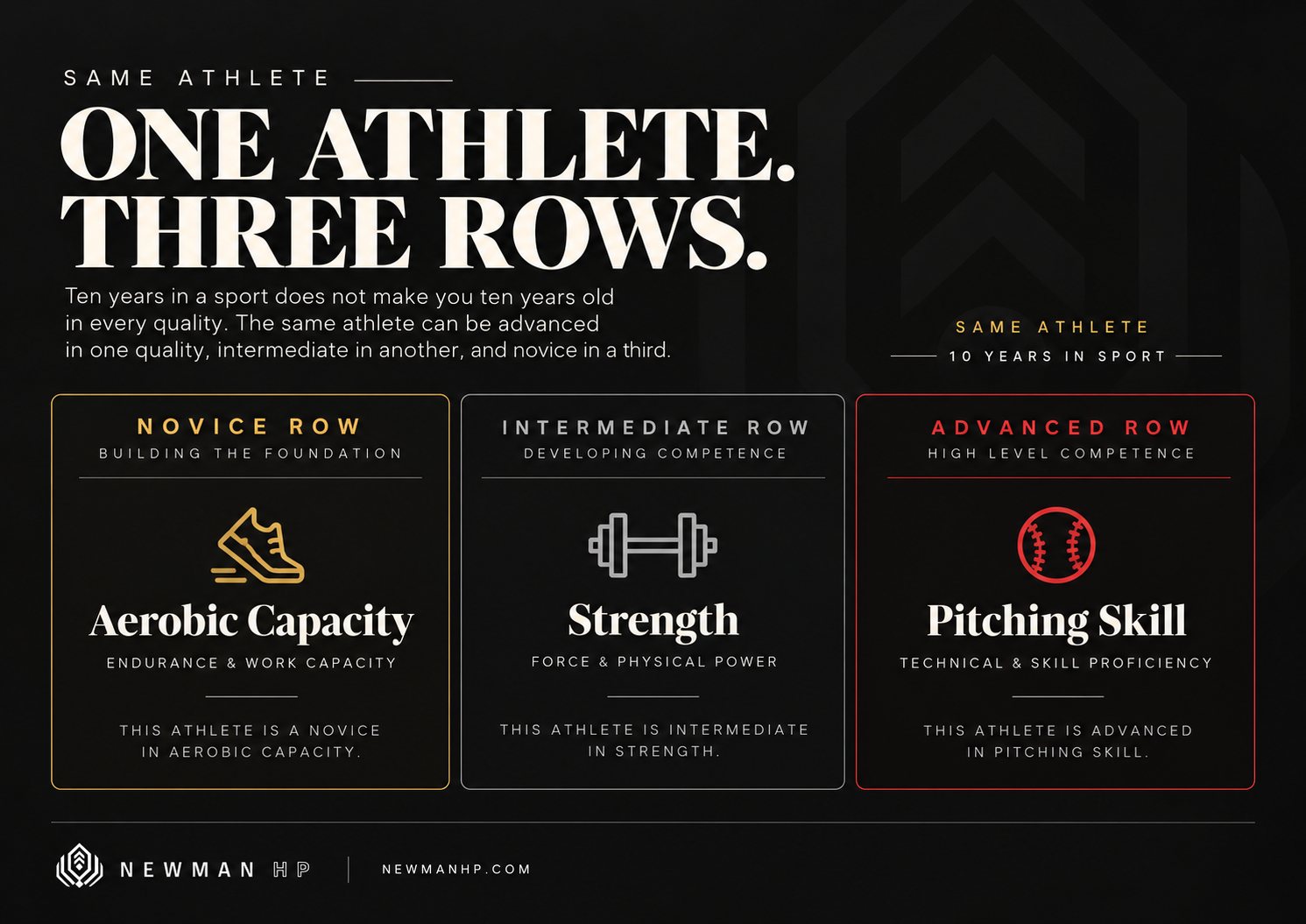
Every quality has its own curve. Ten years of pitching may have pushed skill close to its ceiling, strength somewhere in the middle, and aerobic capacity barely off the floor. Each one needs a different program.
Novice: You Are Learning to Use What You Have
Mark Rippetoe and the Starting Strength community popularized the term novice effect, and it holds up. When you are new to a movement, the first meaningful change is usually neural. Your nervous system learns to coordinate the muscle you already own. That is why strength can climb so fast at the start with very little change to your actual physiology.
This is the best return on investment you will ever get from training, and it is why simple linear programs work. Add weight. Repeat. Add weight. Repeat. Your body can absorb it because it has not yet been asked to change very much structurally. It is learning to organize what is already there. That stage cannot last forever because eventually you run out of easy organization.
You are a novice if adding weight every session still works, regardless of your age or how long you have played your sport. Plenty of college athletes are novices in the weight room.
Intermediate: You Are Running Into the Walls
At some point adding weight every session stops working. That is not a failure. Neural organization is mostly spent, and the next adaptation has to come from something real: muscle cross-section, tendon stiffness, connective tissue, work capacity. Those take weeks, and they do not show up on a perfect schedule. A program that cannot listen cannot tell the difference between a plateau and a bad week, and it will treat both the same way.
Programs like the Texas Method earned their reputation here for a specific reason. Monday you do the volume. Wednesday you back off. Friday functions as a measurement. It is the day you find out what the fibers you currently own can actually produce. If you have a flat week because something underneath needs time to settle, the following week automatically gets easier. The program regulates itself.
Put five athletes on it and their Friday numbers will land in five different places. Some have bigger genetic gains. Some sleep and eat like it matters, and their curve is cleaner. But two things are true for everyone: progress will not be linear, and it will not go on forever.
You are an intermediate if you have stopped making session-to-session gains but still improve when you look at a month at a time.
Advanced: Everything You Own Is Borrowed
The advanced athlete has pushed against the top of their genetics. Aerobic capacity is where it needs to be. Strength is where it needs to be. There are no glaring bilateral or unilateral deficits left to fix. You have spent years building a pyramid and you are standing on top of it.
Every quality up there is on borrowed time. Nothing you built is owned. It is leased, and the rent is stimulus. It has to be stimulated enough to keep, and not so much that it eats you. By now your sport itself is delivering a real training load, which means the weight room is no longer the only thing in the ledger.
This is where most athletes get hurt, and the reason is simple. The program that worked when you were intermediate keeps running. It produced results once. It feels productive. Without anyone auditing the total, stimulus quietly passes recovery. Nobody chose that. It happened because the program did not change when you did.
At this level the question is whether you can still do the thing in October, in February, and the year after that. Recovery is part of training because the adaptation actually happens there. Skip it and you have paid for the stimulus without collecting what it bought.
You are advanced in a quality if it is near your genetic ceiling, your sport is already placing a significant load on it, and your biggest risk is doing too much rather than too little.
You Are Not in Just One Row
Here is the part that most programs miss, and the reason a single search will never find your answer. Strength is one curve. Aerobic capacity is another. Speed, power, tissue tolerance in the shoulder, tissue tolerance in the knee, and the skill of your sport itself each operate as their own nested system with their own training age and their own position on the curve.
A ten-year athlete is not ten years old in everything.
Take an elite pitcher with a decade of experience. His pitching is fully developed. His delivery, his arm action, his tolerance for throwing volume, all of it sits near the ceiling and is on borrowed time. That is the advanced row, and it needs to be read and adjusted daily.
His lower-body strength has been trained for years but never pushed hard, so it lives in the intermediate row. His aerobic capacity, which nobody has ever asked him to build, is a genuine novice. A simple closed program, three conditioning sessions a week with a fixed progression through the offseason, may be exactly the right tool for that quality even though it would be the wrong tool for his arm.
That is why you check the matrix instead of simply choosing a program. One athlete can, and usually should, be running a closed system for one quality, an open system for another, and an individualized system for a third, all in the same week. Your row is simply the current position of each quality, and that position moves.
Question Two: What Does Your Program Run On?
Every program runs on one of three systems. The system determines how much information is allowed to change the plan.
Closed: The Plan Is Written Before You Start
A closed program says: for the next six weeks, this is what happens. Add five pounds a week. Alternate a heavy week and a light week. Seventy percent this week, seventy-three and a half next. It was built by the Soviets for a world where training was the athlete's entire life, and it is still the format of nearly every program you can download.
Closed systems are excellent for novices and early intermediates. The real work at that stage is showing up, eating, sleeping, and learning to move well, and the loads are nowhere near the edge of what your body can handle.
There is also a practical truth here. A closed program is easy to run, easy to schedule, and easy to follow. Sometimes that makes it the best available option.
Where it breaks is your actual life. A closed plan does not know you played two club games on the weekend or that you had a showcase on Thursday. When training is the only load you carry, closed works. When it is one load among five, the plan has no idea what happened to you this week.
One red flag worth knowing: if everyone on your team deloads the same week, and that week happens to be a holiday, the plan is following a calendar rather than anything that happened to the athletes.
Open: One Session Decides the Next
An open program has a feedback loop inside it. Something in the training itself, a top set, a rep max, a velocity target, decides what you lift next.
Go back to that Friday in the Texas Method. Everyone squats, but your load, your intensity, and the wall you hit are yours. That result sets up your Monday.
This is the natural fit once you are intermediate, and it changes how you judge whether a program is working. Strength does not arrive weekly. You might jump a level one week and then need two or three weeks of quality load before the next one shows. No single session tells you enough. The week or the block has to be measured against what it was supposed to accomplish.
The question at the end of each week becomes whether you achieved that week's task. Was it learning a new movement? Building single-leg control? Raw bilateral strength for the tendons and the brain? An open program gives you information you can use to answer that and adjust.
Individualized: Everything About Today Decides Today
The third system adds information from outside the weight room. What the force plate said this morning. What the ring said about last night. Where your heart rate variability has been trending. What you tell your coach at the rack. All of it answers one question: who is the athlete standing here today?
This is the highest level of training, and it is where most textbooks stop being useful, because the athletes who need it are rare and every one of them is different. Strength, tendon, sleep, stress at home, all of it runs on its own timeline.
In our textbook we call this the athlete composite, and we read it in 24-, 72-, and 168-hour windows. In this window, right now, is the biology responding?
There are athletes who cannot tolerate a session longer than thirty minutes but need to train every day. There are athletes who need one or two sessions a week to stay topped off. The only way to know which one you are is to be watched and to be asked.
The read does not require a lab. If a single jump shows you are cooked, you do not need a second jump and an isometric test to confirm it. You are done for the day. The moment a number crosses a threshold, something changes. That is the whole system.
The Nine Squares
Put the two questions together and you get nine possible combinations. This is the matrix we run every program through, and it is the one thing I would want any athlete to be able to draw from memory.
You run it once for each quality you are trying to develop, not once for yourself.
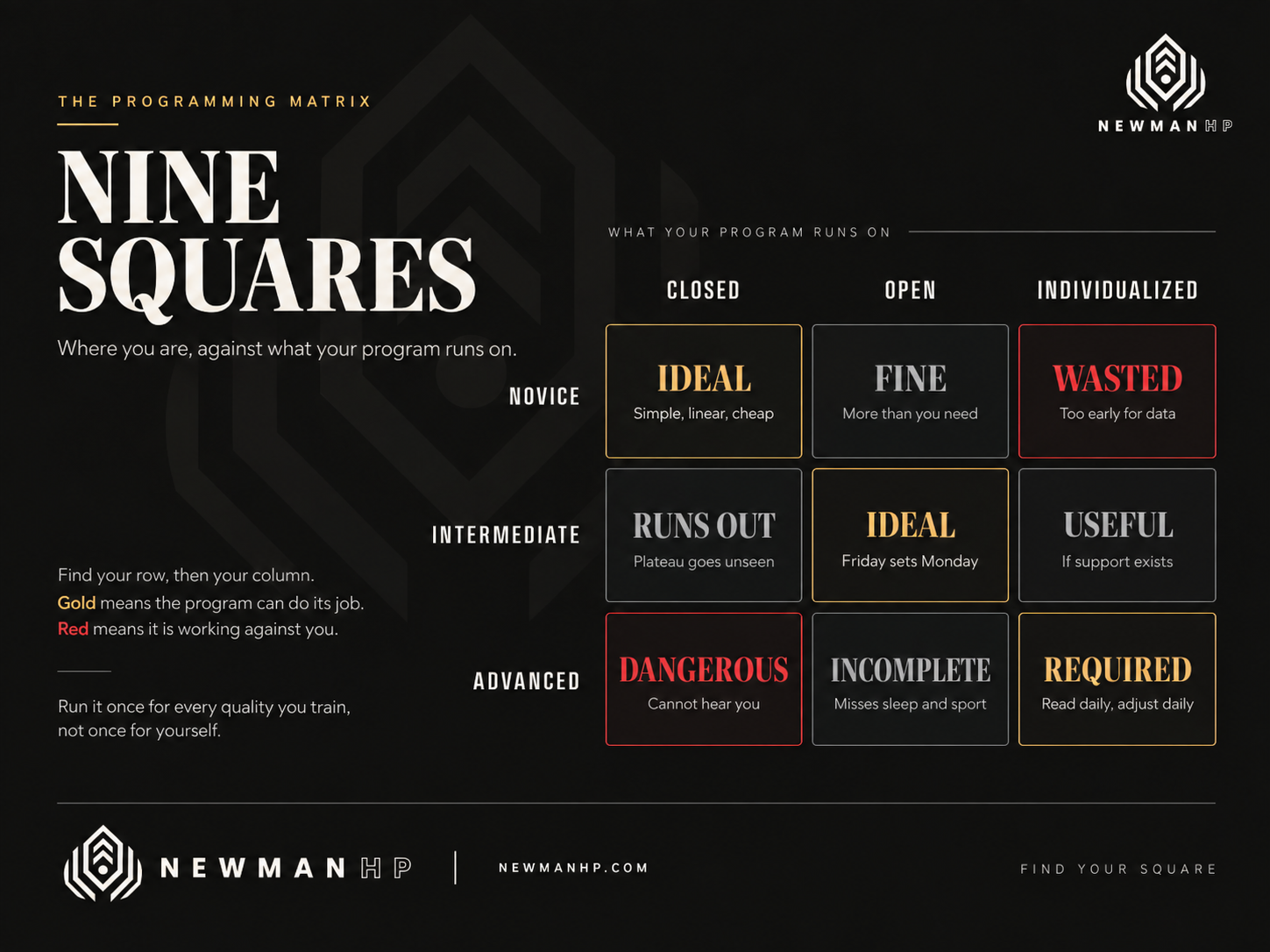
Find your row, then your column. The matrix shows where the program fits the athlete and where a mismatch starts to create problems.
The most expensive square on that grid is the bottom left: an advanced athlete on a closed program. That is where the season-ending injury lives, because the plan keeps talking to an athlete who needed it to listen.
The second most common mismatch is the top right, a first-year lifter buried in force plate data that cannot yet say anything the barbell isn't already saying.
If a quality is a novice on a closed plan, it is in the right place. Leave it there until it stops working. If a quality is intermediate and you are still adding weight to it every session on a fixed calendar, the plateau is coming and the plan will not see it. If a quality is advanced and nothing in your program responds to how you slept, what your sport did to you, or how you feel at the rack, you are carrying risk you do not need to carry.
Most athletes have all three situations at once, which is why a single downloaded program can be right for one part of you and wrong for the rest.
What Actually Gets You Hurt
One more thing about advanced athletes, because it changes what you should be looking for in a program.
Basketball players have long arms, unusual tendon architecture, and refined skill. What takes them out is not the jump. It is the landing. Accelerating requires concentric force, but staying on the floor requires the ability to decelerate, and the governor is the moment your muscles can no longer absorb the load and the passive structures take over. That is the ACL. It does not tear because you jumped. It tears on the way down. Male, female, it does not matter.
So most of what gets called injury prevention is really a deceleration question, and the argument over single-leg versus two-leg training misses it. The useful question is what the mechanism of failure would be. Are you simply weak? Do you lack tendon stiffness? Do you lack the neural adaptations that only come from lifting heavy? Or have you done the heavy lifting and never expressed it in this position, at this angle, at this speed?
Your structure is only as good as the next three degrees.
You do not get hurt on your best day. You get hurt on the day your program thought was a normal day. When you evaluate a program, ask what it thinks would break you, and whether it is doing anything about that.
What You Can Do
If your program and your body are out of alignment, which happens constantly on teams that are understaffed or under-resourced, it falls on you to close the gap. A few things help:
Know your row for each quality. Strength, conditioning, speed, and your sport skill are separate curves. Be honest about which are still climbing every session, which move month to month, and which are near the ceiling.
Know your column. Ask what, if anything, in your program changes based on how you performed last session or how you feel today. If the answer is nothing, you are on a closed plan.
Judge the week, not the workout. Ask what this week was supposed to accomplish and whether it did.
Ask what would break. A program that cannot name your likely mechanism of failure is not protecting you from it.
Do not take the season off. Everything at the top is on borrowed time from stimulus. A runner builds mileage for months before a marathon. A pitcher builds density in the tissue and stability in the joint the same way. Stopping for a summer is not rest. It is a bet you can win once or twice.
The athletes who reach the top understand a simple arithmetic. What you do today determines what you earn tomorrow. Every rep is a dollar. Every recovery session is a dollar. Every meal is a dollar.
The question we put to players is short: how much are you willing to leave on the table? Are you gambling with your career, or investing in it?
Bottom Line
All the noise reduces to two questions. Are you a novice, an intermediate, or an advanced athlete in the quality you are trying to train? And does your program run on a closed system, an open one, or one that is open and individualized?
An open system listens to itself through last session's numbers. An individualized system also listens to everything around the training: sleep, force plate, heart rate, schedule, sport load, and the conversation at the rack.
Everything a good program does is an attempt to get a clearer picture of who you are today and apply the stimulus that picture calls for. The better the match between the athlete, the quality being trained, and the system running the program, the better the chance that the work actually produces what it was intended to produce.
Frequently Asked Questions
How do I know which row I am in?
Ask it for each quality separately. If adding weight or volume every session still works, that quality is a novice. If session-to-session gains have stopped but it improves month over month, it is intermediate. If it is near your ceiling, your sport already loads it heavily, and the main risk is overdoing it, it is advanced.
Training age in that specific quality matters far more than years in your sport or your chronological age.
Can I be in more than one row at once?
Almost everyone is. Every quality you train has its own training age. An experienced athlete is often advanced in sport skill, intermediate in strength, and a novice in conditioning or a movement pattern they have never trained.
Each of those qualities should be matched to its own system. A closed program can be exactly right for the novice quality and dangerous for the advanced one in the same week.
Is a downloaded template a bad program?
Not necessarily. Most templates are closed systems, and closed systems are the right choice for novices and early intermediates. The template becomes a problem when you have outgrown it and nothing in it can notice that.
What is the simplest open program?
Any program where one session determines the next. The Texas Method is the classic example: a weekly top set on Friday sets the following week's loads. A top set that governs your back-off sets, or a velocity target, does the same job inside a single session.
Do I need a force plate or a wearable?
Only if you are advanced. For a novice or intermediate, that data cannot yet tell you anything the barbell is not already saying. For an advanced athlete, some version of an outside read on sleep, readiness, and output is close to mandatory, but it can be as simple as one jump and an honest conversation.
How do I know if my program is working?
Judge the week, not the workout. Strength arrives in waves, so a single session tells you very little. Ask what this week was supposed to accomplish, whether it was a new movement, unilateral control, endurance, or raw strength, and whether that happened.
Why does everyone on my team deload the same week?
Usually because of the calendar. That is not automatically wrong, but it means the plan is following a schedule rather than your body. In an open or individualized system, athletes deload when their own numbers call for it, which is rarely the same week.
What should I ask a coach before starting a program?
Three questions cover most of it. What in this program changes based on how I performed last time? What in it changes based on how I slept or feel today? And what does this program think is most likely to injure me, and what is it doing about that?
Can I stop lifting during my season?
You can, but you are betting. Every quality you have built is maintained by stimulus, and tendon density and joint stability fade when the stimulus goes away. Reduce the volume in season. Do not remove it.
About the Author
Thomas Newman is the Founder and Chief Performance Officer of Newman Performance Systems, Newman HP, a concierge high performance organization serving professional athletes across MLB and the NFL, collegiate programs, and high performing executives.
He spent five years at Yale University as Director of Student Performance and Innovation, overseeing more than 800 student-athletes across 29 varsity teams and contributing to a National Championship in men's lacrosse and back-to-back Ivy League titles in football. He previously served as Chief Innovation Officer at Hawkin Dynamics and as a Lead Performance Specialist at Mass General Brigham's Center for Sports Performance and Research.
He is a co-author of the Human Kinetics textbook Player Development: An Applied Sport Science Roadmap for Optimizing Performance Success (Kraemer, Ratamess, Newman, 2024), a peer-reviewed researcher, and an NSCA Certified Strength and Conditioning Specialist since 2007. His work currently protects more than $151 million in active client career earnings.
To learn more about Newman HP, or to use the free Coach's Toolbox including the Peak Power Calculator, visit newmanhp.com. For inquiries about working with Thomas directly, reach him at tom@newmanhp.com.
Newman HP is committed to bringing evidence-based, practitioner-informed content to coaches, athletes, and performance professionals.