
How to Measure Hydration and Build a Plan Around the Athlete
Hydration is one of the most basic pieces of human performance, but it is often handled with remarkably little precision. Athletes are told to drink more water, carry a bottle, or make sure their urine is clear. Those habits can help, but they do not tell us how much fluid an athlete loses during training, how quickly that fluid is lost, how much sodium leaves with it, or how much still needs to be replaced afterward.
Those numbers matter because relatively small changes in body water can affect performance. The National Strength and Conditioning Association (NSCA) identifies a loss of approximately 2% of body weight through water loss as enough to reduce exercise performance and recommends preventing losses greater than 2% during activity. Research examining muscular performance has also reported reductions of approximately 2% in strength, 3% in power, and 10% in high-intensity endurance when athletes are hypohydrated.
The useful questions are measurable. How much does this athlete lose during a session? How quickly are they losing it? How much are they replacing while training? What is left to replace when the session is over? Repeating those measurements across different environments and workloads can turn hydration from a general recommendation into an individual plan.
Start With a Baseline
Hydration needs vary between athletes and can also change for the same athlete depending on the environment, workload, equipment, and duration of activity, which is why the most useful measurements come from the athlete’s own training and competition. However, before the session begins, a quick urine check can provide some context for whether the athlete appears to be starting adequately hydrated. Generally, very dark urine may indicate that more fluid is needed, while lighter urine is more consistent with better hydration. It is a simple screening tool rather than the primary measurement in this process.
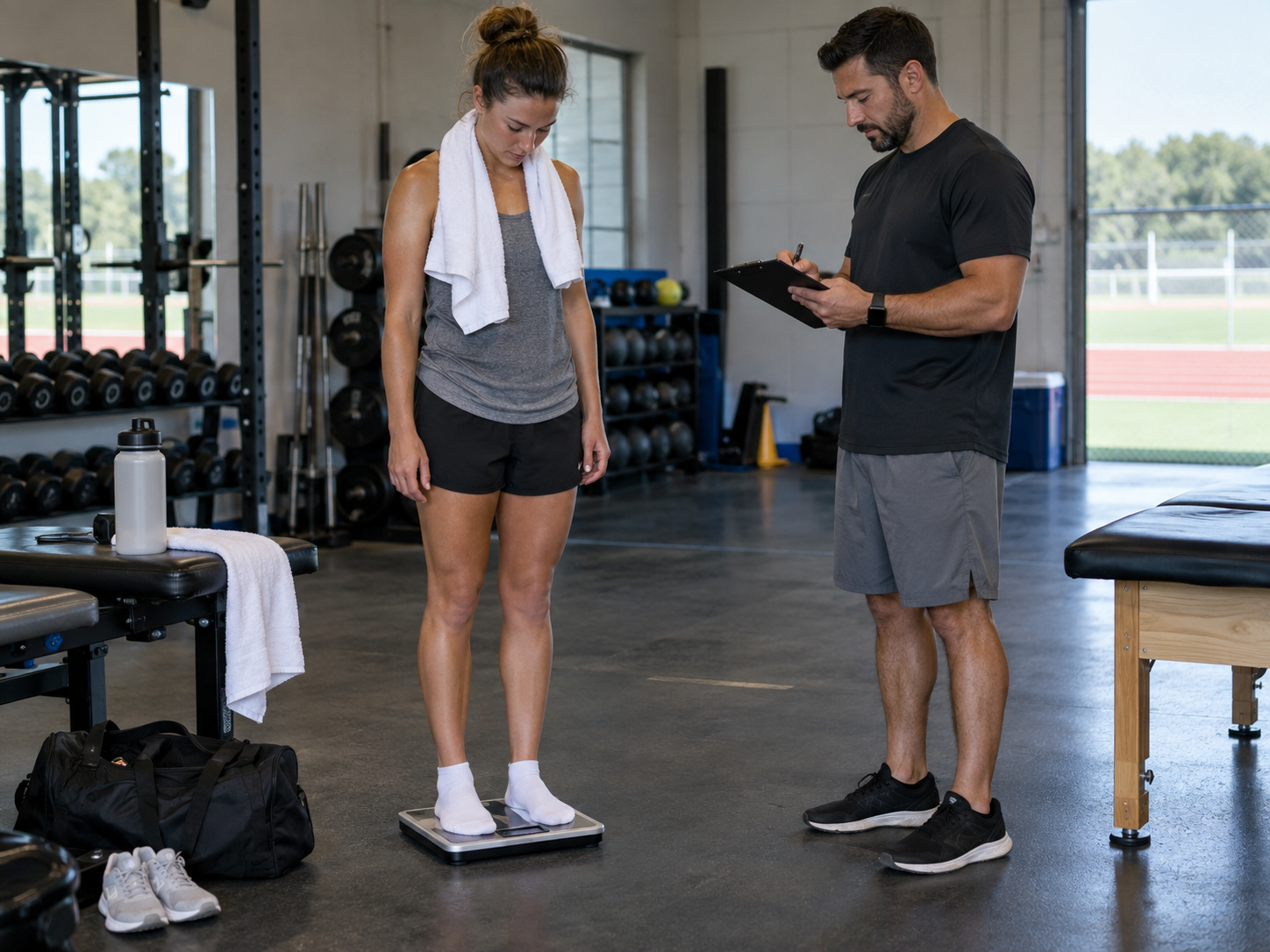
Body weight is where the assessment becomes much more useful. Weighing the athlete immediately before training or competition establishes the starting point for that session, while weighing them again immediately afterward shows how much body mass changed during the activity. That change becomes especially valuable when we also know how much the athlete drank during the session. Together, those numbers allow us to estimate how much fluid the athlete lost through sweating, calculate an approximate sweat rate, and determine how much fluid still needs to be replaced afterward.
Estimate fluid Loss During Training
A practical fluid-loss assessment requires a scale, the duration of the session, and a record of how much the athlete drinks. If the athlete urinates during the session, that amount should also be recorded. NATA uses the following calculation:
Estimated sweat loss = body mass lost + fluid consumed − urine produced
The first step is estimating total sweat loss from that session. The equation is especially simple when the athlete does not urinate during training or competition. I have personally never measured, and do not plan on starting to measure, the liquid volume of urine during a workout. Also, I do not have any creative recommendations for making that part of the process more enjoyable, but it is still important to acknowledge its place in the equation. The fluid consumed during training is added because the change in body weight only shows the athlete’s remaining fluid deficit. Drinking during practice does not increase sweat loss. It replaces some of the fluid being lost, so the scale alone will underestimate how much the athlete actually sweat.
NATA performs this calculation using kilograms and liters, with approximately 1 kilogram of acute body-mass loss treated as 1 liter of fluid. Consider a 200-pound athlete who weighs 197 pounds after a two-hour practice. The athlete finishes three pounds lighter, which is approximately 1.36 kilograms, or about 1.36 liters of remaining fluid loss. If the athlete also drank 32 ounces during practice and did not urinate, those 32 ounces, or approximately 0.95 liters, have to be added back because they replaced some of the fluid lost before the final weigh-in.
The estimated sweat loss is:
1.36 L + 0.95 L = approximately 2.31 L
Once total sweat loss is estimated, that number can be divided by the duration of the session to calculate an approximate sweat rate:
Sweat rate = estimated sweat loss ÷ exercise duration
In this example:
2.31 L ÷ 2 hours = approximately 1.16 L per hour
For me, being an American, the following is much easier to visualize. One liter is almost 35 ounces, so 1.18 liters per hour comes out to almost 40 ounces per hour. The estimate gets a little less precise when we round the conversions like this, but it makes the number much easier to use in practice.
For this athlete, we can now expect roughly 40 ounces of fluid loss per hour during a similar session. Knowing the expected loss tells us how much fluid should be available during the session and how much may still need to be replaced afterward. Sweat rate should be tracked repeatedly and can be especially useful within a team setting. It can help identify which athletes consistently lose fluid at a faster rate and are therefore likely to require greater fluid availability during training or competition.
Electrolytes and Sweat Testing
Sweat contains several electrolytes, but sodium is lost in the greatest quantity and is the primary electrolyte to consider when replacing sweat losses. Sodium losses vary between athletes, so two athletes with similar sweat rates may still have different electrolyte needs.
For exercise lasting longer than approximately 60 to 90 minutes, the NSCA recommends 3 to 8 ounces of a 6% to 8% carbohydrate-electrolyte beverage every 10 to 20 minutes. The carbohydrate can help maintain blood glucose during prolonged exercise, while sodium helps replace losses and retain fluid. Shorter sessions with limited sweating may require little deliberate electrolyte replacement, while longer, hotter, or higher-sweat sessions may require more.
Sweat testing can make that strategy more precise. The Gatorade Gx Sweat Patch is one accessible option that estimates sweat rate and sodium loss during exercise. More advanced testing can provide additional information about sweat composition, but the goal is the same: combine the athlete’s fluid losses with information about sodium loss to better individualize the plan.
Replacing What Was Lost
Sweat rate tells us how quickly an athlete tends to lose fluid, while the change in body weight from before to after training tells us how much of that loss still needs to be replaced. Returning to the previous example, the athlete had an estimated sweat rate of approximately 1.16 liters, or 39 ounces, per hour but still finished practice three pounds below starting weight.
The NSCA recommends consuming approximately 150% of the body weight lost when normal hydration needs to be restored within six hours after exercise. Practically, that works out to approximately 20 to 24 ounces of fluid for every pound lost:
Recovery fluid target = pounds of body weight lost × 20 to 24 oz
For an athlete who finishes three pounds lighter:
3 lb × 20 oz = 60 oz
3 lb × 24 oz = 72 oz
That gives the athlete a recovery target of approximately 60 to 72 ounces of fluid. The target is greater than a one-for-one replacement because some of the fluid consumed afterward will be lost through urine. Including sodium in the recovery beverage or meal can also help retain fluid while replacing sodium lost through sweat.
This matters even more when recovery time is short or environmental conditions are demanding. Dehydration increases cardiovascular strain and can make thermoregulation more difficult, particularly in the heat. Pre- and post-training body weights, sweat rate, fluid intake, environmental conditions, and, when available, sodium-loss data give the athlete and performance staff enough information to build a practical hydration strategy for the next similar session.
FAQ
How much body weight can an athlete lose during exercise?
The NSCA recommends preventing dehydration greater than approximately 2% of body weight during exercise because performance can begin to decline around that level. For a 200-pound athlete, 2% represents approximately four pounds of body-weight loss.
How do I calculate my sweat rate?
Measure body weight immediately before and after exercise, track all fluid consumed, account for urine produced if applicable, and calculate:
Estimated sweat loss = body mass lost + fluid consumed − urine produced
Then divide estimated sweat loss by the duration of the session. Repeating the test in different environments and during different types of training gives a better picture of individual needs.
How much should an athlete drink after training?
Recommendations commonly fall around 1.25 to 1.5 liters of fluid for every kilogram of body mass lost. In pounds and ounces, a practical target is approximately 20 to 24 ounces of fluid for every pound of body weight lost.
Is urine color a good way to check hydration?
Urine color can be a useful low-cost screening tool, particularly when the first morning urine sample is assessed consistently. Diet, supplements, medications, and recent fluid intake can influence urine color, so it is more useful when considered alongside body weight and other information rather than used by itself.
Do athletes always need electrolytes?
No. The need becomes more important as exercise duration, sweat losses, heat exposure, and sodium losses increase. A short session with minimal sweating may require little deliberate electrolyte replacement, while prolonged exercise in the heat may require a more structured strategy.
Is thirst enough?
For shorter sessions with relatively low sweat losses, drinking according to thirst may be adequate. During longer, hotter, or higher-sweat sessions, thirst does not tell the athlete how much fluid or sodium is being lost. NATA reports that when people have free access to fluid and drink voluntarily during activity, they tend to replace roughly two-thirds of their sweat losses. Measuring sweat rate provides additional information when performance and recovery are priorities.
Can you drink too much water?
Yes. Excessive fluid intake can cause an athlete to gain body weight during exercise and can dilute blood sodium enough to contribute to exercise-associated hyponatremia. Athletes who begin exercise adequately hydrated generally should not gain body weight during activity from fluid consumption. The goal is to replace what the athlete needs without consuming fluid substantially beyond those losses.
References
McDermott, B. P., Anderson, S. A., Armstrong, L. E., Casa, D. J., Cheuvront, S. N., Cooper, L., Kenney, W. L., O’Connor, F. G., & Roberts, W. O. National Athletic Trainers’ Association Position Statement: Fluid Replacement for the Physically Active. Journal of Athletic Training. 2017;52(9):877-895.
Judelson, D. A., Maresh, C. M., Anderson, J. M., Armstrong, L. E., Casa, D. J., Kraemer, W. J., & Volek, J. S. Hydration and muscular performance: Does fluid balance affect strength, power and high-intensity endurance? Sports Medicine. 2007;37(10):907-921.
McCartney, D., Desbrow, B., & Irwin, C. The Effect of Fluid Intake Following Dehydration on Subsequent Athletic and Cognitive Performance: A Systematic Review and Meta-analysis. Sports Medicine Open. 2017;3:13.
National Strength and Conditioning Association. Hydration and Performance. Kinetic Select. 2019. https://www.nsca.com/education/articles/kinetic-select/hydration-and-performance/
