
Every Change of Direction Starts With a Brake
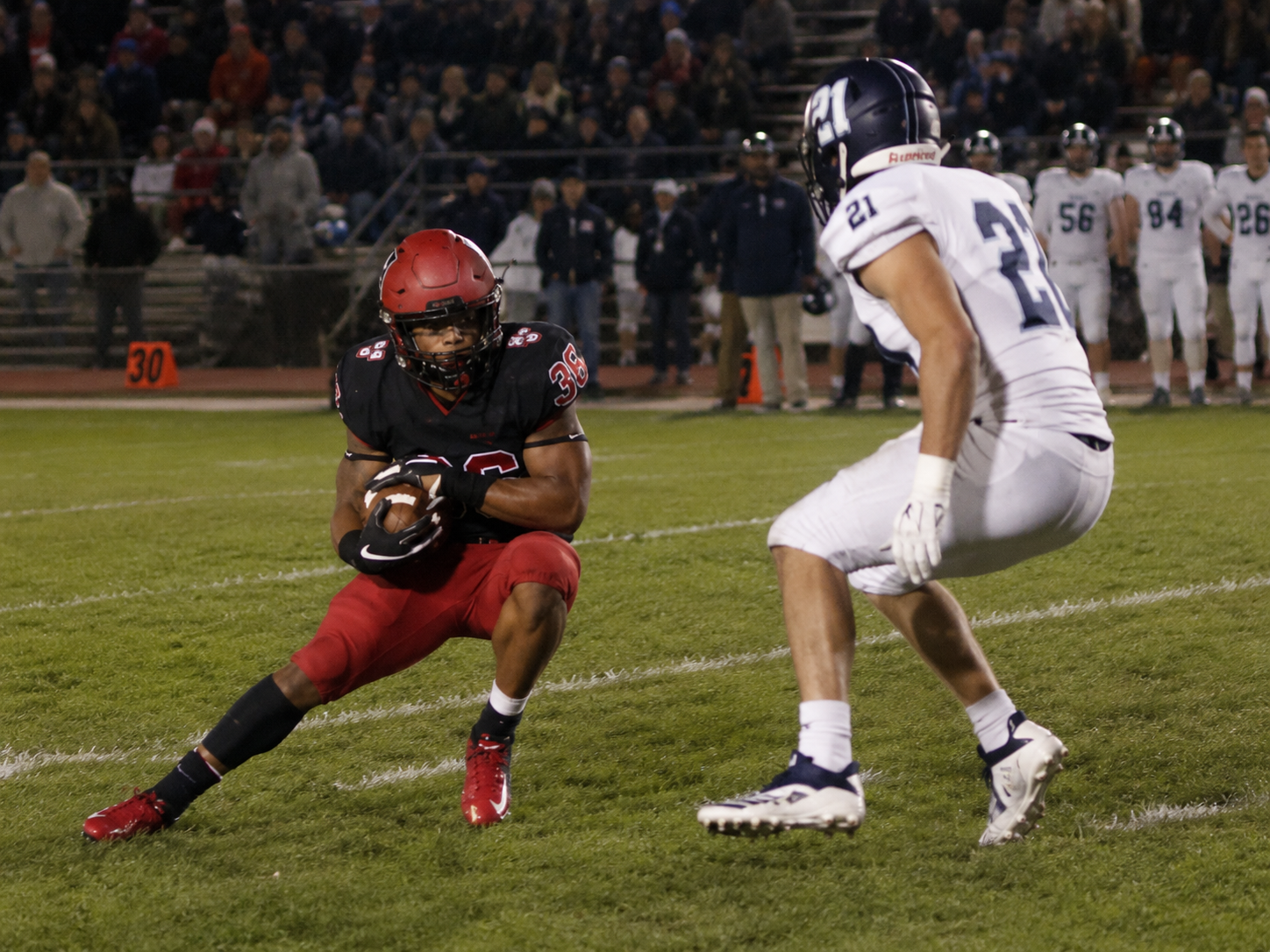
Watch a running back hit a defender with a great juke, or pull up a compilation of the best jukes ever, and almost every highlight has the same thing in common: a change of direction. He plants, cuts, and suddenly the defender is going one way while he is accelerating somewhere else. But before an athlete can redirect momentum, they first have to control it.
Picture an athlete sprinting to the left and then reversing back to the right. At some point, their velocity in the original direction has to be removed. In a complete 180-degree change of direction, that velocity reaches zero before the athlete begins accelerating the other way. In shallower cuts, the athlete may preserve more speed, but braking still plays an important role in organizing the redirect. That is the idea behind this entire article: every change of direction starts with a brake.
The Faster You Arrive, the Better the Brakes Have to Be
The physics are simple. Momentum is the product of mass and velocity, so if either one increases, there is more momentum that has to be controlled. Kinetic energy increases even faster as speed increases because velocity is squared in the equation. That means a 200-pound athlete moving at a high speed has a very different braking problem than the same athlete moving at half that speed.
The amount of force required depends on how quickly and over what distance the athlete needs to slow down, but the coaching implication is straightforward. Higher approach velocities create greater braking demands because the athlete has more momentum to control before redirecting. Faster change-of-direction performers also tend to combine higher approach and exit velocities with greater braking and propulsive forces, which shows that being good at changing direction is not simply about slowing down. It is about controlling speed and then producing force in a new direction. You can see the importance of both qualities in the way NFL prospects are tested. The 40-yard dash measures straight-line speed, while the 20-yard shuttle and three-cone drill require athletes to slow down, redirect, and accelerate again. Straight-line speed matters, but football also repeatedly asks players to control that speed and send it somewhere else.
Braking Is a Strength Quality
When the body has to slow down rapidly, the muscular system has to absorb force. Eccentric strength is an obvious part of that equation because the quadriceps, hamstrings, glutes, calves, and other structures of the lower body are being asked to control large forces while the athlete reduces momentum.
A 2022 review found that the initial braking steps of a maximal deceleration can expose an athlete to ground-reaction forces up to about 2.7 times greater than the corresponding early steps of maximal acceleration. The authors identified eccentric strength as an important component of braking ability while also emphasizing concentric, isometric, and reactive strength, along with coordination and braking technique.
All elements of that combination matter because poor deceleration is not always caused by one thing. Think about the tall, skinny young athlete who can actually run pretty well in a straight line but looks completely different when asked to stop and restart. Sometimes coordination is part of the limitation. Sometimes positioning is part of it. Very often, strength is part of it too. The athlete has to possess enough physical capacity to deal with the forces that high-speed movement creates.
Build the Strength, Then Make It Usable
This connects directly to a framework we have written about before at Newman HP: Schaefer's Law. The first checkpoint in Schaefer's Law is building bilateral strength. For the male strength and power athletes where we commonly apply the model, we use roughly a 2X bodyweight back squat as an important benchmark.
Research supports a strong relationship between relative lower-body strength and athletic qualities including sprinting, jumping, and change-of-direction performance, although no single strength number should be interpreted as a universal biological cutoff. The value of the standard is that it gives us a practical way to judge whether an athlete has built a meaningful strength foundation before expecting that athlete to express high levels of force in faster and more specific environments.
The second Schaefer's Law checkpoint is just as important. Can the athlete move a load equal to their bodyweight at roughly one meter per second during the concentric phase of the squat? There is an important difference between possessing strength and being able to express meaningful force quickly. The first checkpoint builds the force-producing foundation. The second gives us an indication that the strength the athlete has developed is becoming more usable at higher velocities.
The third piece of Schaefer's Law is the specific expression of those qualities. That may include jumps, Olympic lift variations, eccentric work, unilateral training, exercises that challenge force absorption and redirection, and field work that exposes the athlete to the actual demands of their sport. None of those things have to be completely absent earlier in an athlete's development. The difference is where the training emphasis belongs. First, build enough force-producing capacity. Then, make sure the athlete can express that force quickly. Once those checkpoints are established, more of the emphasis can shift toward the specific qualities the athlete needs, which in this case may mean absorbing force, decelerating at higher speeds, and redirecting that force into the next movement.
Learn to Stop Before You Learn to Cut
On the field, one of the simplest ways to progress deceleration is to increase the speed the athlete has to control. A coach might start with a five-yard acceleration into a stop, then progress to ten yards and fifteen yards. The longer approach gives the athlete more time to accelerate, which means they enter the stop at a higher velocity and have more momentum to control. In research discussed by Young et al. (2018), Australian football players starting from a standstill needed an average of 26.6 meters, or about 29 yards, to reach 97.5% of maximum speed. Harper et al. (2026) showed the same relationship in sprint-to-stop testing, with deceleration distance increasing as approach distances progressed from 5 to 10 to 15 to 20 meters. That gives us a simple way to increase the braking demand without immediately making the drill more complicated.
Once the athlete can control higher entry velocities, the task can start to include redirection, different cutting angles, reacceleration, and eventually reactive situations that look more like sport. None of that happens in isolation. The athlete is still developing the strength, eccentric capacity, coordination, reactive strength, and force-expression qualities that support good braking, while the field work gives those qualities a place to be expressed at higher speeds. Eventually, what looks like a great juke is not just quick feet. It is an athlete carrying speed, controlling it, redirecting it, and getting moving again.
The Highlight Is Built on the Brake
Watch the best change-of-direction athletes in football, basketball, lacrosse, or any multidirectional sport and their ability to stop is part of what makes their acceleration look so impressive. They can enter situations at high speeds because they have the physical capacity to control those speeds, organize their body, and redirect force into the next movement.
Research consistently identifies higher approach velocity, greater braking force, effective braking impulse, and strong propulsive forces as characteristics associated with faster change-of-direction performance. That does not mean strength alone creates a great cutter. Coordination matters. Skill matters. Footwork matters. Perception and decision-making matter as well. But when an athlete is moving quickly and has to change direction aggressively, there is still a substantial force problem underneath the skill. The athlete has to absorb force and then redirect it. That is very different from simply trying to move the feet faster.
Braking Influences Both Performance and Injury Risk
Performance is the main point, but braking also deserves attention because high-force deceleration places significant stress on more than just the joints. Cutting, rapid stopping, and landing are common situations in noncontact lower-extremity injuries, including ACL injuries, but they also place large demands on the muscle-tendon system. The hamstrings, adductors, calves, Achilles tendon, and other soft tissues all have to help absorb and control force as the athlete slows down. A 2026 systematic review and meta-analysis of video-verified ACL injuries identified cutting, decelerating, and landing among the primary movement contexts associated with noncontact ACL injury, which reinforces how demanding these braking moments can be.
To be clear, better deceleration training doesn’t eliminate injury. Injury is far more complicated than that, and no single physical quality can make an athlete injury-proof. It does mean that the ability to tolerate and organize high braking forces is a physical quality worth preparing for because sport is going to expose athletes to those forces whether we specifically prepare them for them or not.
Better Brakes Expand What an Athlete Can Do
Acceleration gets an athlete moving, and maximum velocity determines how much speed they can create, but games repeatedly ask athletes to control that speed, remove momentum, and redirect it somewhere else. As athletes become faster and more powerful, their ability to manage those forces becomes increasingly important. That is why deceleration deserves to be viewed as its own physical quality rather than something that simply happens during a change-of-direction drill. The better an athlete becomes at controlling momentum, the more options they have when the game asks them to stop, cut, redirect, and accelerate again.Every change of direction starts with a brake.
Frequently Asked Questions
What physical quality matters most for deceleration?
There is no single quality that determines deceleration ability, but eccentric strength is a major component because athletes must absorb force while slowing down. Relative strength, isometric and reactive strength, coordination, positioning, and braking technique also contribute.
Does a 2X bodyweight squat guarantee great change of direction?
No. At Newman HP, it is a developmental checkpoint, not a guarantee. Research supports the importance of relative strength, but change of direction also depends on how quickly force can be expressed, braking skill, coordination, approach velocity, body position, and sport-specific experience.
Should athletes practice deceleration separately from change of direction?
They can. A simple progression is to teach controlled stops from lower approach speeds, progressively increase the distance and velocity preceding the stop, and eventually add reacceleration and directional changes.
Do speed ladders improve cutting ability?
They can provide coordination and footwork exposure, but quick foot contacts alone do not recreate the braking forces involved when an athlete enters a cut at high speed. High-speed change of direction requires the physical capacity to absorb and redirect momentum.
How can deceleration be tested?
Simple acceleration-to-stop protocols can assess how quickly and over what distance an athlete controls momentum. More advanced testing can examine entry velocity, deceleration distance, deceleration time, braking steps, and instantaneous velocity with radar, laser, video, or other technologies.
References
Singh U, Leicht AS, Connor JD, Brice SM, Alves A, Doma K. Biomechanical Determinants of Change of Direction Performance: A Systematic Review. Sports Medicine. 2025;55:2207-2224. doi:10.1007/s40279-025-02278-3.
Dos'Santos T, Thomas C, Comfort P, Jones PA. The Effect of Angle and Velocity on Change of Direction Biomechanics: An Angle-Velocity Trade-Off. Sports Medicine. 2018;48:2235-2253.
Harper DJ, McBurnie AJ, Dos'Santos T, et al. Biomechanical and Neuromuscular Performance Requirements of Horizontal Deceleration: A Review with Implications for Random Intermittent Multi-Directional Sports. Sports Medicine. 2022;52:2321-2354. doi:10.1007/s40279-022-01693-0.
Suchomel TJ, Nimphius S, Stone MH. The Importance of Muscular Strength in Athletic Performance. Sports Medicine. 2016;46:1419-1449. doi:10.1007/s40279-016-0486-0.
Harper DJ, Philipp NM, Eriksrud O, Jones PA, Graham-Smith P, Dos'Santos T. Assessing Deceleration Performance: Methodological and Practical Considerations. Sports Medicine. 2026;56:1-22. doi:10.1007/s40279-025-02339-7.
Young WB, Duthie GM, James LP, Talpey SW, Benton DT, Kilfoyle A. Gradual vs. Maximal Acceleration: Their Influence on the Prescription of Maximal Speed Sprinting in Team Sport Athletes. Sports. 2018;6(3):66. doi:10.3390/sports6030066.
Situations Leading to Anterior Cruciate Ligament Injury in Sports: A Systematic Review with Meta-analysis. Sports Medicine. 2026.
Liu R, Liu J, Clarke CV, An R. Effect of Eccentric Overload Training on Change of Direction Speed Performance: A Systematic Review and Meta-analysis. Journal of Sports Sciences. 2020;38(22):2579-2587. doi:10.1080/02640414.2020.1794247.
Newman HP. Schaefer's Law: Ten Years Later. 2026.
