
What is a High Performance Director?
We give every Newman HP athlete one rule: if you’ve been thinking about a problem for more than five minutes, bring it to us. It might involve training, recovery, food, travel, or something at home. You don’t have to figure out whose job it is first. We can help work that out.
That rule is the clearest way to explain what a high performance director does. An athlete can be surrounded by experts and still lack someone responsible for connecting their work. Each professional may understand a different part of the athlete’s situation, while questions that cross departments remain unresolved.
Who Owns What? Who’s Connecting the Dots?
Consider the information a serious athlete might accumulate over a season:
Force plate and jump testing.
Training logs.
Blood work.
DEXA scans for body composition and bone density.
Conditioning and aerobic tests.
Medical notes, rehabilitation records, and imaging.
Pitching, swing, or other sport-specific biomechanics data.
Wearable data, including HRV, resting heart rate, and sleep estimates.
For each category, an athlete or staff member may be able to say, “I can get it,” “I can’t get it,” or “I’m not sure it exists.” Working through those answers helps establish what information is available, who is responsible for it, and whether it has informed a decision.
A test can be completed in one department without reaching another person who could use the findings. Records may be available but difficult to locate, or collected repeatedly without a clear plan for reviewing them. Medical information also requires appropriate consent and access controls, so connecting the information does not mean distributing every record to everyone.
The director’s responsibility includes understanding what exists, what is relevant, and how the appropriate people can use it. Collecting more data is only useful when it helps answer a question or guide an action.
Who Does the Job When There’s No Director?
The responsibilities of a high performance director don't disappear when a program doesn't have one. They fall to different people depending on the level of competition.
In youth and travel sports, coaches often take on responsibilities outside their expertise, including designing strength and conditioning programs, managing recovery, and providing nutrition advice. Without qualified professionals, athletes risk receiving inappropriate or ineffective guidance.
At the collegiate level, programs may have qualified strength coaches, athletic trainers, physicians, and other specialists. However, coordinating their work often falls to the head coach, who is already responsible for recruiting, competition, and managing the team. Medical decisions remain the independent responsibility of qualified healthcare providers, as emphasized by NCAA guidance on independent medical care.
In professional sports, athletes often coordinate their own support teams outside their organizations. They may work with several independent specialists but become responsible for managing communication, scheduling, and conflicting recommendations.
Across all three levels, gaps in qualified personnel are common. Even when specialists are available, the person coordinating their work may lack the time, expertise, or resources to do it effectively. A high performance director addresses these gaps by connecting qualified professionals, coordinating their work, and ensuring the athlete's broader performance needs are being met.
What Does a High Performance Director Do?
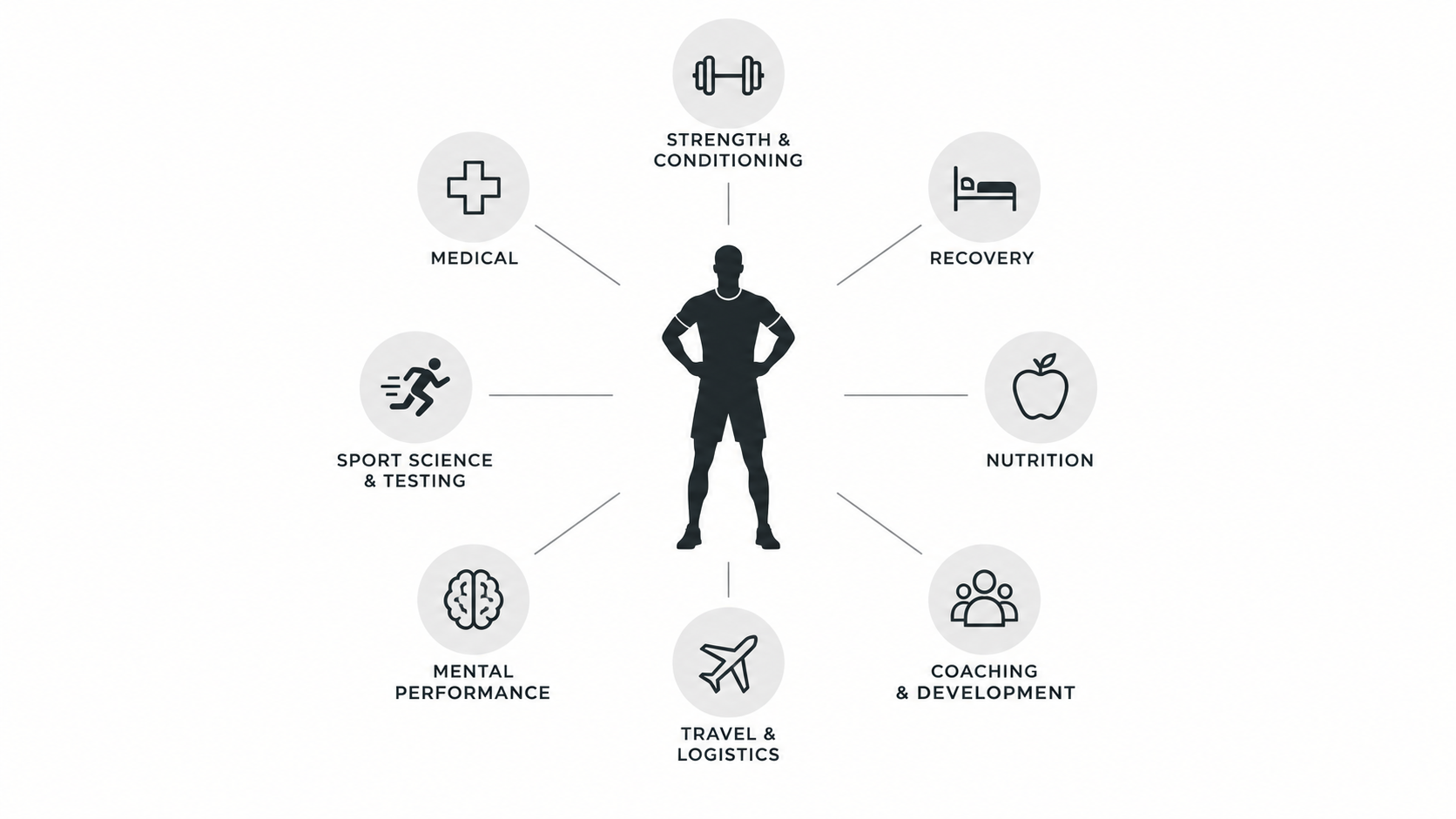
A high performance director maintains an understanding of the athlete’s broader situation and helps turn that understanding into coordinated action. Depending on the athlete and setting, the work might include:
Daily: reviewing relevant recovery information, speaking with the athlete, and following up on immediate concerns.
Weekly: working with the strength coach and other staff to review the athlete’s response and determine whether training adjustments are needed.
Monthly: planning around travel, facilities, appointments, and the schedule ahead.
At planned review points: coordinating appropriate retesting and assessing whether the plan is producing the intended changes. Medical testing follows the recommendations of the treating clinician.
The cadence should serve the athlete’s needs. Some questions require testing, while others are better understood through conversation, observation, or input from a specialist. The director helps identify the question, obtain useful information, and make sure it leads to an appropriate response.
That responsibility also extends to unfamiliar problems. If an athlete raises a health concern, the director can help them access medical evaluation and address practical barriers to following the clinician’s recommendations. If the issue involves food access during travel, the useful intervention may involve meal arrangements, storage, or facilities rather than another explanation of nutrition targets.
The scope follows the problem. It can include organizing recovery supplies, planning seasonal hydration and nutrition resources, arranging education around team questions, or simplifying a process that consumes unnecessary staff time. The director needs enough flexibility to recognize what is getting in the way and involve the people best equipped to help.
Not the Boss of Everybody
A fair question is how someone with a background in one discipline can lead a program involving several others. The distinction is between expertise in a particular field and responsibility for how the broader program functions.
The U.S. Army’s Holistic Health and Fitness system, H2F, illustrates this structure. Army doctrine describes performance team leaders with backgrounds in exercise and rehabilitation sciences, while its team model assigns distinct responsibilities to the program director and specialists in strength and conditioning, physical therapy, athletic training, nutrition, and other areas. The program director helps integrate that work into the unit’s planning. U.S. Army, FM 7-22; H2F role descriptions
My background is in strength and conditioning, and there are settings where I contribute directly to that work. A collegiate team with an established strength coach can still need a high performance director because leading the strength program and coordinating the wider performance effort are different responsibilities.
For example, a dietitian remains responsible for nutrition recommendations, while the director can help ensure those recommendations are practical during a road trip. Medical professionals retain responsibility for clinical decisions, while the director helps coordinate the relevant implications for training and logistics, with appropriate permission to share information.
The director needs to understand enough about each discipline to ask useful questions and recognize when a specialist should lead. That allows the role to remain broad without treating one person as the authority on every subject.
Someone Has to Own the Plan
Whether an athlete is supported by a college department or a group of independently hired professionals, the contributions need to fit together. Someone should understand what is being trained, what information is being reviewed, which adjustments have been recommended, and whether the athlete has the resources to carry them out.
Without clear ownership, that work becomes an additional responsibility absorbed by coaches, support staff, or the athlete. It may get done through strong relationships and individual effort, but the organization remains dependent on people finding time around their primary jobs.
The title and staffing arrangement will vary, but someone needs clear responsibility for connecting the information, coordinating the people involved, and following through when a problem remains unresolved. That is the function a high performance director provides.
About the Author
Ben Kaiserman is a Senior Partner at Newman HP, where he works with professional and collegiate athletes across the MLB, NFL, PLL, NCAA, and professional lacrosse. Prior to joining Newman HP, he served as an H2F Strength and Conditioning Coach with the U.S. Army's 101st Airborne Division, working with tactical athletes in a high-performance military setting. He holds a Master's in Sports Administration from Tusculum University and is a Certified Strength and Conditioning Specialist through the NSCA. He previously served as Director of Sports Performance at Tusculum University and has also worked with athletes at UCLA, Yale, the University of Tennessee, and Sacramento State.
Frequently Asked Questions
What does a high performance director do?
A high performance director coordinates the broader support around an athlete or team. The role can involve training, medical communication, nutrition, recovery, testing, travel, and practical problem-solving. Responsibilities depend on the setting, with specialists retaining authority within their respective fields.
Do professional athletes have high performance directors?
Some organizations employ high performance directors or use other titles for comparable responsibilities. Away from the club, an athlete may also work with independent providers and coaches. When that group has no designated coordinator, the athlete can end up managing communication and logistics themselves.
How is a high performance director different from a head strength coach?
A head strength coach leads strength and conditioning. A high performance director considers how that work connects with medical recommendations, nutrition, recovery, competition, travel, and other demands. The responsibilities can overlap in some settings, but a program with an established strength staff can still need broader performance leadership.
Who is responsible for an athlete’s sleep and recovery?
Responsibility may be shared across several professionals, depending on the issue and the organization. A high performance director can coordinate their observations and recommendations, help address practical obstacles, and facilitate referral when clinical assessment is needed.
Does a high performance director replace medical staff?
Medical professionals retain responsibility for clinical assessment, treatment, and medical decisions. The director supports communication and follow-through, including helping address scheduling, access, or logistical barriers that affect the athlete’s ability to carry out recommendations.
How do you know if a high performance director is working?
Look at whether problems reach resolution, relevant information gets to the appropriate people, recommendations lead to practical action, and recurring processes improve. Staff should understand their responsibilities, and athletes should know where to raise a concern. Performance outcomes also matter, but they have multiple influences and should be evaluated in context.
References
Department of the Army. (2020). FM 7-22: Holistic health and fitness. U.S. Department of the Army.
U.S. Army Holistic Health and Fitness. (n.d.). Unit resources. U.S. Army.
National Collegiate Athletic Association. (n.d.). Key publications. NCAA.
