
Speed Training vs. Plyometrics for Kids: What's the Difference, and What Should They Avoid?
A 10-year-old walks out of a speed training session. They’ve been sprinting, jumping over hurdles, and dropping off boxes before immediately jumping again. Sounds like a pretty intense workout, but was it actually productive? More importantly, were they physically prepared for those exercises? The kid doesn’t need to know the difference between speed training and plyometrics. They’re 10, not exercise physiologists. The adults designing their training, however, should understand exactly what they’re prescribing.
Speed training and plyometrics are closely related, but they differ in purpose, execution, and the physical demands they impose. Was the goal to improve how quickly the athlete moves, develop explosive and reactive abilities, or simply exhaust them? Were they performing each repetition with maximal intent and adequate recovery, or rushing through exercises because “they’ll still need to be fast when they’re tired”? Understanding these distinctions helps coaches choose the right stimulus and recognize when an exercise is too advanced for the athlete in front of them.
What Is Speed Training?
At its simplest, speed training is designed to improve how quickly an athlete can perform a movement. Running is the most obvious example, but speed isn't exclusive to sprinting. A baseball player swinging a bat, a basketball player moving defensively, or an athlete attempting to move a barbell as quickly as possible can all be training speed. While the movements differ, they share a common objective: improving the ability to execute a particular action quickly. However, it's important to distinguish speed training from technical practice. For example, learning the mechanics of an Olympic lift is not power training, even though that technique may allow an athlete to express more power in that specific lift. The same principle applies to speed. Practicing sprint mechanics at slower speeds may improve an athlete's ability to execute those specific movements, but that doesn't make the drill itself speed training. Submaximal technical work primarily helps organize movement, while maximal-intent efforts provide the specific stimulus needed to develop speed.
Speed training involves an emphasis on performing movements as quickly as possible. To begin to understand what we're actually training when we train speed, we need to look at the physiology behind rapid movement, starting with the nervous system.
How the Nervous System Influences Speed
The physiology behind speed is complex, so we'll use a simplified military analogy to explain how the nervous system activates muscles. Think of a muscle (army) as a larger system made up of motor units (platoons). Each motor unit (platoon) has a motor neuron (leader) and the muscle fibers (soldiers) it controls. When the motor neuron (leader) fires, all the muscle fibers (soldiers) belonging to that unit are activated. The muscle fibers (soldiers) produce force, while the nervous system coordinates which motor units (platoons) are called into action and how frequently their motor neurons (leaders) send commands.
Two important neurological mechanisms help regulate this process: (1) motor unit recruitment and (2) rate coding.
Motor unit recruitment is like calling additional platoons (motor units) into action. The nervous system recruits motor units according to the demands of the movement. Generally, smaller, lower-threshold motor units are recruited first, with larger, higher-threshold units added as needed. These units differ in their capabilities because the muscle fibers (soldiers) within them have different characteristics. The number and type of motor units recruited, along with how quickly they join the effort, influence how rapidly and how much force the muscle can produce.
Rate coding describes how frequently an active motor neuron (platoon leader) sends electrical signals to its muscle fibers (soldiers). Imagine that platoon leader issuing commands more frequently. Each signal triggers a response from the soldiers, and when those signals arrive close enough together, the force generated by successive contractions can build upon itself. This allows the active muscle fibers to produce greater force, while their own contractile properties influence how rapidly they can develop force and shorten.
Together, rapid motor unit recruitment and increased firing frequency contribute to an athlete's ability to develop force quickly. The rate at which force increases is known as rate of force development (RFD). When an athlete performs a maximal-effort sprint or moves a barbell explosively, the nervous system must recruit the necessary motor units rapidly and activate them at high firing rates. Training with maximal intent and adequate recovery challenges these neurological mechanisms, helping athletes develop the ability to produce force more rapidly. Research by Maffiuletti and colleagues (2016) identifies rapid muscle activation, particularly motor unit discharge rate, as an important contributor to explosive force production. This helps explain why moving a relatively light object explosively can create a different training stimulus than moving the same object slowly. Speed-oriented training can challenge the nervous system's ability to activate muscles rapidly, but the resulting adaptations are still specific to the demands of the activity. Improving an athlete's ability to develop force rapidly doesn't necessarily improve their speed in every movement. Technique, coordination, and the specific muscles and movement patterns involved all influence how that ability translates into performance.
Why Fatigue Turns Speed Work Into Conditioning
Maximal speed depends on high-threshold motor units firing at high rates, and the fibers in those units run on a small, fast-depleting energy supply. Within seconds of all-out work it’s mostly spent, and it takes a few minutes to refill. Start the next rep too soon and those fibers can’t produce force at the rate they could when fresh. The rep slows, and the session has shifted from speed to conditioning.
If a rep isn’t close to the athlete’s best, it isn’t developing speed. Rest long enough that each rep looks like the first, which for short sprints means minutes, not seconds.
What Are Plyometrics?
Plyometric training uses a physiological mechanism called the stretch-shortening cycle (SSC). The stretch-shortening cycle occurs when an active muscle-tendon system is rapidly lengthened and immediately transitions into shortening to produce force. Imagine bouncing a basketball against the ground. The ball briefly compresses before rebounding upward. Our muscle-tendon system can behave somewhat similarly. When an athlete performs a repeated jump, the muscles and tendons absorb and manage force upon landing before contributing to the next takeoff. That rapid transition can improve force production through several mechanisms, including elastic energy storage and return, muscular activation, and the mechanical properties of muscles and tendons.
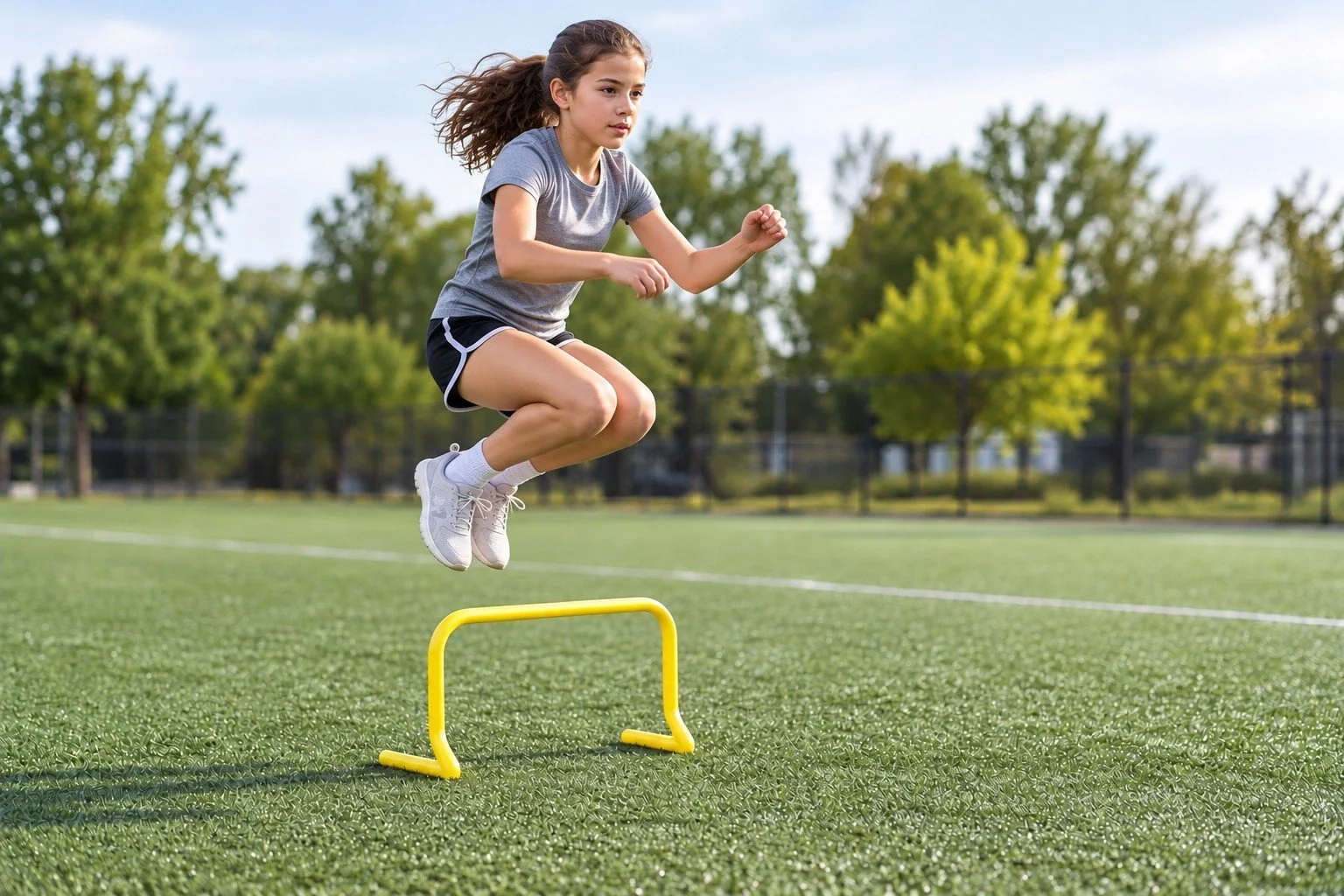
Plyometric training aims to develop these explosive and reactive capabilities. Examples include broad jumps, pogo jumps, lateral hops, bounding, and depth jumps. However, these exercises aren't equally demanding. A simple jump with a controlled landing presents a different challenge than stepping off an elevated platform and immediately rebounding into another jump. The distinction is especially important for developing athletes because the ability to produce force and the ability to absorb and rapidly redirect force aren't necessarily developed to the same degree.
Why Strength Matters for Plyometrics
One of the most important considerations in plyometric training is an athlete's ability to tolerate the forces associated with landing. Every jump requires some degree of force absorption. However, the demands increase considerably when athletes must absorb substantial forces and immediately transition into another explosive movement. Consider the difference between a basic box jump and a depth jump. During a box jump, the athlete jumps onto an elevated surface and lands under control. The elevated landing surface reduces the distance the athlete falls after takeoff. During a depth jump, the athlete steps from an elevated surface, lands, and immediately rebounds. The second exercise introduces a greater demand for rapid force absorption and redirection.
This is where relative strength, or strength in relation to bodyweight, becomes particularly important. Low-intensity jumping activities can be appropriate for developing athletes without meeting a predetermined strength requirement. Advanced plyometrics are a different story. Depth jumps and other high-intensity reactive exercises can produce landing forces several times an athlete’s bodyweight, and those forces have to be absorbed and redirected in a fraction of a second. An athlete who can’t produce high levels of force relative to their bodyweight isn’t prepared to absorb them. A commonly referenced benchmark is the ability to squat 1.5 times bodyweight. It’s a reference point rather than a pass/fail test, but the principle behind it holds: the stronger an athlete is relative to their bodyweight, the better prepared they are to tolerate high-intensity plyometrics. Strength alone isn’t enough, either. Landing mechanics, training experience, and the ability to control and rapidly reverse movement are equally important considerations. The objective is to progressively develop these qualities rather than exposing athletes to forces they’re not prepared to manage.
Should Young Athletes Be Doing Both?
Absolutely. Children naturally sprint, jump, skip, and hop during physical activity. These movements contribute to the development of coordination, strength, and overall athleticism. The NSCA's Long-Term Athletic Development Position Statement supports appropriately prescribed strength, speed, and plyometric training throughout childhood and adolescence. However, introducing plyometrics and introducing high-intensity plyometrics are two very different things.
A young athlete can benefit from short sprints, introductory jumping exercises, and basic landing practice without being prepared for aggressive depth jumps or other highly demanding reactive exercises. Developing the ability to land under control, produce force efficiently, and coordinate movement creates the foundation for more advanced training. As athletes become stronger and more experienced, their training can gradually introduce greater loading demands and faster transitions between force absorption and production. Progression should depend on an athlete’s physical development, movement competency, and training history rather than chronological age alone. Training volume matters, too. An athlete already performing hundreds of jumps during practices and competitions may not need substantial additional jumping volume. Rushing to the most advanced exercises skips the physical qualities that make demanding training productive.
What Young Athletes Should Avoid
Most issues in youth speed and plyometric training come from the right exercises used at the wrong time, in the wrong amount, or with the wrong intent. Here’s what to watch for, and what to do instead.
Depth jumps and box drops before the athlete can land under control. The box drop from the opening session is a depth jump, and for most 10-year-olds it’s the wrong exercise. Build landing first with stick landings and box jumps, and add rebounds once the athlete can absorb force consistently.
Speed drills run as conditioning. Once fatigue slows the rep, the athlete is no longer training speed. Keep speed work short and maximal, and program conditioning as its own block.
Short rest between maximal efforts. If the next rep can’t match the last one, the rest was too short. For short sprints, that means minutes, not seconds.
Extra jumping stacked on top of a heavy practice load. Count the jumps an athlete is already getting in their sport. During heavy practice and competition periods, cut back added plyometric volume.
Progressing by age or by what older athletes are doing. Advance an athlete when their strength, landing quality, and training history support it.
Pushing through reps that are falling apart. When landings get loud, knees cave, or ground contacts get long, end the set.
The Bottom Line
Speed training and plyometrics are related, but they develop athletic performance through different, sometimes overlapping, mechanisms. Speed training focuses on improving how quickly an athlete performs a movement, drawing on neurological function, coordination, strength, and movement mechanics, and it only develops speed when reps are maximal and fully recovered. Plyometric training uses the stretch-shortening cycle to improve explosive and reactive force production. Both belong in youth athletic development, but not every plyometric exercise is appropriate for every athlete. Introductory plyometrics help build the foundation, while strength and progressive training prepare athletes for higher-intensity plyometrics that demand substantial force absorption and rapid redirection. Effective training means selecting the right stimulus for the athlete’s current abilities and long-term development.
About the Author
Ben Kaiserman is a Senior Partner at Newman HP, where he works with professional and collegiate athletes across the MLB, NFL, PLL, NCAA, and professional lacrosse. Prior to joining Newman HP, he served as an H2F Strength and Conditioning Coach with the U.S. Army's 101st Airborne Division, working with tactical athletes in a high-performance military setting. He holds a Master's in Sports Administration from Tusculum University and is a Certified Strength and Conditioning Specialist through the NSCA. He previously served as Director of Sports Performance at Tusculum University and has also worked with athletes at UCLA, Yale, the University of Tennessee, and Sacramento State.
Frequently Asked Questions
Is plyometric training the same as speed training?
No. Speed training aims to improve how quickly a movement can be performed. Plyometric training uses the stretch-shortening cycle to develop explosive and reactive capabilities. Both can contribute to improved speed, but they aren’t synonymous.
Can plyometrics make young athletes faster?
Yes. Appropriately programmed plyometrics can improve qualities that contribute to sprinting, jumping, and other athletic movements. However, plyometrics should complement rather than automatically replace movement-specific speed training.
What age should young athletes start speed training?
There is no universal minimum age for appropriately selected speed-development activities. Children can begin developing running mechanics, coordination, and movement speed through age-appropriate activities. Training should progress according to their physical abilities and experience.
Is sprinting while fatigued still speed training?
No. Once fatigue slows the rep, the athlete can no longer produce force fast enough to express top speed, and the work becomes conditioning. Speed training requires maximal intent and enough rest for each rep to match the last.
Does an athlete need to squat 1.5 times bodyweight before doing plyometrics?
Not for introductory plyometrics. Advanced plyometrics are different. Depth jumps and other high-intensity exercises require high relative strength to tolerate the forces involved. The 1.5-times-bodyweight squat is a useful reference point for that readiness, alongside landing mechanics and training experience.
Are depth jumps appropriate for young athletes?
Depth jumps are advanced plyometric exercises that place substantial demands on force absorption and rapid force production. They are not recommended as introductory exercises. Athletes should progressively develop strength, landing mechanics, and training experience before attempting them.
How do you know when an athlete is ready to progress?
Look at their strength relative to bodyweight, landing quality, movement competency, training experience, and total training workload, including the jumps they’re already getting in their sport.
References
Bobbert, M. F., Huijing, P. A., & van Ingen Schenau, G. J. (1987). Drop Jumping. I. The Influence of Jumping Technique on the Biomechanics of Jumping. Medicine and Science in Sports and Exercise, 19(4), 332–338.
Bogdanis, G. C., Nevill, M. E., Boobis, L. H., Lakomy, H. K. A., & Nevill, A. M. (1995). Recovery of Power Output and Muscle Metabolites Following 30 s of Maximal Sprint Cycling in Man. Journal of Physiology, 482(2), 467–480.
Lloyd, R. S., et al. (2016). National Strength and Conditioning Association Position Statement on Long-Term Athletic Development. Journal of Strength and Conditioning Research, 30(6), 1491–1509.
Maffiuletti, N. A., et al. (2016). Rate of Force Development: Physiological and Methodological Considerations. European Journal of Applied Physiology, 116, 1091–1116.
National Strength and Conditioning Association. (2020). Stretch-Shortening Cycle. Excerpt from NSCA’s Guide to Program Design.
National Strength and Conditioning Association. (2019). Plyometric Exercises. Excerpt from Developing Power.
