The Programs That Built Me: A Strength Coach's Field Guide to the Greatest Training Systems Ever Written
Over the years I've had the chance to study programming at a pretty high level, in person, in the weight room, and from mentors who literally wrote the game. And here's what I keep coming back to. There really is unlimited ways to write a program. You can break it down into the five acute program variables, you can manipulate tempo, you can play with all the individual knobs and dials until you go cross-eyed.
But every so often you run into a program, a specific collection of stimulus, that just produces results year in and year out, day in and day out. A program that just keeps printing adaptation no matter who's running it.
I want to pay homage to a few of those. The ones that became cornerstones for me, the ones you can build derivatives off of for the rest of your career. Because when you go back and look at the history of each one, what you find is a kind of accelerated evolution. Somebody kept making tweaks until the biology finally gave them the outcome they wanted, and then they had the discipline to stop messing with it. That's really the whole game. In no particular order, here are the programs that built me.
Walter Camp's Daily Dozen: The Power of Keeping It Simple
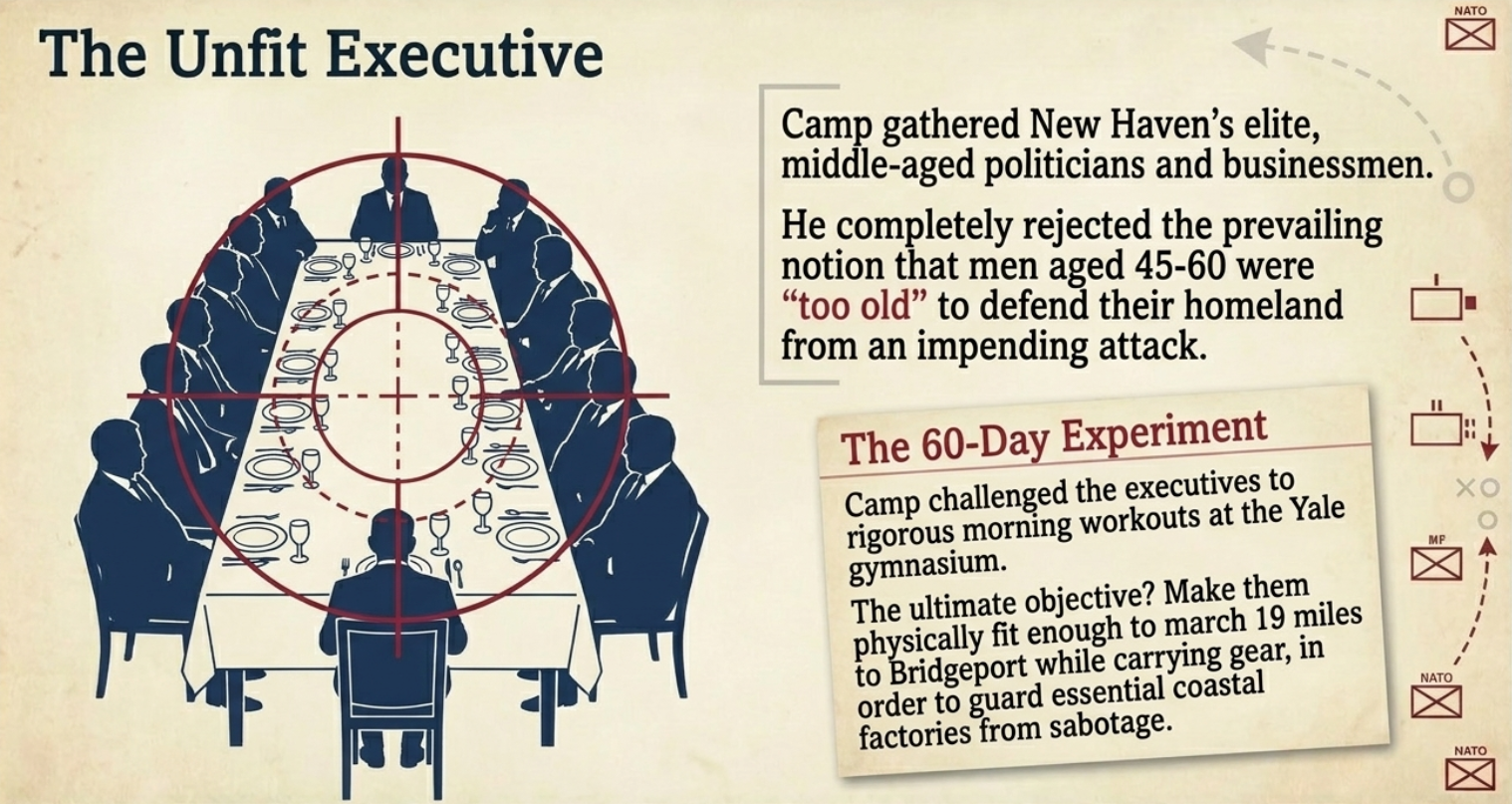
If you go back and read the history, Walter Camp, the father of American football and both a coach and a player at Yale, got pulled in by FDR's people to take the country's fitness to another level. It was wartime, and the problem on the table was a real one. What kind of program do you put a whole nation on to be fit to fight? You had a population of businessmen who were out of shape but who could maybe still serve a role, and Camp was the guy asked to stand up the National Security League.
The actual challenge was beautifully concrete. Over a span of days he had to build an exercise program that would let ordinary people carry load from New Haven to Bridgeport, the idea being to help secure the factories in case of sabotage if the homeland ever got attacked. His whole ethos came down to “Keep it simple and do the work.”
The Daily Dozen itself was exactly what the name suggested: twelve simple bodyweight movements built around bending, reaching, twisting, circling, crouching, and rising, organized so an ordinary person could get through the entire routine quickly without equipment. Whenever I think of Walter Camp I think about consistency and what he called the bowl of vitality, the idea that each day you're building yourself up rather than crushing yourself into the floor.
And here's where most high speed beautifully designed programs fall apart. The perfectly periodized plan with a clever little technique caveat thrown in never accounts for the reality that, most of the time, it won't be executed perfectly. Putting an asterisk on your plan and quietly accepting that there are going to be some casualties just doesn't work in the real world. The Daily Dozen worked because anybody could do it. Camp put his own voice on vinyl so people all over the country could play it and follow along, and if you look up the Library of Congress you can actually find him working through it with FDR and members of the War Cabinet to keep them in shape.
A program simple enough that an entire nation can run it, a program that the people running the nation could follow as well? That's a novel concept, and it's why Camp earns the number one spot.
Starting Strength: The Book That Gave Me a Framework
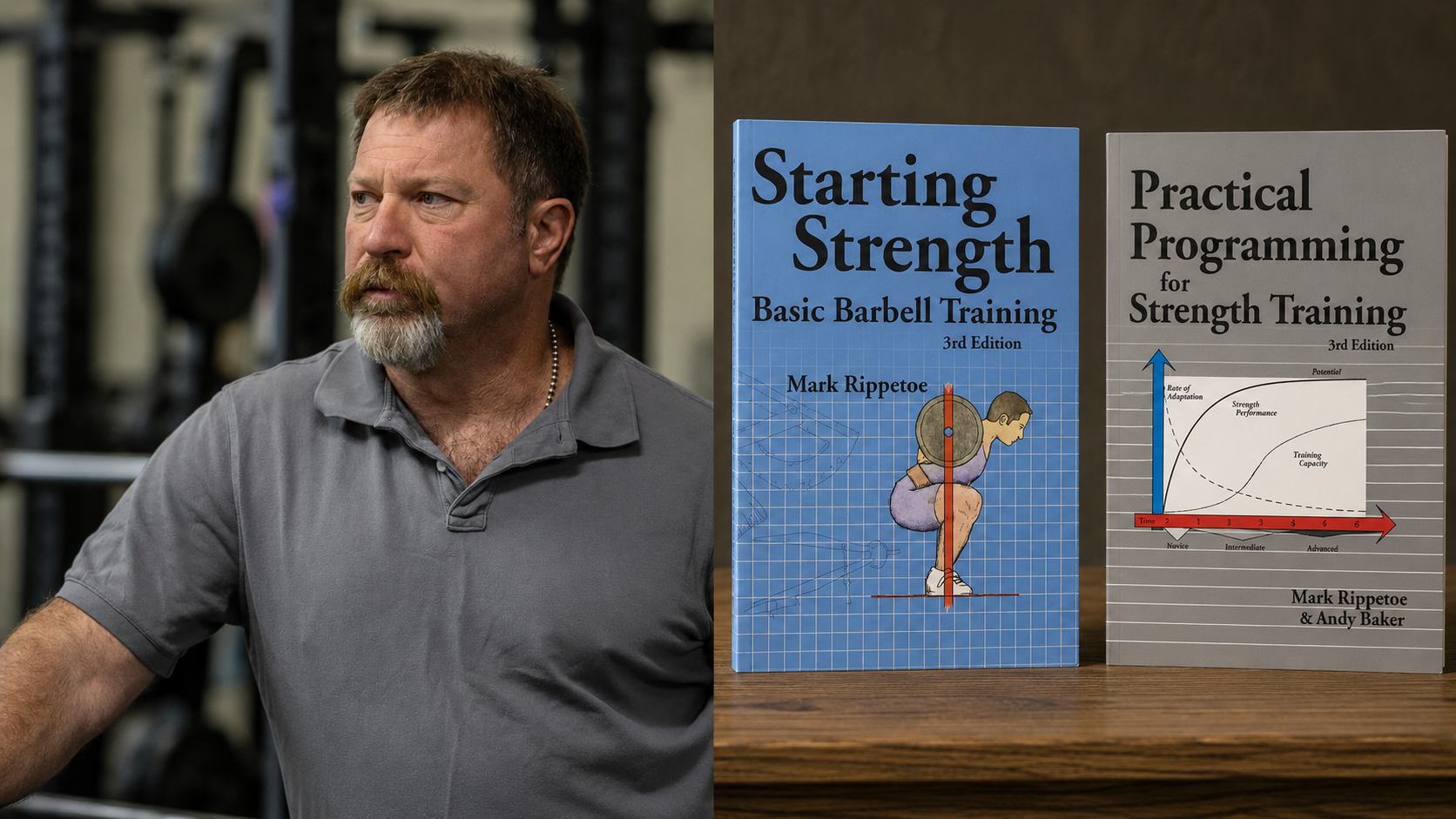
This one takes me back to my undergrad days at the University of Rhode Island, seeing that black-and-yellow book on the shelf at Barnes and Noble. What I loved about it was how clearly it explained what strength actually is and how to go get it.
When you're buried in biology, physics, and biochemistry, it was a relief to have a coach's book. Reading it alongside the programming follow-up gave me a framework I still use to evaluate every program I see:
The novice effect is really just the organization of the brain learning how to move the limbs and the load around in space. That's why it moves so fast early on.
The intermediate is where the additional systems start coming online, things like tendon thickness and muscle, and those adaptations move about a week at a time. Some weeks adapt slower than others, and some weeks you can push.
The advanced lifter is grinding toward genetic capacity, which has to be handled with a lot of care, because the further out you go on that spectrum the more the risk of overtraining or tweaking something climbs.
And the linear approach of just adding five pounds sounds laughably simple until you actually run the math on it. You almost never see an intensity jump beyond 3 to 5%, and you rarely see volume, as a function of reps times sets times load, exceed 8 to 10% workout over workout. There's real governance hiding inside that simple instruction. (I dig into why the simplest tool usually wins in our Mark Rippetoe piece.)
How your structure moves under load is immensely important early on in development, and that's really the entire guiding principle of lifting as heavy as you can without the structure starting to fall apart. The goal of strength training was never about chasing numbers. It was always about pushing to the boundary so the tissue actually grows. This structured training provides a logical path forward and avoids “playing weights,” where the body is under-stimulated and every four weeks you spend your entire career on novice organizational busywork with choreographed movements that get clicks but falsely tout functionality that is safer and has greater transfer.
And there's just something about the first time someone slides two big plates onto the bar. The reward for showing up, getting under the bar, and doing the work. As a coach I celebrate 135 every bit as much as I celebrate 405. You run three to five sets, you complete the reps, you move up. It's tried and true, and it's a phenomenal builder of both character and foundational strength.
The Husker Metabolic Circuit: The Factory of Gains
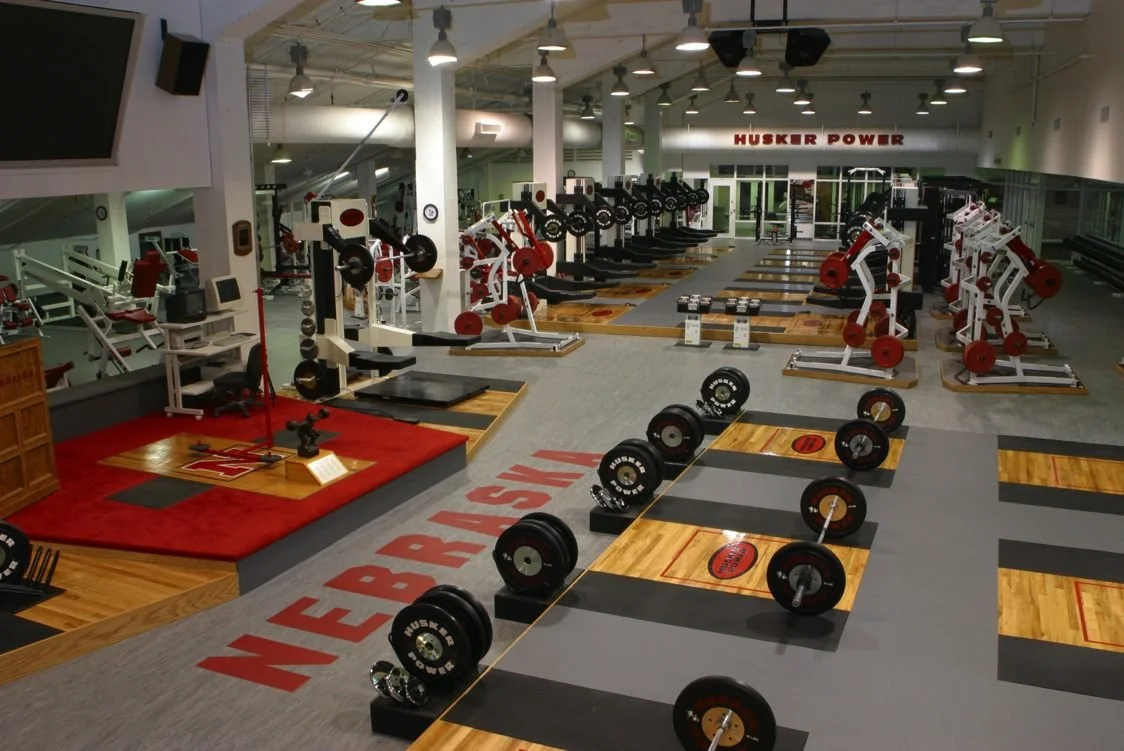
Now we move into the more advanced stuff, and here I have to pay homage to having had the chance to learn directly from Boyd Epley. The metabolic circuit he designed with Dr. Bill Kraemer back in the day, that short rest protocol of 20 seconds of absolute effort across nine stations with everything scripted and on time, was my first real look at a program you could run in a mechanistic and systematic near assembly line fashion across an entire team.
When you start talking about a factory of gains that produces repeatable results, the Husker is it. And the thing running it teaches you is that your biggest limiting factor was never the work itself. It always comes down to recovery, and recovering in time for the next exposure, and that recovery has a few faces:
Sleep, which in a college population is chronically short.
Nutrition, which is really the other half of the whole equation.
Advanced recovery toolslike float, red light, and cryo, things they didn't even have when the program was first written.
When you see a circuit putting on close to half a pound of muscle each exposure, and then you watch a team of 80 add somewhere between 350 and 370 pounds of muscle on DEXA in a month, and it happens year over year, that's a game changer. You're talking about individuals layering on 10, 12, 15, even 20 pounds of muscle over four years, and at that point you're fundamentally changing who they are along with their internal chemistry.
The short rest design also trains the buffering capacity they'll actually use in a game, along with the norepinephrine and adrenaline drive it takes to execute under that kind of load, and the mental adaptation of doing genuinely hard things cannot be overstated. In Starting Strength you show up and you watch the weight go up on the bar. In the Husker, people start noticing psychological changes, hormonal changes, the mirror changing, swings in hunger and exhaustion, and then this real vigor, a brand new appetite for the work. It's worth its weight in gold, and it won a whole lot of championships.
Dr. Kraemer's Carroll College Program: A Strength “Drip” Over 72 Hours
In today's NIL environment the advanced strength question has gotten urgent in a way it never used to be. Sometimes I've got two or three months and I need to make someone genuinely strong, and I don't mean stage strong or stack the plates for a photo strong. I mean strong at the level where you actually understand the adaptations happening at those high thresholds, with the high Hertz frequency discharge running down the spinal cord and getting slammed into the tissue.
For that I keep coming back to Dr. Kraemer's program from his Carroll College days, and that pyramid of 6, 4, 2, 2, 4, 6 that truly tests the upper limits of maximal strength exposure. What's interesting isn't really the rep scheme itself, it's the timing of it all. Those top doubles land on a Tuesday, you take Wednesday off, and then on Thursday your newly regulated max feeds a 3, 3, 5, 5 scheme.
The first time I saw it I asked Doc how on earth you could run that heavy a load back to back. He told me not to think of it as a heavy load back to back at all, but as a single strength exposure spread out over 72 hours. That one took me a while to process.
We're no longer applying strength inside the normal constraints of a calendar. We're dosing it, along with the underlying systems that support it, no differently than if someone ran an IV drip over the course of several hours, except we're running that strength drip over the course of several days. And the numbers are consistently absurd, somewhere between 80 and 120 pounds added to a 1RM in a single month in trained lifters. A 350-pound squatter going to 500 in two months. A 400 going up to 670.
This whole thing actually started because I once bragged to Doc about a plan we ran at Yale, where the average gain was around 60 pounds added over four or five months with our players moving from the 400s up into the 500 1RM class. He just said, “Oh, that's cute. Why don't you give this a try?” The Carroll program is still my number one when you need to get somebody brutally strong in a hurry, and it remains the undisputed king of all the strength work I've ever seen.
The Next Generation: Using the Brain as the Limiter
And now we're standing at a brand new frontier. We finally have the technology and the ways to measure not just physiology, but the cognitive and neuro layers sitting right on top of it. I can easily see a future where the rest between efforts gets regulated by some targeted limiting factor rather than a number on a clock. You wouldn't go back to the next set until your brain chemistry had settled, your HRV had come back, and your executive function was back within about 80% under load. The rest period becomes a readiness check instead of a stopwatch.
I'm confident this is where the field is heading. For decades the instruction was simply to go in, do the work, push through it, and make the physical adaptation. The question we get to ask now is how can we train your brain in genuinely toxic and challenging environment, when you're chemically taxed and hormonally taxed and sleep deprived, and still have you execute. There are hundreds of these next frontier programs waiting to be written, whether it's bike protocols gated by hydrogen buffering or strength protocols regulated not by pounds per rep but by the cognitive arousal of the athlete. Honestly, this is the most exciting time in human history to be in human performance.
The Thread Running Through All of Them
If you read those five back to back, the through-line was never about some magical rep scheme. Every one of them respects the body as a set of nested systems, layers that adapt on completely different clocks, from the brain that reorganizes itself in days to the tendon and bone that answer back in weeks and months. The great programs all, in their own way, matched the dose to the layer they were actually trying to change. The Daily Dozen protected the base. Starting Strength rode the novice layer hard and then deliberately slowed down for the intermediate. The Husker pushed the metabolic and hormonal layers while practically begging you not to forget recovery. And the Carroll program spread one exposure across 72 hours because that turned out to be the optimal window for that particular stimulus.
That's the lesson I'd hand any coach. Figure out which layer you're after, match the dose to it, and then plan the recovery with the same care you put into the stimulus. Monitor the balance of the response to both as best you can, and honor the field by bringing the human structure to heights we hadn't thought possible. (There's a lot more on how those layers interact in our Nested Systems piece.)
Frequently Asked Questions
What is the best strength training program for a beginner?
For a true beginner, a simple linear program like Starting Strength is really hard to beat. The novice effect means a new lifter is mostly just teaching the brain how to coordinate the body around a load, which is why adding a small amount of weight each session keeps working for months on end. You complete your prescribed sets and reps, add roughly five pounds, and repeat, and most of your progress ends up being governed by how well you recover rather than by anything clever in the programming.
Why does “just add five pounds” actually work?
It works because it keeps you inside the body's tolerances. Adding five pounds rarely pushes intensity past a 3 to 5% jump or pushes total volume past an 8 to 10% increase from one workout to the next. It feels almost too simple to be real, but that built-in restraint is exactly what lets you progress for a long stretch without overshooting what the structure can actually absorb.
What made the Husker Power program so effective?
The Husker metabolic circuit paired short, all-out work bouts with scripted rest across multiple stations, and the whole thing could be run systematically across an entire team. It drove large, measurable muscle gains that we could confirm on DEXA, it trained the kind of buffering capacity athletes actually use in a game, and it built up the mental capacity to do genuinely hard things. Its biggest limiter is recovery, with sleep and nutrition sitting above everything else.
How can you build maximal strength in only two or three months?
You build it by dosing strength like a drip rather than relying on a single heavy day. The Carroll style approach treats a top set on Tuesday, a rest day, and follow-up work on Thursday as one strength exposure spread across 72 hours, which respects how long high-threshold tissue actually takes to respond. Trained lifters can add 80 to 120 pounds to a 1RM in a month this way, as long as it's all programmed and recovered with real precision.
What are “nested systems” in strength training?
Nested systems is the idea that the body isn't one single system but many of them stacked together, all adapting on different clocks. Your brain and neural organization adapt in days, muscle in days to weeks, and tendon and bone in weeks to months, with hormonal, autonomic, sleep, and psychological layers woven all the way through. Good programming matches both the stimulus and the recovery to whichever specific layer you're trying to change, instead of treating the whole body like a single dial you turn up.
Does strength training have to look like my sport to transfer?
No, it really doesn't. Strength is a general adaptation, so getting meaningfully stronger improves your overall force production, and that carries over to sprinting, jumping, change of direction, and contact without the exercise ever needing to mimic the sport itself. You build the strength first and then let the sport go apply it.
About the Author
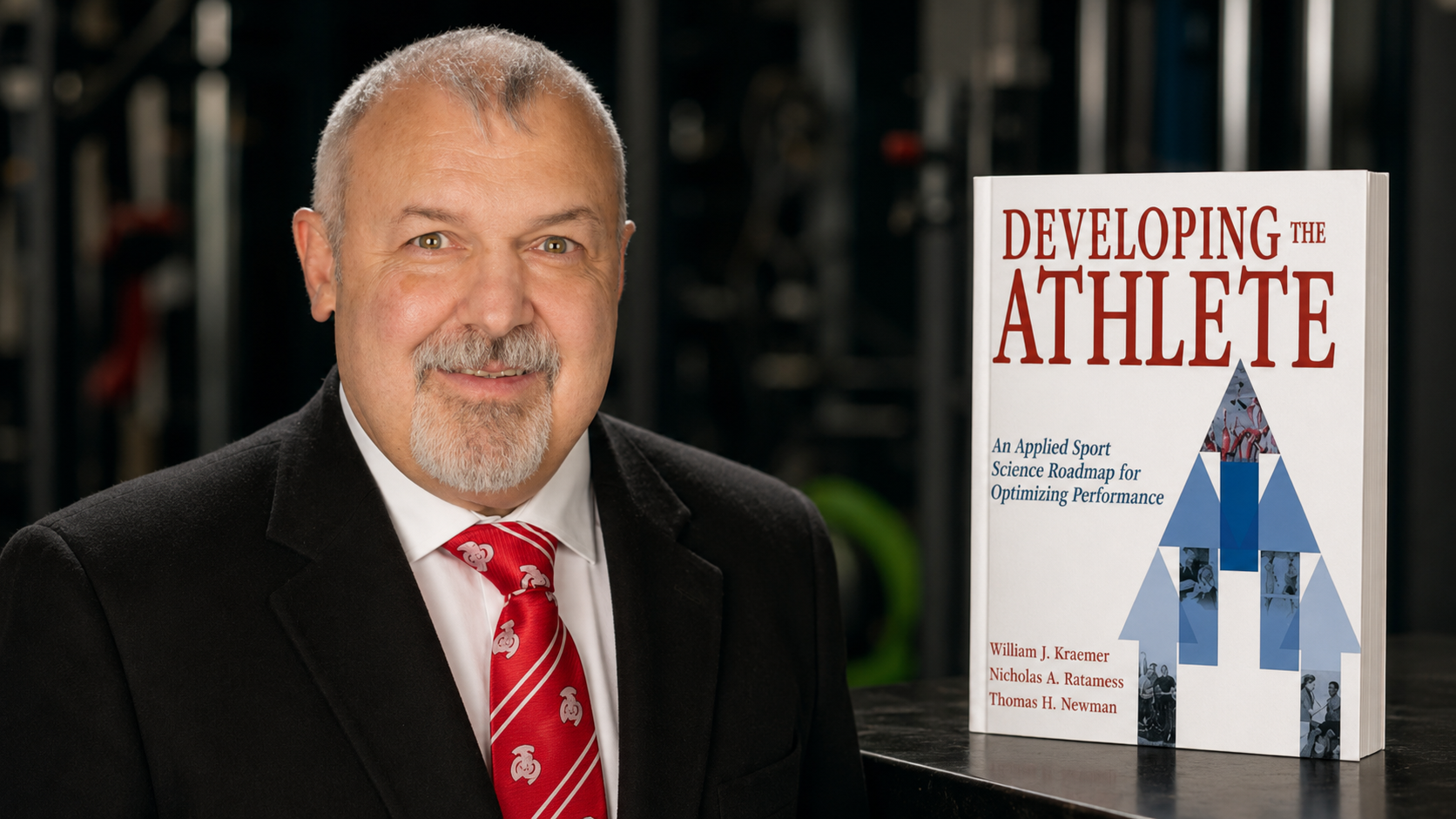
Thomas Newman is the founder of Newman HP and a Certified Strength and Conditioning Specialist (CSCS) with nearly two decades in human performance. As Director of Student Performance and Innovation at Yale University, he oversaw more than 800 student-athletes across 29 varsity programs and contributed to a Division I National Championship in men's lacrosse and back-to-back Ivy League football titles. He has served as Lead Performance Specialist at Mass General Brigham's Center for Sports Performance and Research (CSPAR) and as Chief Innovation Officer at Hawkin Dynamics, where he helped develop force-plate analytics and AI-driven performance tools used across the industry. He is a co-author of the Human Kinetics textbook Developing the Athlete: An Applied Sport Science Roadmap for Optimizing Performance Success (Kraemer, Ratamess, Newman, 2024) and today provides concierge performance services to professional athletes across professional sports.
Talk With Newman HP
References
Epley, B. (2004). The Path to Athletic Power: The Model Conditioning Program for Championship Performance. Human Kinetics.
Kraemer, W. J., Noble, B. J., Clark, M. J., & Culver, B. W. (1987). Physiologic responses to heavy-resistance exercise with very short rest periods. International Journal of Sports Medicine, 8(4), 247–252. https://doi.org/10.1055/s-2008-1025663
Phillips, M., & Todd, J. (2020). Walter Camp and the Daily Dozen: A largely forgotten episode in the history of American physical culture. Iron Game History, 14(4), 15–29. https://starkcenter.org/igh/igh-v14/igh-v14-n4/igh1404p15.pdf
Rippetoe, M. (2017). Starting Strength: Basic Barbell Training (3rd ed., 3rd rev.). The Aasgaard Company.
Rippetoe, M., & Baker, A. (2014). Practical Programming for Strength Training (3rd ed.). The Aasgaard Company.