
How to Know What Type and Amount of Training Is Right for Your Child
Every parent wants a clean answer. How many days a week should my child train? Should they lift? Should they run more? Should they take time off? Are they falling behind?
I have spent my career coaching athletes in high performance environments, including UCLA, Yale, University of Tennessee Knoxville, Tusculum University, military performance staffs, and now professional and college athletes through Newman HP. Those rooms may look different from youth baseball, but the body still follows the same physiological principles, and that experience has taught me that the right training answer is rarely found in a single number. It starts with understanding the athlete’s stage of development, what their body is ready for, and what qualities need to be built for the long term. So first ask, “What does this athlete need?”
That essential question sounds simple, but it is rarely asked in the youth sports landscape. The reason is the culture we are all swimming in. In America, the default setting is "no pain, no gain" and "more is always better." We treat exhaustion like proof of progress. If a kid comes home dripping sweat and too tired to talk, we assume the session worked. The answer to every problem becomes more training, more practice, more lessons, more tournaments, more conditioning, and the most prevalent fear is doing too little. We pile on volume before anyone has defined what we are actually giving the child, and tired is not the same thing as better. The goal of youth training sessions becomes invoking fatigue and the result is exercise soup dumped into the kitchen sink.
Many youth coaches and parents hear "training" and picture a single dial that only goes up. But strength, speed, conditioning, mobility, coordination, sport practice, recovery, and play are all different inputs. A good plan eventually touches all of them, but they do not create the same adaptation and should not all be pushed hard at once. When you do not understand the difference between training modalities, "more" is the only tool you have, and that is how a child ends up overloaded and underbuilt at the same time.
Fatigue Is Not a Coaching Philosophy
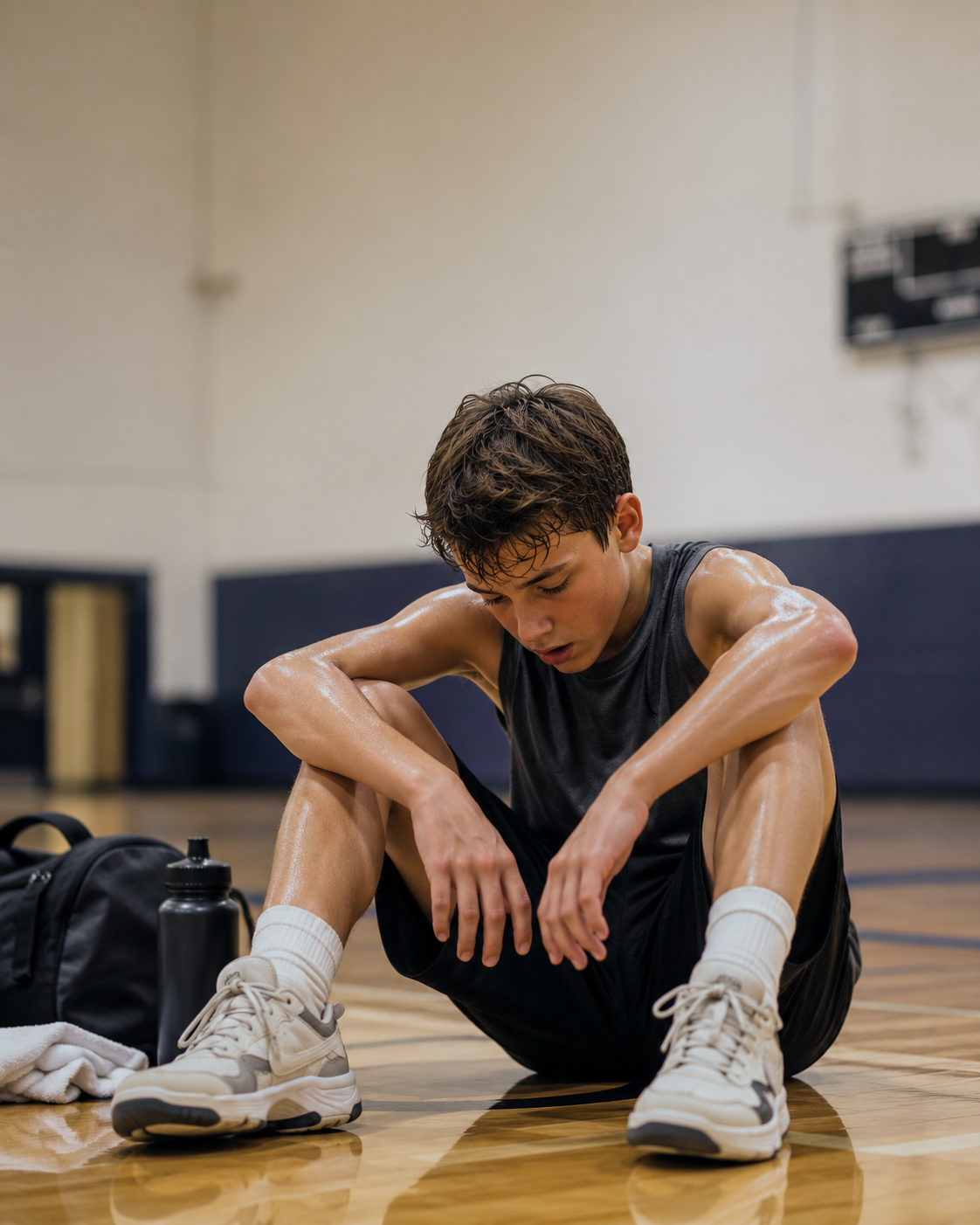
Most youth practices already involve plenty of running around, and many end with conditioning. Parents see a sweaty, exhausted kid and assume they got value. But if the only goal of a session is to burn energy, the child can leave tired without becoming stronger, faster, or more coordinated. That is not development. That is supervised exhaustion. A good coach should be able to explain what they are trying to improve, why it matters for that child, and how they will know whether it worked.
Two kids can be the same age, play the same sport, and need completely different training, because the sport is only a small part of the question. One middle schooler needs strength because he cannot control his body; another needs coordination because he is growing fast; another needs less volume because his week is already overloaded. The program should be built around the athlete, not the sport label.
Training the Child in Front of You
Kids are moving targets. They are growing taller, gaining bodyweight, changing limb lengths, learning coordination, and developing confidence all at the same time. Strength training absolutely matters, but with young athletes, movement quality has to be the foundation that strength is built on. A stronger body that still cannot land, rotate, sprint, decelerate, or control posture is not fully prepared for sport. According to the American Academy of Pediatrics, imbalances between training load and recovery can have important negative consequences for young athletes, including overuse injuries, overtraining, impaired well-being, and burnout. That is why we have to watch more than numbers. School stress, sleep loss, family pressure, travel ball, private lessons, long practices, conditioning, and training all stack on top of each other. The mental and physical sides do not live in separate buckets. A child who is constantly sore, slower than normal, emotionally flat, dreading practice, losing confidence, or no longer enjoying the sport may not just have an attitude problem. That may be the body showing stress through behavior. When we pay attention to both sides, we get a clearer picture of whether training is building the athlete or just adding more load to a system that is already full.
Movement Literacy Has a Window

Movement literacy is not a cute add-on for little kids. Running, jumping, throwing, catching, balancing, landing, and changing direction are the operating system for sport. If a child does not build that system early, every later skill sits on a weaker foundation. The Canadian Sport for Life physical literacy framework maps a key window for learning fundamental movement skills in early childhood, with remedial work becoming more important when they are not learned by roughly age 11, and notes that chasing sport skills before mastering the underlying movement skills reduces later performance.
A 12-year-old who moves poorly is not doomed, but parents should stop treating movement quality like the parsley on the plate. It is the plate. Before adolescence, the body is extremely receptive to learning movement, so kids should be exposed to a broad vocabulary: sprinting, landing, carrying, climbing, balancing, cutting, and playing different games in different environments. A kid who looked smooth at 11 may look like a baby giraffe with cleats at 13. He did not lose athleticism, his nervous system is updating the software while the hardware is still being installed.
Physiology Still Applies to Kids
Adults either treat kids like tiny adults, which is wrong, or act like physiology does not apply to them, which is also wrong. Adaptation, progressive overload, recovery, and motor unit recruitment all still matter. The size principle, originally described by Henneman, explains that the body recruits motor units from smaller, lower-force units to larger ones as demand increases. In coaching language: the body does not bring out the big engines unless the task requires them.
That is why a bodyweight exercise is not automatically "easy." If a child can only do five good push-ups, the push-up is a high-strength exercise for that child. If they train and eventually do 30, that is real progress! However, the same push-up is now a different stimulus that is less demanding and does not recruit motor units in the same manner.
Strength Training Is Usually Part of the Answer

Parents still ask whether strength training is safe for kids. The better question is whether the program is appropriate. The National Strength and Conditioning Association and the 2014 International Consensus statement on youth resistance training both support appropriately designed and supervised resistance training when it is progressed and coached properly. It is not maxing out or bodybuilding. Before major hormonal changes, the goal is coordination, control, confidence, posture, tissue capacity, and learning how to train. Research consistently shows kids gain strength before puberty largely through neural adaptations rather than big increases in muscle size. Most do not need true maximal lifting; they need loads they can control for quality reps. Can the child move the weight with control and leave better than they entered? That matters more than the number on the bar.
More Is Not Always Better
When parents feel their child is falling behind, the instinct is to push harder. But more structure is not the same as more intensity. Travel ball is not automatically better than rec ball; private lessons are not automatically better than team practice; strength work is not automatically better than skill work. The question is not "Is this travel, private, team, or training?" but "What experience is my child getting, and is it helping?" The most expensive trap in youth sports is paying for activity that looks serious but does not seriously improve the athlete.
So before signing up, ask one question: how will I know my child is getting better? The answer should not be “we work hard.” It should identify the problem, explain the plan, and use markers that fit the athlete. For youth athletes, the first markers should usually be movement based: posture, body control, confidence, landing, deceleration, sprint mechanics, and clean technical patterns. From there, measurable sport specific markers can be layered in, such as throwing velocity, exit velocity, sprint times, jump height, change of direction times, weight lifted with clean technique, or the number of practices and games completed without pain. The red flag is a session built around going as hard as possible for its own sake. Effort should produce higher quality reps and a clearer adaptation, not just energy spent.
The Long View
The goal of youth training is improvement, but improvement cannot be measured only by today's scoreboard or this weekend's tournament. Good training should build physical development and also produce intent, confidence, discipline, and a better relationship with effort. If you stack the bricks correctly, you eventually build a much taller house. But if every decision is driven by fear that the child is falling behind, the process gets frantic, the child feels the pressure, and the adults start chasing outcomes instead of foundations.
The best training environments do not just make kids tired. They make kids more capable, able to understand their bodies, trust effort, tolerate challenge, and carry skills beyond sport. Every child is going to go pro in something, and most will not do it in athletics. That does not make training less important. It makes the standard higher. The weight room, the field, and the court should produce a better athlete, but they should also produce a more resilient adult. That is the real measure.
About the author
Ben Kaiserman is a partner at Newman Performance Systems (Newman HP), where he works with professional and collegiate athletes across the MLB, NFL, PLL, NCAA, and professional lacrosse. He holds a Master’s in Sports Administration from Tusculum University and is a Certified Strength and Conditioning Specialist (CSCS) through the NSCA. He previously served as Director of Sports Performance at Tusculum University and has worked with athletes at UCLA, Yale, the University of Tennessee, and Sacramento State. Learn more at newmanhp.com.
Frequently Asked Questions
How many days per week should a young athlete train? Most young athletes can benefit from two to three structured training sessions per week, but the right number depends on age, sport schedule, sleep, stress, training history, and the quality of the program. A well-designed week matters more than a high number of sessions.
Why is movement literacy so important for kids? Movement literacy is the foundation for later athletic skill. Running, jumping, landing, throwing, catching, balancing, rotating, and changing direction are the building blocks that make sport skill easier to learn. The earlier a child builds that foundation, the better. Research-based physical literacy models describe childhood as the key window for developing fundamental movement skills, with remedial work becoming more important after roughly age 11.
How do I know if my child is training too much? Watch for repeated soreness, nagging pain, declining performance, poor sleep, irritability, dread before practice, loss of motivation, or a child who no longer seems like themselves. Burnout can show up physically, emotionally, or behaviorally.
Should kids lift weights? Yes, when the program is age-appropriate, supervised, and progressed properly. Research-supported position statements from major strength and conditioning organizations support youth resistance training when it is designed correctly.
Should young athletes do speed training? Yes, but speed training should be coached with purpose. Young athletes need to learn acceleration, deceleration, posture, coordination, and force expression. Speed work should not just be more running until the child is tired.
Should my child train during the season? Usually, yes, but the goal changes. In-season training should maintain strength, movement quality, tissue capacity, and readiness without adding unnecessary fatigue. The sport schedule should guide the dose.
What is better: private lessons, travel sports, or strength training? None of those categories is automatically better. A great rec coach may create a better developmental experience than a poor travel environment. A great strength coach may solve a problem private lessons cannot. Parents should evaluate the quality and purpose of the experience, not just the label.
What should I ask a youth trainer before signing up? Ask: What are you trying to improve in my child? How will you measure progress? How do you adjust training during the season? How do you handle growth spurts, soreness, fatigue, and burnout? If the answers are vague, keep looking.
Is soreness normal for young athletes? Some soreness can be normal, especially when learning new movements. Warning signs include sharp pain, joint pain, pain that changes how the child moves, pain that worsens during activity, or soreness that does not improve after a few days.
References
Higgs, C., Balyi, I., Way, R., Cardinal, C., Norris, S., & Bluechardt, M. (2008). Developing physical literacy: A guide for parents of children ages 0 to 12: A supplement to Canadian sport for life. Canadian Sport Centres.
Lloyd, R. S., Faigenbaum, A. D., Stone, M. H., Oliver, J. L., Jeffreys, I., Moody, J. A., Brewer, C., Pierce, K. C., McCambridge, T. M., Howard, R., Herrington, L., Hainline, B., Micheli, L. J., Jaques, R., Kraemer, W. J., McBride, M. G., Best, T. M., Chu, D. A., Alvar, B. A., & Myer, G. D. (2014). Position statement on youth resistance training: The 2014 International Consensus. British Journal of Sports Medicine, 48(7), 498–505. https://doi.org/10.1136/bjsports-2013-092952
Mendell, L. M. (2005). The size principle: A rule describing the recruitment of motoneurons. Journal of Neurophysiology, 93(6), 3024–3026. https://doi.org/10.1152/classicessays.00025.2005
Raedeke, T. D., & Smith, A. L. (2001). Development and preliminary validation of an athlete burnout measure. Journal of Sport & Exercise Psychology, 23(4), 281–306. https://doi.org/10.1123/jsep.23.4.281
