
Matching the Right Recovery Tool to the Type of Fatigue
Athletes have access to more recovery options than ever before. Cold plunges, saunas, massage guns, compression boots, float therapy, red light therapy, breathwork, and countless other methods are now common in training facilities and on social media. That access can be valuable, but it also creates confusion. The problem is no longer finding a recovery tool. The problem is knowing which one actually matches what the athlete needs.
Recovery is often treated as one general category, but the fatigue created by training is not always the same. A heavy strength session places a different demand on the body than a high-volume hypertrophy workout. A tournament weekend creates a different recovery problem than a short power session. Mental fatigue from travel, work, school, and competition can also affect performance even when the body does not feel especially sore. Because the source of fatigue changes, the recovery strategy should change with it.
That is the purpose of this framework. It is not meant to suggest that every athlete needs more recovery modalities. It is meant to help athletes make better decisions by identifying the dominant type of fatigue and choosing a tool that fits the situation.
The Essential Recovery Foundation
Before discussing any recovery modality, it is important to establish the hierarchy. Sleep, nutrition, hydration, and appropriately managed training load are the essential foundations of recovery. They support muscle repair, glycogen restoration, nervous system function, immune health, hormone regulation, and cognitive performance. These are not optional tools or advanced strategies. They are biological requirements.
An athlete can recover without cryotherapy, red light therapy, compression boots, or a float session. The body cannot continue functioning well without adequate sleep, energy intake, nutrients, fluids, and enough time to adapt to training. When those essentials are missing, the athlete is behind and unrecovered even in the absence of a physical stimulus. Sleep debt, underfueling, dehydration, and excessive workload create additional fatigue of their own.
The modalities in this guide should therefore be viewed as targeted additions. They can help address a specific problem and speed up recovery, but they cannot replace the recovery foundation.
Every Workout Creates a Different Recovery Demand
Every training session creates a specific combination of stress. Maximal strength work emphasizes force production, motor-unit recruitment, and neuromuscular efficiency. Power training places a premium on speed, coordination, and rate of force development while usually creating less metabolic fatigue. Hypertrophy training produces more local muscular stress through mechanical tension, repeated contractions, and accumulated volume. Endurance and work-capacity training increase cardiovascular and metabolic demand in ways that feel very different from heavy lifting.
These categories are not perfectly separate, and most sessions create overlap. A heavy squat workout can produce both neural fatigue and local muscular soreness. A long conditioning session can create systemic fatigue, local tissue discomfort, and cognitive strain at the same time. The useful question is not whether several types of fatigue are present. It is which one is most responsible for limiting the athlete’s current readiness.
That distinction becomes important when two athletes complete similar training and respond differently. One athlete may tolerate a heavy session without much soreness but still feel neurologically flat the following day. Another athlete may perform the same work and experience a much larger whole-body recovery cost including a high degree of muscle soreness.
Recognizing the common types of fatigue that come from specific types or phyisical workouts give you a great starting point to understanding the fatigue the athlete is experiencing. The workout type that the athlete completed gives you a great guess of what type of fatigue an athlete is likely to experience as a respnonse, but it is also important to identify the interaction between the workout and the athlete.
Matching Recovery to the Stress
A practical recovery decision begins by identifying what the athlete is actually feeling. Localized soreness, stiffness, and reduced range of motion point toward a different problem than a general sense of heaviness, low motivation, or reduced explosiveness. Swelling and joint discomfort after repeated competition suggest a different need than mental exhaustion following travel or academic stress.
Two athletes can both describe themselves as tired and still require very different approaches. One may need light movement and local tissue work after a high-volume lower-body session. Another may need better sleep, a lower-stimulation environment, and reduced training stress after several demanding days. A third may be physically capable but mentally drained, making cognitive recovery the immediate priority.
The purpose of the Newman HP framework is to organize those experiences into four broad categories: local tissue fatigue, systemic fatigue, inflammatory or beat-up fatigue, and cognitive stress. These categories are not diagnoses, and they are not meant to make recovery overly complicated. They simply provide a clearer starting point for deciding which tools are likely to be useful.
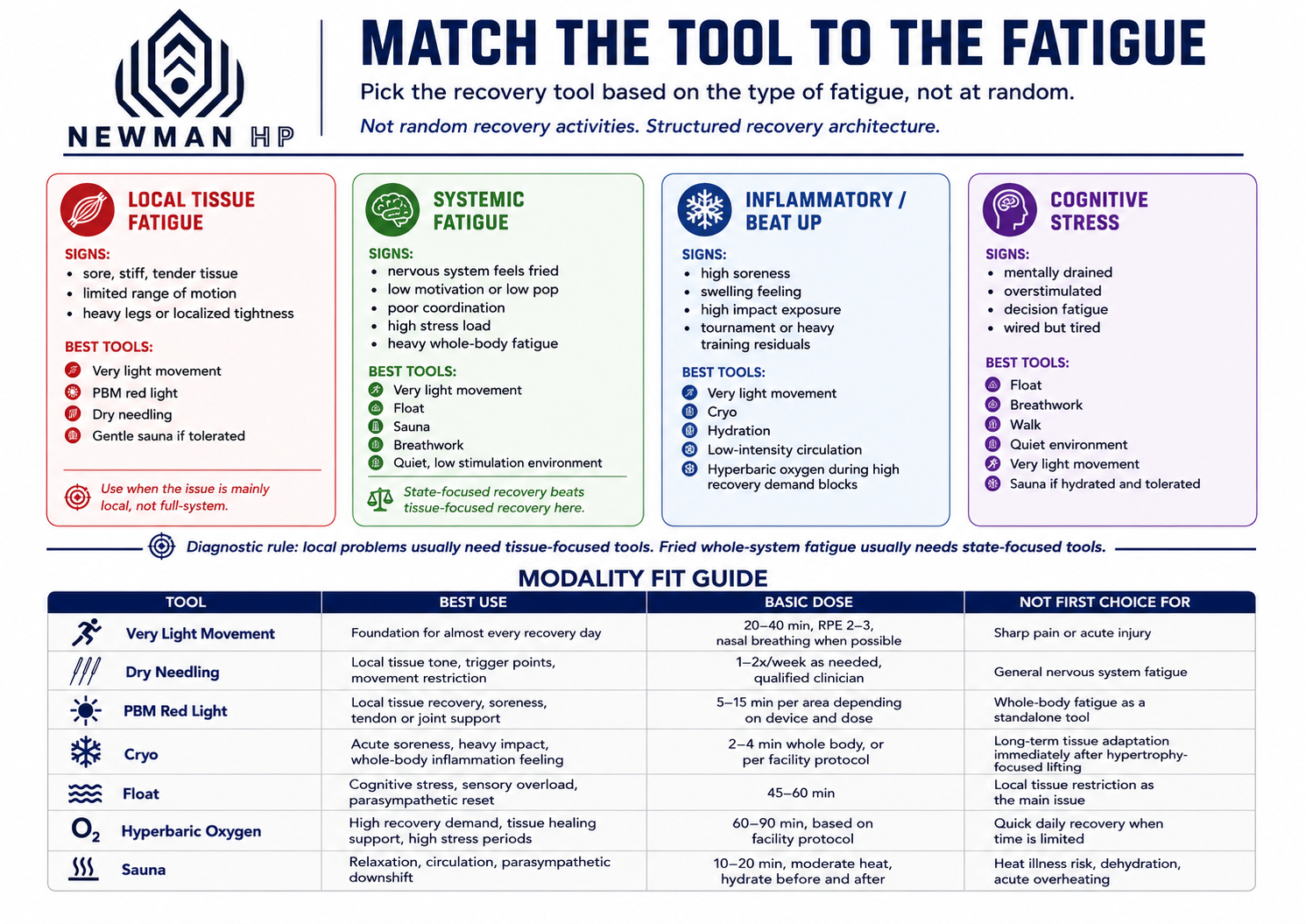
Understanding the Four Types of Fatigue
Although every training session creates a unique combination of physiological stress, most recovery challenges can be grouped into four primary categories: local tissue fatigue, systemic fatigue, inflammatory fatigue, and cognitive stress. These categories are not completely independent of one another, nor does every athlete fit neatly into a single box. A demanding practice may create muscular soreness, nervous system fatigue, and mental exhaustion all at once. The purpose of separating them is simply to identify which type of fatigue is having the greatest influence on recovery so that the intervention can better match the problem.
Local Tissue Fatigue
Local tissue fatigue is probably the easiest type of fatigue for athletes to recognize because it is exactly what most people associate with being sore. One muscle group or one region of the body simply feels worked. The quadriceps tighten up after heavy squats, the shoulders become stiff after a high-volume pressing session, or the calves remain sore for two days after an aggressive sprint workout. The rest of the body may feel perfectly capable of training, but one area clearly needs more time to recover.
This type of fatigue is primarily driven by localized mechanical stress placed on muscles, tendons, and connective tissue. Small amounts of tissue damage, temporary reductions in force production, and changes in muscle stiffness are all normal responses to training. The goal is not to eliminate those responses, because they are often part of the adaptation process. Instead, recovery should focus on restoring normal movement, maintaining circulation, and creating an environment that supports tissue repair.
That is why very light movement appears first in this category. Walking, cycling, swimming, or other low-intensity activity increases blood flow without creating meaningful additional fatigue. Depending on the situation, photobiomodulation therapy may support local tissue recovery, while dry needling performed by a qualified clinician may help manage pain or mobility in selected cases. Post-exercise heat exposure may also have context-specific benefits, although evidence for improved acute recovery remains limited. None of these replace the body's natural repair process, but they may help support it when used appropriately.
Systemic Fatigue
Systemic fatigue feels different because the entire athlete is affected rather than one muscle group. Strength may feel lower than expected, explosive movements lose some of their sharpness, motivation decreases, and the athlete often describes feeling flat despite having very little localized soreness. This type of fatigue commonly develops after several demanding training sessions, periods of inadequate sleep, accumulated psychological stress, or long stretches of consistently high workload.
Unlike local tissue fatigue, systemic fatigue reflects a broader disruption in overall recovery. The nervous system, endocrine system, and other physiological systems all contribute to the athlete's readiness to perform. When recovery has not kept pace with training, performance often declines before obvious soreness appears.
Because the fatigue extends beyond a single body part, the recovery strategy should also become more global. Improving sleep quality and ensuring adequate energy intake should always be the first priorities. Once those essentials are in place, very light movement can promote circulation without adding substantial stress. Float therapy may improve perceived recovery after demanding exercise, while slow breathing may support parasympathetic activity and help the athlete transition toward a lower-stimulation state. The objective is not simply to feel relaxed. It is to restore the body's overall readiness to produce high-quality performance.
Inflammatory or "Beat Up" Fatigue
Some periods of training leave athletes feeling more than just sore. After a weekend tournament, several football games, or a demanding stretch of competition, athletes often describe themselves as feeling beaten up. Joints ache, muscles remain tender, movement feels restricted, and even routine activities seem more physically demanding than usual.
Inflammation is a normal and necessary part of tissue repair, but unusually high training volumes, repeated collisions, or dense competition schedules can temporarily increase the body's overall inflammatory burden. During these periods, recovery becomes less about maximizing adaptation from one workout and more about helping the athlete arrive at the next competition healthy enough to perform.
Very light movement again serves as an effective starting point because prolonged inactivity rarely accelerates recovery. Hydration and adequate carbohydrate intake become especially important during periods of repeated competition to replace fluid losses and restore energy availability. Cryotherapy may help reduce discomfort and soreness in situations where rapid recovery between competitions is necessary, while hyperbaric oxygen therapy may have a role for athletes recovering from certain injuries or exceptionally demanding competitive schedules. The appropriate strategy depends on the context, but the common goal is supporting recovery from unusually high physical stress.
Cognitive Stress
Recovery is not purely physical. Athletes also accumulate mental fatigue through travel, competition, work, school, family responsibilities, and the constant attention required to perform at a high level. Even when the muscles feel relatively fresh, cognitive fatigue can reduce concentration, decision-making, reaction time, and the perception of effort during training.
This category has received increasing attention in sports science because mental fatigue can negatively influence performance even when traditional physical recovery markers appear normal. Coaches have likely seen this firsthand. An athlete may complete every physical requirement of the training session but still appear distracted, unusually slow to react, or mentally disengaged.
The recovery strategy shifts accordingly. High-quality sleep remains the most powerful intervention for restoring cognitive function, but reducing external stimulation also becomes valuable. Breathwork, float therapy, walking, time outdoors, and other low-stimulation activities may help facilitate recovery by allowing the nervous system to transition away from the constant demands of training and daily life. Rather than asking the body to do more work, these interventions create opportunities for the brain to recover from sustained cognitive load.
Why Some Recovery Tools Appear More Than Once
One observation many readers will notice is that very light movement appears in nearly every category of the framework. That repetition is intentional. While no single recovery modality addresses every problem equally well, low-intensity movement consistently supports several physiological processes without creating meaningful additional fatigue. It promotes circulation, maintains joint motion, encourages lymphatic flow, and helps athletes avoid the prolonged inactivity that can sometimes make soreness feel even worse.
Other recovery tools tend to be more situation-specific. PBM is primarily used when local tissue recovery is the priority. Cryotherapy may be particularly valuable during congested competition schedules. Float therapy is often more useful when systemic or cognitive fatigue dominates. None of these interventions are universally superior. Their value depends on how well they match the fatigue they are intended to address.
Other Recovery Tools
Readers may notice that several commonly used recovery methods do not appear in the primary framework. That omission is intentional and should not be interpreted as evidence that they lack value. Instead, the infographic focuses on modalities that most directly target the four broad categories of fatigue discussed throughout this article.
Foam rolling, massage guns, compression boots, massage therapy, stretching, and contrast therapy can all play meaningful roles within a recovery plan. Most of these methods work by temporarily improving comfort, increasing perceived recovery, improving range of motion, or promoting circulation. Depending on the athlete and the situation, they may fit into more than one fatigue category rather than belonging exclusively to one.
Foam rolling and massage guns, for example, are often used to address local tissue stiffness and temporarily improve mobility before or after training. Compression boots may help some athletes feel more recovered after long travel days or high-volume training by encouraging fluid movement and reducing the sensation of heaviness in the legs. Stretching can restore range of motion when stiffness limits movement, while massage may improve relaxation and reduce soreness in some individuals.
The important point is not whether these tools "work." It is understanding what they are designed to accomplish. Most recovery methods produce specific physiological or psychological effects, but no single modality addresses every type of fatigue equally well. Just as different training sessions create different adaptations, different recovery tools produce different responses.
That perspective also helps explain why athletes often have very different opinions about recovery methods. A modality that feels incredibly effective after one training session may seem almost useless after another because the dominant source of fatigue has changed. Rather than searching for one perfect recovery tool, athletes should focus on choosing the one that best matches the challenge they are trying to solve.
Bringing It All Together
Recovery is often discussed as though it begins after training ends, but in reality it begins with understanding what the training session asked the body to do. Every workout creates a physiological cost alongside the adaptation it is trying to produce. Heavy strength sessions challenge the nervous system differently than hypertrophy training. Long competitions create different recovery demands than technical practices. Mental stress accumulated away from sport can influence performance just as much as physical fatigue.
Recognizing those differences changes the way recovery is viewed. Instead of asking, "What is the best recovery tool?" a better question becomes, "What type of fatigue am I trying to recover from?" That small shift creates a much clearer path toward choosing an appropriate strategy.
It is equally important to remember that none of these modalities replace the essentials. Sleep, nutrition, hydration, and appropriate training loads remain the foundation of recovery because they support every major physiological system involved in adaptation. Recovery modalities should be viewed as complementary tools that help fine-tune the process once those fundamentals are consistently in place.
As research continues to expand, new recovery technologies will continue to emerge. Some will prove valuable, while others may offer only small or highly specific benefits. Regardless of what new tools become available, the underlying principle is unlikely to change. Recovery is most effective when it matches the physiological demands created by training. Understanding that relationship allows athletes and coaches to make decisions with greater confidence instead of relying on trends, marketing, or trial and error.
Ultimately, the goal of recovery is not simply to feel better. The goal is to prepare the body and mind to perform at a high level again. When recovery strategies are selected with the same level of intention as training itself, athletes place themselves in the best position to continue adapting, improving, and performing over the long term.
Frequently Asked Questions
Is one type of fatigue always present by itself?
No. Most training sessions produce a combination of local tissue fatigue, systemic fatigue, inflammatory stress, and cognitive fatigue. The purpose of this framework is not to perfectly categorize every workout, but to identify which type of fatigue is currently having the greatest impact on performance and recovery.
Why are sleep and nutrition discussed separately from the recovery modalities?
Sleep, nutrition, hydration, and appropriate workload management are biological necessities rather than optional recovery tools. An athlete can recover without cryotherapy or red light therapy, but they cannot consistently recover without adequate sleep, sufficient energy intake, proper hydration, and time to adapt. Recovery modalities are designed to complement those essentials, not replace them.
Can I combine multiple recovery methods?
Absolutely. Recovery strategies often work well together when they address different aspects of fatigue. An athlete recovering from a demanding competition weekend may prioritize sleep, nutrition, hydration, and light movement while also using cryotherapy to manage soreness or a sauna later in the recovery process. The key is ensuring each modality has a purpose rather than using several methods simply because they are available.
Why does very light movement appear in several fatigue categories?
Low-intensity movement improves circulation, maintains joint mobility, encourages lymphatic flow, and creates very little additional fatigue. Those benefits are valuable regardless of whether the dominant challenge is local tissue fatigue, systemic fatigue, inflammation, or cognitive stress, making it one of the most universally applicable recovery strategies.
Where do massage guns, foam rolling, stretching, and compression boots fit?
These tools primarily improve comfort, mobility, circulation, or perceived recovery rather than targeting one specific physiological system. They can be useful additions to a recovery plan, particularly when local tissue stiffness or soreness is present, but their effectiveness depends on the athlete and the context.
Should I use cryotherapy after every workout?
Not necessarily. Cryotherapy can be useful during periods of frequent competition or unusually high physical stress when managing soreness and maintaining readiness are priorities. It is not automatically the best choice after every training session, particularly when the primary goal is maximizing long-term adaptation to resistance training.
Can two athletes perform the same workout and need different recovery?
Yes. Training history, sport demands, fitness level, sleep quality, nutrition, stress, age, and genetics all influence how an athlete responds to the same training stimulus. Recovery should always be individualized to the athlete rather than based solely on the workout they completed.
What's the single best recovery strategy?
If there is one consistent takeaway from the research, it is that recovery starts with the fundamentals. High-quality sleep, adequate nutrition, hydration, and intelligent training loads have a greater impact on long-term recovery than any individual recovery modality. Once those essentials are consistently addressed, targeted recovery tools can help athletes better manage the specific type of fatigue they are experiencing.
References
Ahokas, E. K., Hennessy, R. S., Hanstock, H. G., Kyröläinen, H., & Ihalainen, J. K. (2025). Effects of post-exercise heat exposure on acute recovery and training-induced performance adaptations: A systematic review. Sports Medicine - Open, 11, 106. https://doi.org/10.1186/s40798-025-00910-0
Caldwell, L. K., Kraemer, W. J., Post, E. M., Volek, J. S., Focht, B. C., Newton, R. U., Häkkinen, K., & Maresh, C. M. (2022). Acute Floatation-REST improves perceived recovery after a high-intensity resistance exercise stress in trained men. Medicine & Science in Sports & Exercise, 54(8), 1371–1381. https://doi.org/10.1249/MSS.0000000000002906
Cheung, K., Hume, P., & Maxwell, L. (2003). Delayed onset muscle soreness: Treatment strategies and performance factors. Sports Medicine, 33(2), 145–164. https://doi.org/10.2165/00007256-200333020-00005
Dupuy, O., Douzi, W., Theurot, D., Bosquet, L., & Dugué, B. (2018). An evidence-based approach for choosing post-exercise recovery techniques to reduce markers of muscle damage, soreness, fatigue, and inflammation: A systematic review with meta-analysis. Frontiers in Physiology, 9, 403. https://doi.org/10.3389/fphys.2018.00403
Ferreira, R. M., Silva, R., Vigário, P., Martins, P. N., Casanova, F., Fernandes, R. J., & Sampaio, A. R. (2023). The effects of massage guns on performance and recovery: A systematic review. Journal of Functional Morphology and Kinesiology, 8(3), 138. https://doi.org/10.3390/jfmk8030138
Fullagar, H. H. K., Skorski, S., Duffield, R., Hammes, D., Coutts, A. J., & Meyer, T. (2015). Sleep and athletic performance: The effects of sleep loss on exercise performance, and physiological and cognitive responses to exercise. Sports Medicine, 45(2), 161–186. https://doi.org/10.1007/s40279-014-0260-0
Halson, S. L. (2014). Monitoring training load to understand fatigue in athletes. Sports Medicine, 44(Suppl. 2), S139–S147. https://doi.org/10.1007/s40279-014-0253-z
Higgins, T. R., Greene, D. A., & Baker, M. K. (2017). Effects of cold-water immersion and contrast-water therapy for recovery from team sport: A systematic review and meta-analysis. Journal of Strength and Conditioning Research, 31(5), 1443–1460. https://doi.org/10.1519/JSC.0000000000001559
Huang, X., Wang, R., Zhang, Z., Wang, G., & Gao, B. (2021). Effects of pre-, post- and intra-exercise hyperbaric oxygen therapy on performance and recovery: A systematic review and meta-analysis. Frontiers in Physiology, 12, 791872. https://doi.org/10.3389/fphys.2021.791872
Laborde, S., Allen, M. S., Borges, U., Dosseville, F., Hosang, T. J., Iskra, M., Mosley, E., Salvotti, C., Spolverato, L., Zammit, N., & Javelle, F. (2022). Effects of voluntary slow breathing on heart rate and heart rate variability: A systematic review and meta-analysis. Neuroscience & Biobehavioral Reviews, 138, 104711. https://doi.org/10.1016/j.neubiorev.2022.104711
Leal-Junior, E. C. P., Lopes-Martins, R. Á. B., & Bjordal, J. M. (2019). Clinical and scientific recommendations for the use of photobiomodulation therapy in exercise performance enhancement and post-exercise recovery: Current evidence and future directions. Brazilian Journal of Physical Therapy, 23(1), 71–75. https://doi.org/10.1016/j.bjpt.2018.12.002
Maia, F., Nakamura, F. Y., Sarmento, H., Marcelino, R., & Ribeiro, J. (2024). Effects of lower-limb intermittent pneumatic compression on sports recovery: A systematic review and meta-analysis. Biology of Sport, 41(4), 263–275. https://doi.org/10.5114/biolsport.2024.133665
Malta, E. S., Dutra, Y. M., Broatch, J. R., Bishop, D. J., & Zagatto, A. M. (2021). The effects of regular cold-water immersion use on training-induced changes in strength and endurance performance: A systematic review with meta-analysis. Sports Medicine, 51(1), 161–174. https://doi.org/10.1007/s40279-020-01362-0
Meeusen, R., Duclos, M., Foster, C., Fry, A., Gleeson, M., Nieman, D., Raglin, J., Rietjens, G., Steinacker, J., & Urhausen, A. (2013). Prevention, diagnosis, and treatment of the overtraining syndrome: Joint consensus statement of the European College of Sport Science and the American College of Sports Medicine. Medicine & Science in Sports & Exercise, 45(1), 186–205. https://doi.org/10.1249/MSS.0b013e318279a10a
Peake, J. M. (2019). Recovery after exercise: What is the current state of play? Current Opinion in Physiology, 10, 17–26. https://doi.org/10.1016/j.cophys.2019.03.007
Poppendieck, W., Wegmann, M., Ferrauti, A., Kellmann, M., Pfeiffer, M., & Meyer, T. (2016). Massage and performance recovery: A meta-analytical review. Sports Medicine, 46(2), 183–204. https://doi.org/10.1007/s40279-015-0420-x
Salazar-Arias, M. P., Gómez-Carmona, C. D., Azofeifa-Mora, C., Sánchez-Ureña, B., Badri, S., & Rojas-Valverde, D. (2026). Dry needling and exercise in the treatment of musculoskeletal pain: A systematic review. Sportverletzung · Sportschaden. Advance online publication. https://doi.org/10.1055/a-2825-6294
Saw, A. E., Main, L. C., & Gastin, P. B. (2016). Monitoring the athlete training response: Subjective self-reported measures trump commonly used objective measures. British Journal of Sports Medicine, 50(5), 281–291. https://doi.org/10.1136/bjsports-2015-094758
Smith, M. R., Marcora, S. M., & Coutts, A. J. (2015). Mental fatigue impairs intermittent running performance. Medicine & Science in Sports & Exercise, 47(8), 1682–1690. https://doi.org/10.1249/MSS.0000000000000592
Thomas, D. T., Erdman, K. A., & Burke, L. M. (2016). Position of the Academy of Nutrition and Dietetics, Dietitians of Canada, and the American College of Sports Medicine: Nutrition and athletic performance. Journal of the Academy of Nutrition and Dietetics, 116(3), 501–528. https://doi.org/10.1016/j.jand.2015.12.006
Wilke, J., Müller, A. L., Giesche, F., Power, G., Ahmedi, H., Behm, D. G., & Banzer, W. (2020). Acute effects of foam rolling on range of motion in healthy adults: A systematic review with multilevel meta-analysis. Sports Medicine, 50(2), 387–402. https://doi.org/10.1007/s40279-019-01205-7
